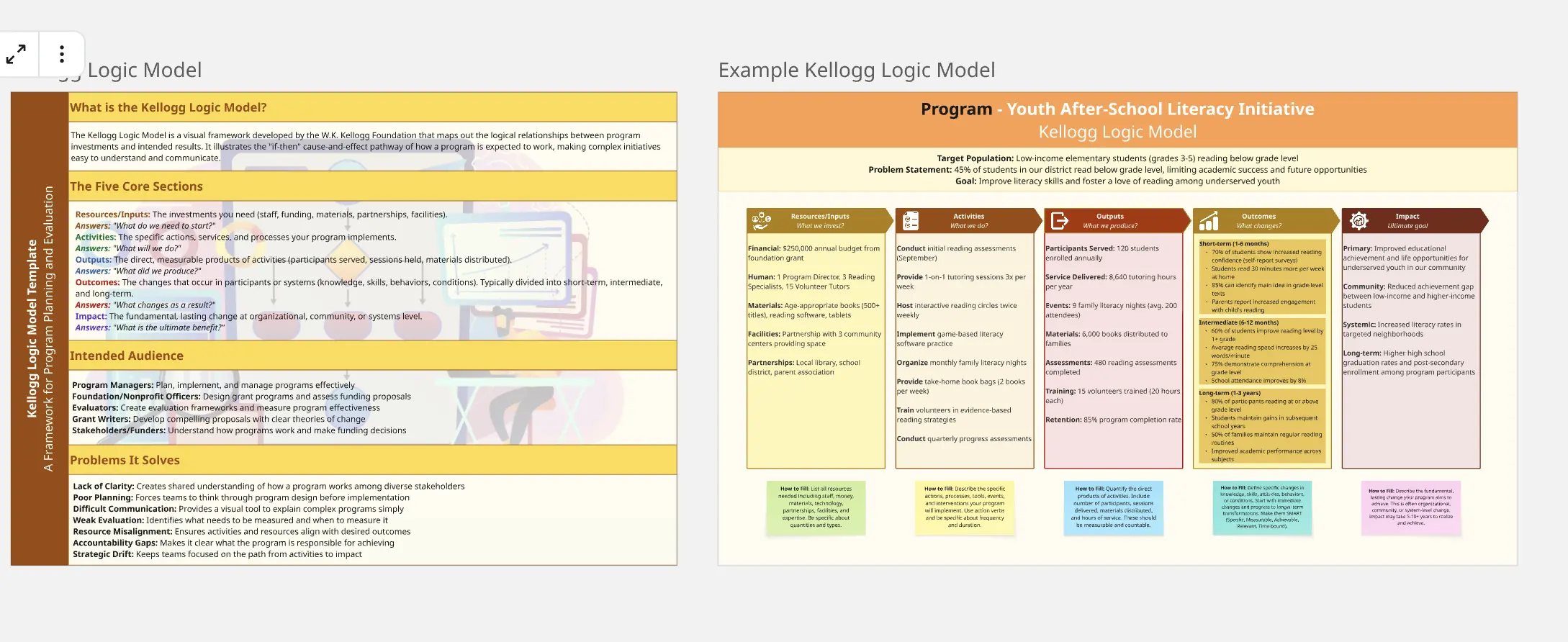
The Simple Logic Model is a visual planning and evaluation tool that helps you map the journey from resources and activities to meaningful outcomes and long-term impact.
Also known as a Logic Model, Theory of Change, or I(A)OOI Model (Inputs → Activities → Outputs → Outcomes → Impact), it helps individuals and organisations understand how their actions are expected to create change.
Widely used in impact entrepreneurship, social enterprises, non-profits, education, sustainability, philanthropy, government programmes, and community development, the model provides a clear framework for planning initiatives and measuring success.
How to use it
Define the Inputs required to deliver your initiative.
Identify the Activities that will be undertaken.
Describe the Outputs that will be directly produced.
Map the Outcomes you expect to achieve in the short to medium term.
Define the longer-term Impact your work aims to contribute to.
Review the connections between each stage and identify assumptions, risks, and opportunities.
Workshop suggestion
Time: 45–90 minutes
Start by defining the desired long-term impact.
Work backwards to identify outcomes, outputs, activities, and inputs.
Discuss assumptions and success factors.
Refine the model until there is a clear and logical pathway to impact.
Who is it for?
Social entrepreneurs
Non-profits and charities
Impact-driven businesses
Sustainability professionals
Educators and researchers
Community organisations
Government agencies
Consultants and facilitators
Anyone designing, managing, or evaluating projects and programmes
What should you consider?
✓ Focus on the change you want to create, not just the activities you deliver.
✓ Ensure each step logically leads to the next.
✓ Distinguish clearly between outputs, outcomes, and impact.
✓ Identify assumptions that need to be tested or monitored.
✓ Use the model as a living document that evolves over time.
What’s the output?
✓ A clear pathway from resources to impact
✓ Shared understanding among stakeholders
✓ Defined outcomes and success indicators
✓ Stronger project and programme design
✓ A foundation for monitoring, evaluation, reporting, and impact measurement
✓ Greater clarity on how your activities contribute to long-term change