119likes
708uses
Explore Business Idea templates and examples from Miro. Free editable templates ready to use for teams, online and collaborative.
5 templates
A Business Idea template is a dynamic, foundational visual workspace designed for founders, product innovators, and entrepreneurs to deconstruct a raw business concept into a structured, viable business model. Instead of writing a dense, 40-page business plan that becomes obsolete the moment it hits the market, this collection serves as a lean testing ground. By utilizing a standardized Miro template, teams can visually stress-test assumptions, map customer value loops, outline cost structures, and identify the core competitive advantages necessary to transform an abstract spark of inspiration into a highly scalable enterprise.
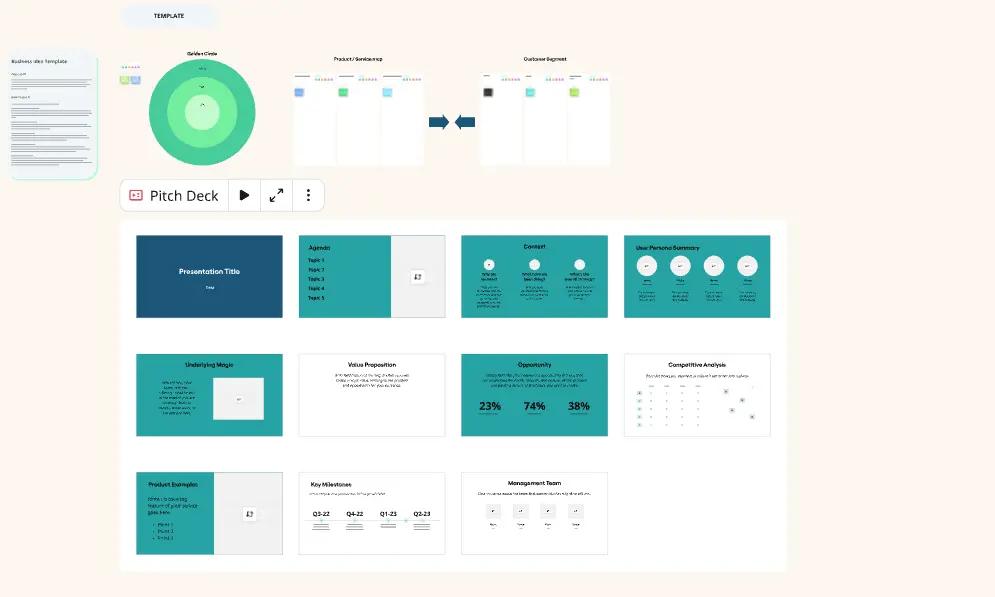
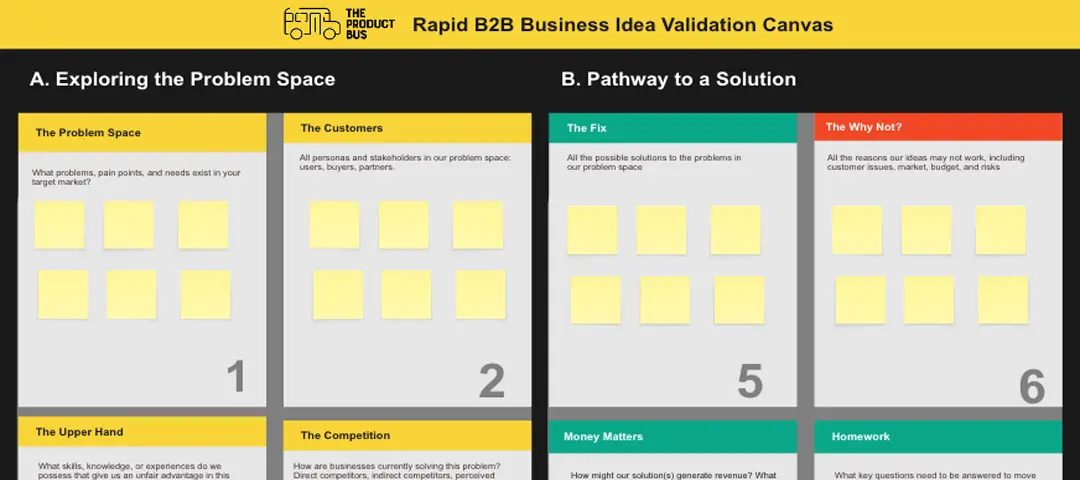
An effective business ideation workspace prevents founders from falling in love with a flawed concept by forcing them to evaluate the idea through an objective, multi-dimensional lens. Every professional Miro business idea board should include these five essential elements:
The Problem-Solution Anchor: A dual-zone framework dedicated to clearly defining the top three target customer pain points and the corresponding mechanisms your product or service uses to solve them.
The Unique Value Proposition (UVP) Showcase: A high-visibility central block to draft a clear, compelling statement that describes why your solution is different and worth paying for.
Customer Segment & Distribution Channels Map: Dedicated columns to identify your beachhead market (the exact group of early adopters you will target first) and the marketing or sales channels you will use to reach them.
Revenue Streams & Cost Structure Ledges: An economic balance zone to list potential pricing models, recurring revenue opportunities, and the primary operational expenses (fixed and variable costs) required to launch.
The Unfair Advantage Shield: A specialized section designed to isolate your defensible moats—the unique assets, data, partnerships, or team expertise that cannot be easily copied or bought by competitors.
1. Anchor Your Central Hypothesis Open your chosen Business Idea template in Miro. Use the central workspace to write down the core thesis of your concept in a single sentence. Lock this structural frame to keep the team focused and prevent the session from drifting into irrelevant tangent ideas.
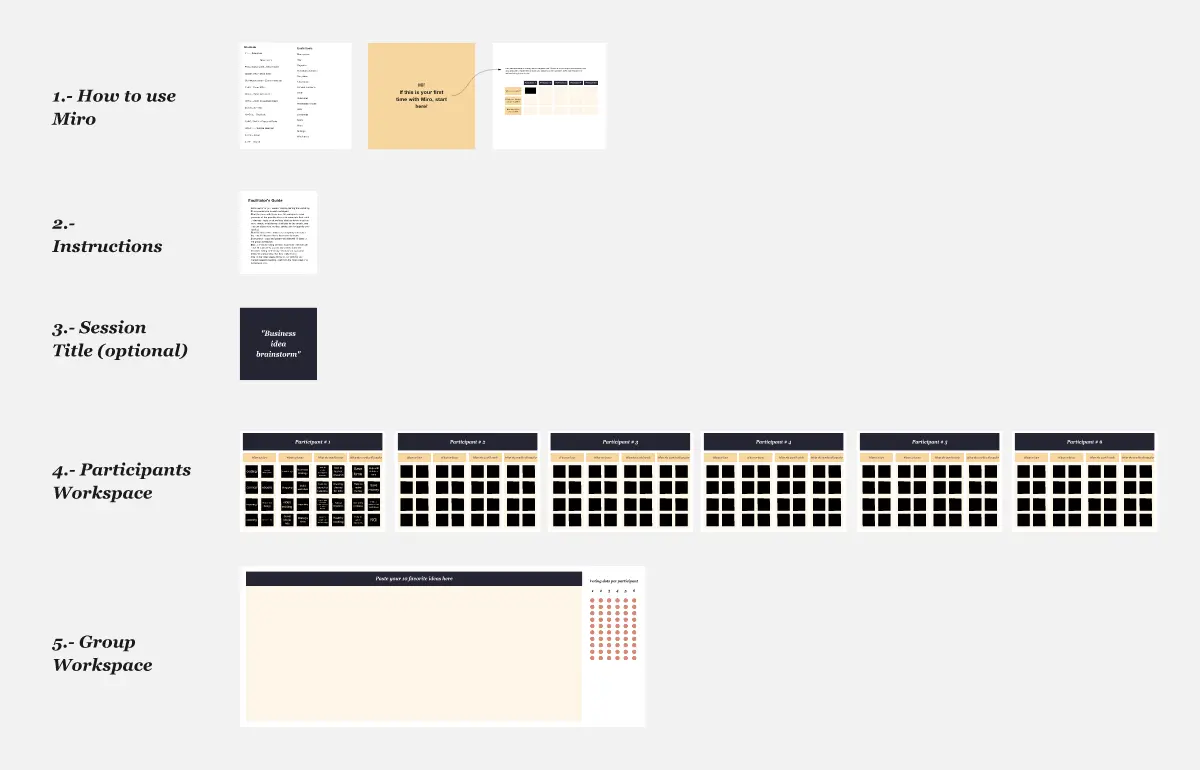
2. Map the Real-World Customer Problem Direct your team to the Problem column. Give everyone 5 minutes of quiet time to use digital sticky notes to list the specific frustrations, manual workarounds, and economic losses your target audience experiences today.
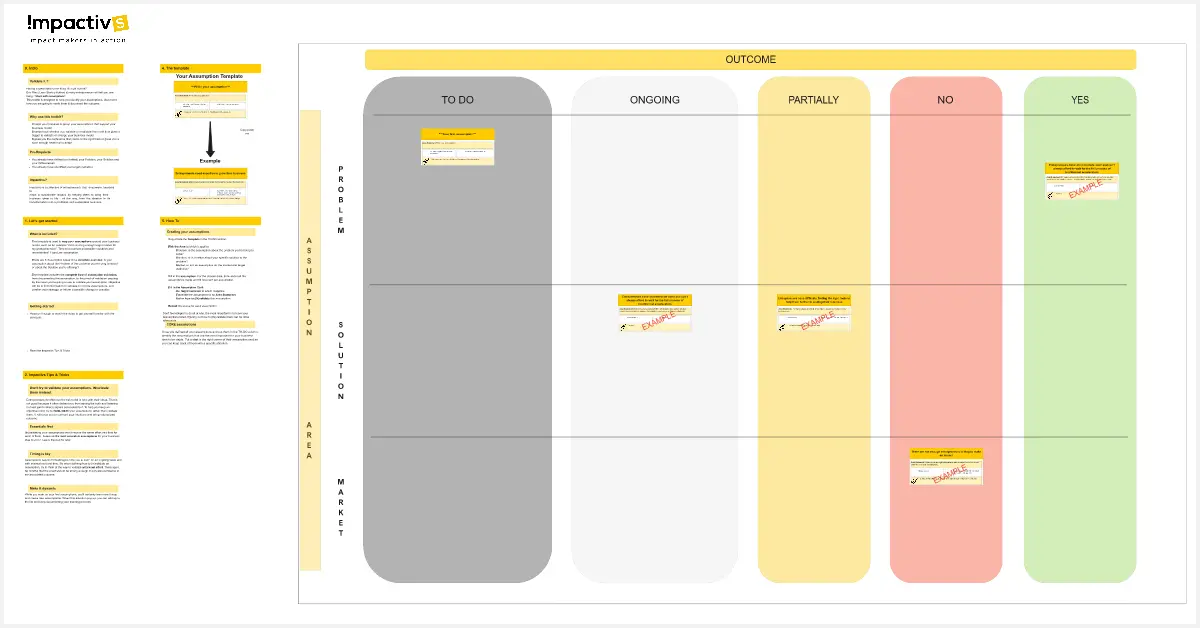
The Founder's Trap Rule: Never design a solution in search of a problem. If your team cannot list three painful, acute, real-world problems that your target customer group actively complains about, pause the workshop to conduct direct user discovery interviews.
3. Define the Beachhead Customer Segment Move to the Customer Segments area. Be specific: avoid broad generalizations like “everyone who owns a phone.” Instead, use distinct sticky notes to profile your ideal early adopter—the exact group of users who experience the problem most acutely and are actively looking for a solution right now.
4. Brainstorm the Solution and Value Loop Only after the problem and customer boundaries are locked should you pivot to the Solution canvas. Align your product features directly to the customer pain points you mapped in Step 2. Draw connector lines to show exactly how a feature eliminates a specific operational friction point.
5. Outline the Economics (Revenue and Costs) Fill out the Revenue Streams and Cost Structure ledges. Use distinct sticky notes to map out how you will charge customers (e.g., SaaS subscription, transaction fee, marketplace commission) against your primary cash outflows (e.g., software hosting, marketing spend, specialized labor).
6. Stress-Test Your Unfair Advantage Review the Unfair Advantage shield. Challenge your team to answer honestly: "If a large competitor copies our features by next month, why do we still win?" Brainstorm your long-term moats—such as proprietary machine learning algorithms, exclusive distribution partnerships, or network effects.
7. Convert Assumptions into Validation Experiments Clean up your board layout and highlight high-risk, unproven assumptions in a distinct color. Convert these flagged sticky notes into a concrete execution checklist for a Minimum Viable Product (MVP). Export the frame view as a crisp reference image to guide your validation tests and initial investor pitch decks.