36likes
111uses
Some problems never go away no matter how many times you try to "solve" them. Should we centralize or decentralize? Focus on the individual or the team? Drive for results or invest in relationships? Push for change or protect stability? If your team keeps swinging back and forth between two options — never quite landing, always rebounding — you're probably not facing a problem to solve at all. You're facing a polarity to manage.
This template gives you a ready-to-use Polarity Map® to help you and your team see these tensions clearly, talk about them productively, and leverage both sides instead of fighting over which one is "right."
Polarity Thinking™ (also called Polarity Management™) is a framework developed by Dr. Barry Johnson, who created the first Polarity Map® and its set of principles in 1975 and introduced them to a wide audience in his 1992 book Polarity Management: Identifying and Managing Unsolvable Problems. . It's a tool for navigating "polarities" — also called interdependent pairs or unsolvable problems — which are ongoing tensions that can't be fixed by choosing one side over the other, but must instead be managed by leveraging the strengths of both poles over time. Classic examples include balancing stability and change, individual and team, or activity and rest: rather than treating these as either/or decisions, the map helps people see how each pole's upside and downside interact, so they can maximize the benefits of both while avoiding the downsides of overemphasizing either.
Johnson introduced the approach to a broad audience in his 1992 book Polarity Management: Identifying and Managing Unsolvable Problems, and he continues to develop and teach the method through his organization, Polarity Partnerships, whose official website is polaritypartnerships.com.
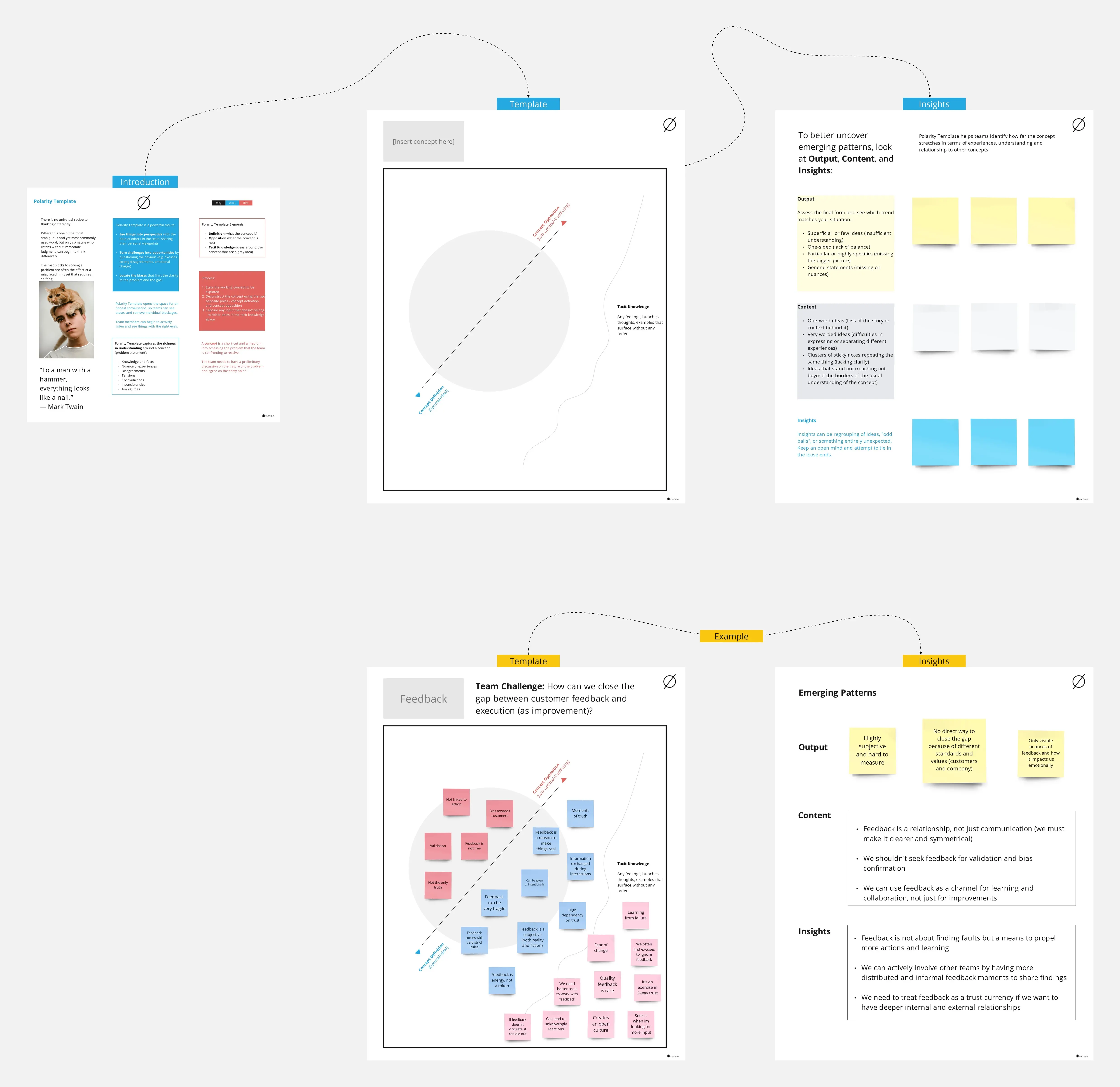
This board is structured around the classic Polarity Map® so you can map any tension in minutes:
Two poles: name the two interdependent values at the center of each po (for example, Stability and Change).
What we want (Greater Purpose): the shared "why" that sits above both poles and that you're pursuing by managing the polarity well.
What we don't want (Deeper Fear): the loss you're trying to avoid, which lives below the map and quietly drives the swing between poles.
Four quadrants: capture the upsides (positive results) of each pole and the downsides (negative results) of over-focusing on each pole, so the full picture is visible at a glance.
Early Warnings — measurable signs that you're slipping into the downside of a pole, so you can course-correct before things go wrong.
Facilitators, coaches, team leads, OD and HR practitioners, product and strategy teams, change agents, and anyone navigating a recurring tug-of-war. It's especially powerful when a decision keeps getting re-litigated, when two groups are dug into opposing positions, or when a past "solution" caused an unexpected new problem.
Name the polarity. Frame the tension as two positive, interdependent values rather than a problem versus a solution.
Find what is it you want (the Greater Purpose) and waht you don't want (Deeper Fear). Anchor the conversation in what you're all really trying to achieve and avoid.
Fill the four quadrants together. Invite both "sides" to contribute — people who favor each pole hold essential pieces of the truth.
See the whole. Notice how chronic over-focus on one pole eventually delivers its downside and pushes you toward the other.
Make it actionable. Add Early Warnings so managing the polarity becomes part of how the team operates.
Polarity Thinking lowers the temperature of polarized conversations because no one has to be wrong for the team to move forward. It transforms "us vs. them" into "us and them," surfaces the wisdom on both sides, and replaces exhausting pendulum swings with intentional, ongoing balance. The result is better decisions, less conflict, and the ability to hold complexity without getting stuck.
Polarity Thinking™, Polarity Management™, and the Polarity Map® were created by Dr. Barry Johnson and Polarity Partnerships. This template is intended to help teams apply his framework. To go deeper — including facilitation guides, certification, and assessments — visit the official site at polaritypartnerships.com.