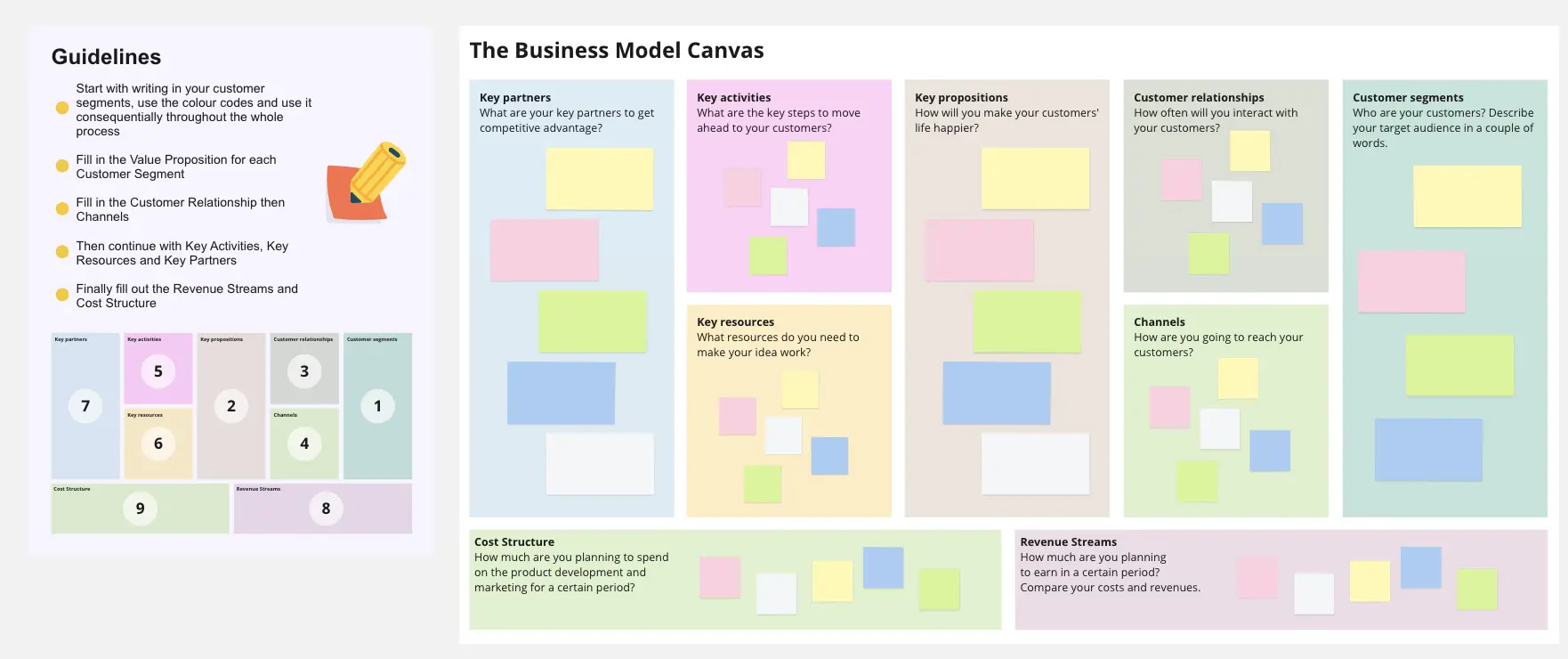
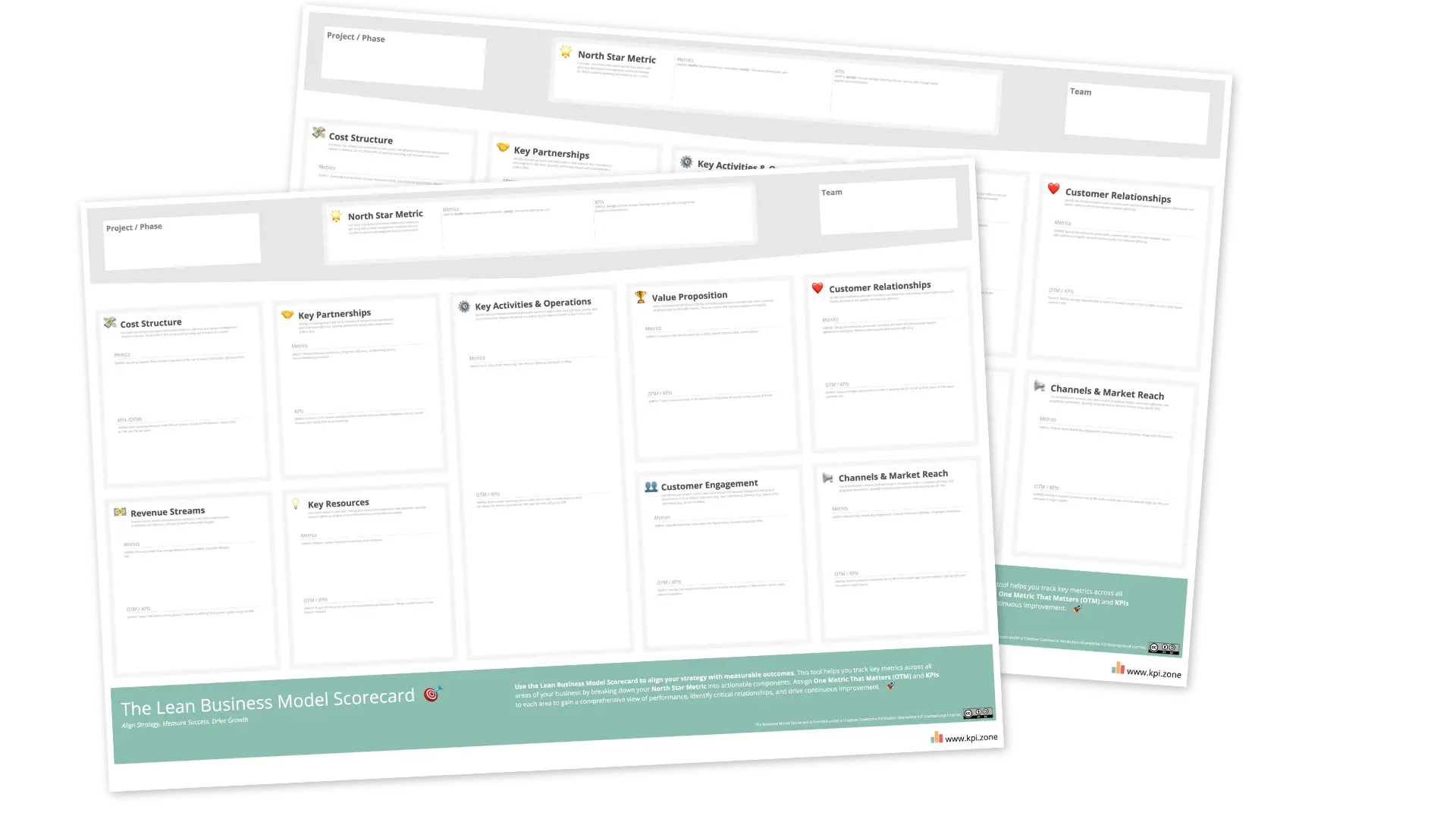
The Lean Business Model Canvas is a simple, visual tool that helps entrepreneurs, startups, innovators, and small businesses design, test, and refine their business model on a single page.
Instead of spending weeks creating a detailed business plan, this canvas helps teams focus on the most important elements of a business and the assumptions behind them. It encourages learning through experimentation, customer feedback, and continuous improvement.
The Lean Business Model Canvas is especially valuable in uncertain environments where customer needs, market conditions, and business models are still evolving.
What does “Lean” mean?
The Lean approach originates from Lean Startup methodology and focuses on learning quickly while minimising wasted time, money, and effort.
Rather than assuming that a business idea will work, teams identify their key assumptions and test them through customer conversations, prototypes, pilots, and experiments.
Key principles include:
Start small and learn fast
Test assumptions before making large investments
Gather customer feedback early and often
Adapt based on evidence and insights
Focus on creating value rather than writing lengthy plans
A lean business model is never considered finished. It evolves as new information becomes available.
Why is this approach suitable for startups?
Startups operate in conditions of uncertainty. They often do not yet know:
Who their ideal customers are
Whether customers will buy their solution
Which channels will work best
What pricing model customers prefer
What resources are truly required
The Lean Business Model Canvas helps founders make these assumptions visible and prioritise what needs to be tested first. Rather than building a complete business before validating demand, teams can learn quickly, reduce risk, and improve their chances of success.
How to use this template
Step 1: Define your customers
Start by identifying your customer segments and early adopters.
Step 2: Clarify your value proposition
Define the problem you solve and the value you create.
Step 3: Map relationships and channels
Describe how customers discover, buy, and engage with your offering.
Step 4: Identify operations
Map the activities, resources, and partnerships needed to deliver value.
Step 5: Consider finances
Outline your key costs and potential revenue streams.
Step 6: Identify assumptions
Highlight areas where you lack evidence and need further validation.
Step 7: Test and learn
Conduct interviews, build prototypes, run pilots, and gather feedback.
Step 8: Update the canvas
Revise the canvas regularly as you learn more about your customers and market.
Workshop suggestions
Rapid Startup Design (45–60 minutes)
Ideal for founders and small teams.
Introduce the canvas (10 min)
Complete all sections individually (15 min)
Compare and discuss assumptions (15 min)
Identify top validation priorities (10 min)
Team Alignment Workshop (90–120 minutes)
Ideal for startups, project teams, and internal innovation teams.
Introduce lean thinking (15 min)
Complete the canvas collaboratively (45 min)
Discuss assumptions and risks (20 min)
Prioritise experiments and next steps (20 min)
Business Model Review (60 minutes)
Ideal for existing businesses.
Map the current business model
Identify changes in customers, markets, or operations
Highlight opportunities for innovation
Define actions and experiments
By the end of the process, you will have:
✓ A visual overview of your business model
✓ A shared understanding among team members
✓ A clearer value proposition
✓ Identified assumptions and risks
✓ A list of validation priorities
✓ Potential experiments and next steps
✓ A living document that can evolve as your business grows
Who is this template for?
Entrepreneurs and founders
Startups and scaleups
Innovation teams
Product managers
Small business owners
Consultants and facilitators
Accelerators and incubators
Students and educators
Social enterprises and impact ventures
Use this template when:
Exploring a new business idea
Launching a startup
Designing a new product or service
Testing assumptions
Preparing for customer discovery
Running innovation workshops
Aligning a team around a business model
Reviewing and improving an existing business