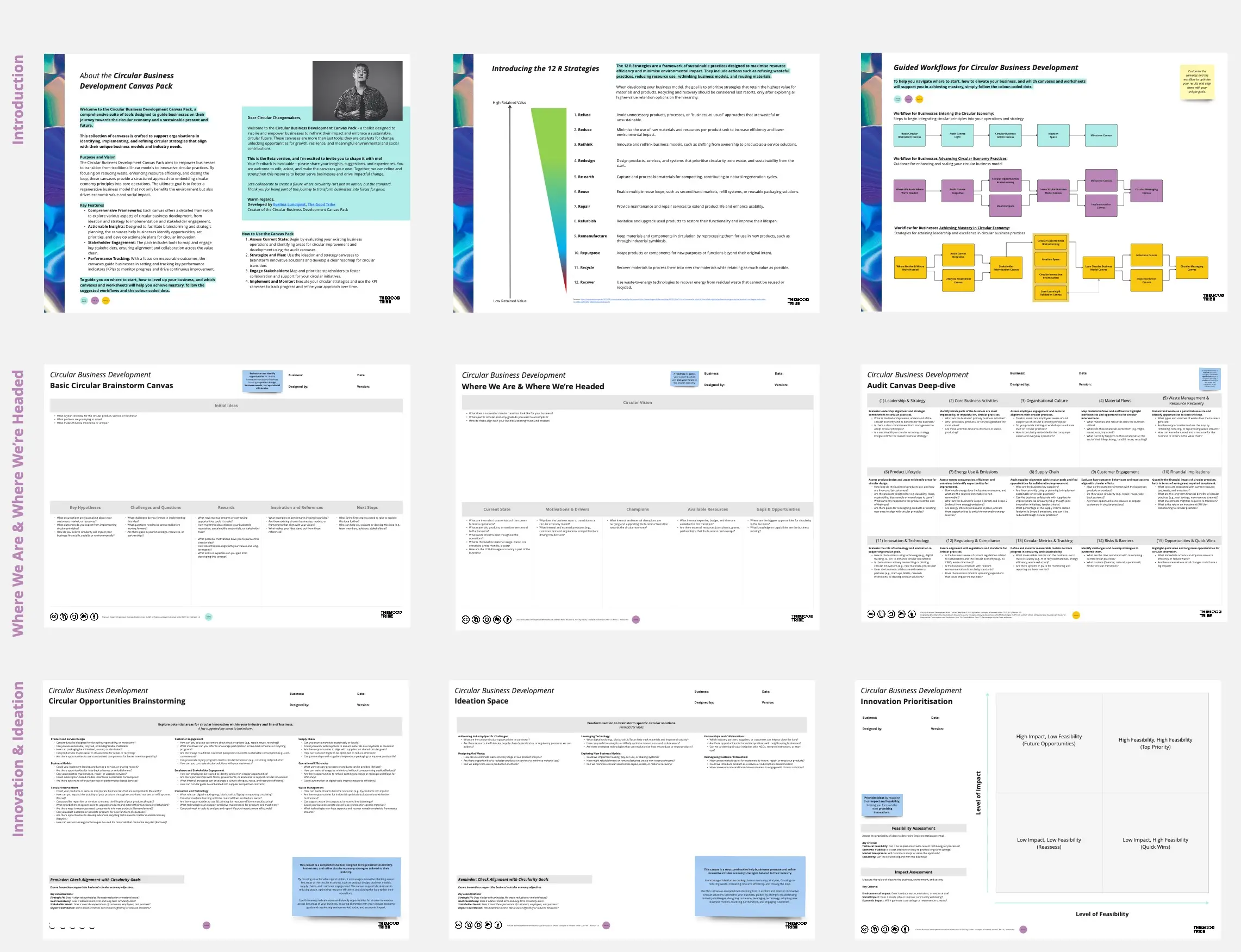
The Circular Business Action Canvas helps businesses identify, prioritise, and plan their first (or next) circular economy initiatives.
Built around the 12 R Strategies of the Circular Economy—from Refuse and Reduce through Reuse, Repair, Refurbish, and Remanufacture to Recycle and Recover—the canvas contains more than 160 practical actions that organisations can use to reduce waste, retain value, conserve resources, and create new business opportunities.
Rather than starting with a blank page, teams can use the canvas to quickly explore circular opportunities, evaluate potential initiatives, and create a practical implementation roadmap.
This template is suitable for:
Small and medium-sized businesses (SMEs)
Start-ups and entrepreneurs
Sustainability professionals and consultants
Innovation and business development teams
Municipalities and public organisations
Educators, trainers, and workshop facilitators
No prior knowledge of the circular economy is required.
Use this canvas to:
Identify circular economy opportunities
Generate ideas for waste reduction and resource efficiency
Explore new business models and circular services
Develop circular products and processes
Prioritise actions based on impact and feasibility
Create a 12-month implementation roadmap
Facilitate workshops and strategy sessions
How to use the template
Step 1: Explore
Review the 160 actions organised according to the 12 R Strategies.
Step 2: Select
Mark the 10 actions that are most relevant or interesting for your organisation.
Step 3: Prioritise
Assess your selected actions based on criteria such as impact, feasibility, cost, stakeholder acceptance, and timing.
Step 4: Decide
Choose 3 initiatives to focus on over the next 12 months.
Step 5: Plan
Use the implementation timeline to define milestones, responsibilities, and next steps.
Why the 12 R Strategies?
The 12 R Strategies represent a hierarchy of circular economy interventions. Actions at the top of the hierarchy retain the most value and prevent waste before it occurs. As materials move down the hierarchy, more value is lost and additional resources are required to recover it. The goal is to prioritise prevention, reuse, repair, refurbishment, and remanufacturing before considering recycling or recovery.
Tips for Facilitators
Use the canvas in workshops, innovation sessions, strategy meetings, or sustainability programmes.
Encourage participants to focus on practical actions rather than perfect solutions.
Remind teams that circular transformation often starts with small experiments and continuous learning.
Use the “Other” section to capture ideas specific to your industry or organisation.
Created by
Evelina Lundqvist
Sustainability Consultant | Circular Economy Specialist | Founder of The Good Tribe. The template is licensed under CC BY 4.0 and may be adapted and shared with attribution.