
19likes
142uses
This template combines two proven ideas into a single weekly workflow: Adora Cheung's (YC partner) "real work vs. fake work" framework, and the classic impact vs. complexity matrix. Together, they help you and your team cut through busywork and focus on the 20% of tasks that actually drive revenue, growth, or whatever your primary metric is. The template runs in three stages on one Miro board. First, a transcript input area where you paste your weekly meeting notes. Second, a Kanban board that auto-classifies every task mentioned as either "real work" or "fake work." Third, an impact/complexity matrix that produces a final ranked priority list. The whole thing is designed to be run with Miro AI Flows, so what used to take hours of team debate now takes minutes.
Most early-stage founders work extremely hard on the wrong things. The Pareto principle tells us that 80% of revenue comes from just 20% of tasks, but in the day-to-day, it's almost impossible to tell which tasks are which. This template makes that distinction visible, shared, and actionable across your whole team.
This template is built for:
Early-stage startup founders running weekly planning or founder's meetings
Founding teams of 2 to 10 people who need to align on what matters this week
Product managers and team leads who want a repeatable prioritization system
Operators, chiefs of staff, and ops leads at fast-growing startups
Solo founders who want more rigor in their weekly planning
It's especially useful if you feel like your team is constantly busy but not making real progress on your core metric.
By the end of a single session, you and your team will have:
A clear separation of every task on your plate into "real work" (moves your primary metric) and "fake work" (feels productive but doesn't)
An impact/complexity matrix showing which tasks are high-leverage wins and which are time sinks
A ranked priority list, sorted from highest to lowest priority, with high-impact and low-complexity tasks at the top
Team alignment on exactly what to start working on Monday morning
Run your weekly founder's or team meeting as usual, and record it.
Paste the meeting transcript into the input frame on the board.
Fill in the business context section with your primary metric (e.g., MRR, weekly active users, signups) and any goals or constraints relevant to this week.
Run Miro AI Flows with the included prompt. It will auto-generate a Kanban board extracting every task from the meeting and classifying each as real work or fake work, based on whether it plausibly moves your primary metric.
Review the classifications as a team and adjust any tasks Miro AI got wrong.
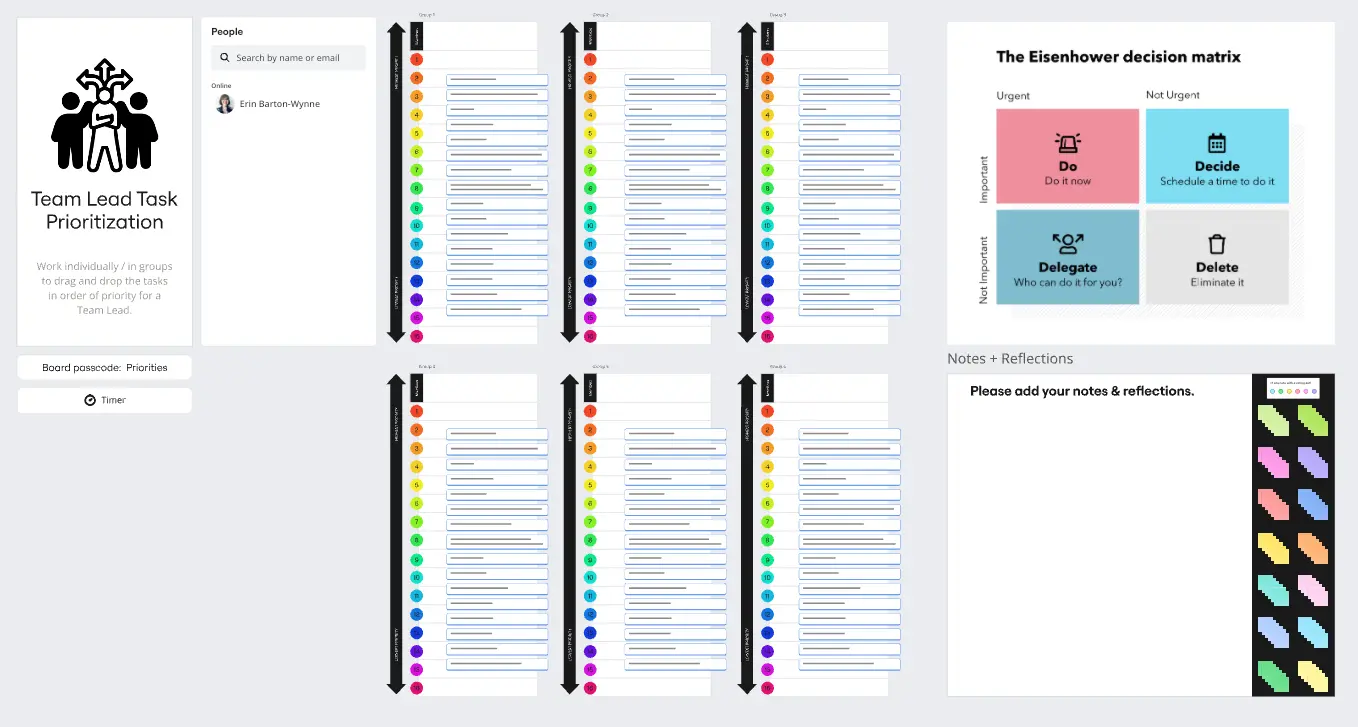
Drag the real-work sticky notes onto the impact/complexity matrix. Impact is ranked Low, Medium, or High (probability the task moves your primary metric). Complexity is ranked Easy (under a day), Medium (1 to 2 days), or Hard (2+ days).
Run Flows a second time. It will generate a final ranked priority list, ordered from highest to lowest priority, with high-impact and low-complexity tasks at the top.
Start at the top of the list on Monday.
Run this every single week. Prioritization isn't a one-time exercise. What counts as "real work" shifts as your business and metric change.
Keep your primary metric to ONE number. If you track three primary metrics, you effectively track none. This is Adora's rule.
Be ruthlessly honest in the real vs. fake step. The template only works if you're willing to call your own busywork what it is.
Break down "Hard" complexity tasks before starting them. A 2+ day task is usually three smaller tasks hiding inside one trench coat.
Archive each week's board. Reviewing past priority lists against what actually moved your metric is one of the highest-leverage learning loops you can build into your operating cadence.