42 likes
526 uses
Predict the future by imagining the failure. Use the Premortem template to brainstorm everything that could go wrong before you launch, allowing your team to build safeguards and prevent disasters before they happen.
6 templates
A pre-mortem template is a structured workspace used to identify "blind spots" before a project launches. Popularized by psychologist Gary Klein, the exercise flips the traditional "What could go wrong?" question into a definitive statement: "It is one year from now and this project is a disaster. What happened?" This cognitive shift bypasses the "Overconfidence Bias" and "Groupthink" that often silence skeptics in a room full of optimists.
A pre-mortem is only effective if the team feels safe being "brutally honest." Before starting your session on Miro, apply these three expert "health checks":
1. The "Prospective Hindsight" Audit
The Audit: Is your team just listing "Risks" like a standard RAID log? The Fix: Audit for Imagined Certainty. A professional template forces the team to start from the end. Instead of saying "A competitor might launch," they must say "A competitor launched a better version for half the price." By treating the failure as a historical fact, the brain becomes much better at finding the realistic path that led there.
2. The "Spectacular Failure" Test
The Audit: Are the "Failures" your team identifies too small or easy to fix? The Fix: Audit for Scale. Encourage the team to imagine a "Total Catastrophe"—legal lawsuits, 90% churn, or a complete brand meltdown. When you imagine a massive failure, you uncover systemic weaknesses (e.g., "Our server architecture can't handle 2x traffic") that small-scale risk thinking misses.
3. The "Anti-Groupthink" Guardrail
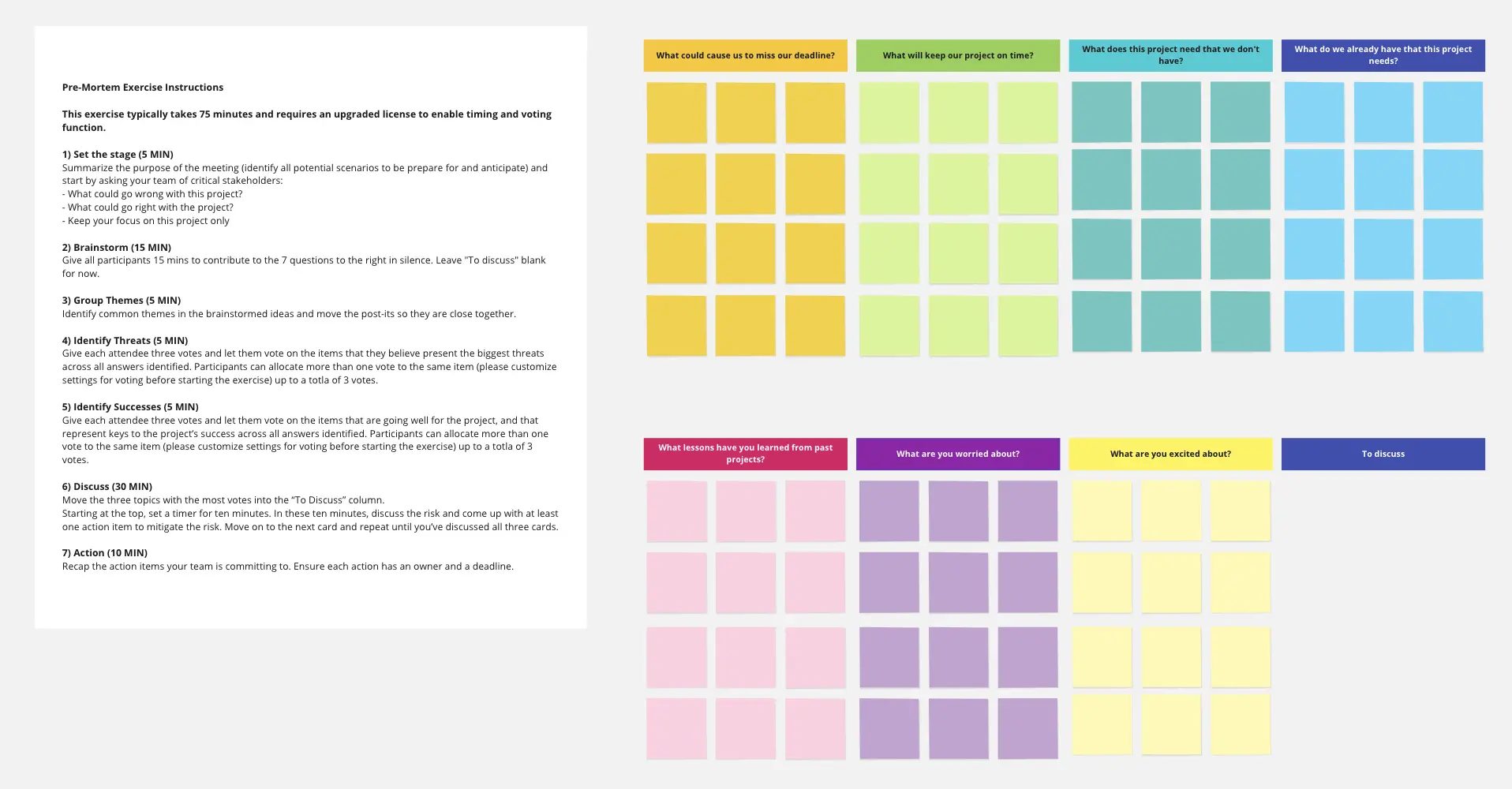
The Audit: Is the Project Manager or Lead "defending" the project during the brainstorm? The Fix: Audit for Independent Brainstorming. Use "Silent Writing" for the first 10 minutes. Everyone must write down their "Reason for Failure" individually before sharing. This ensures that the junior developer who sees a technical flaw isn't intimidated into silence by the senior manager's optimism.
Select the framework that matches your project’s complexity:
The Basic Pre-mortem Canvas:
Best For: Small teams or feature launches.
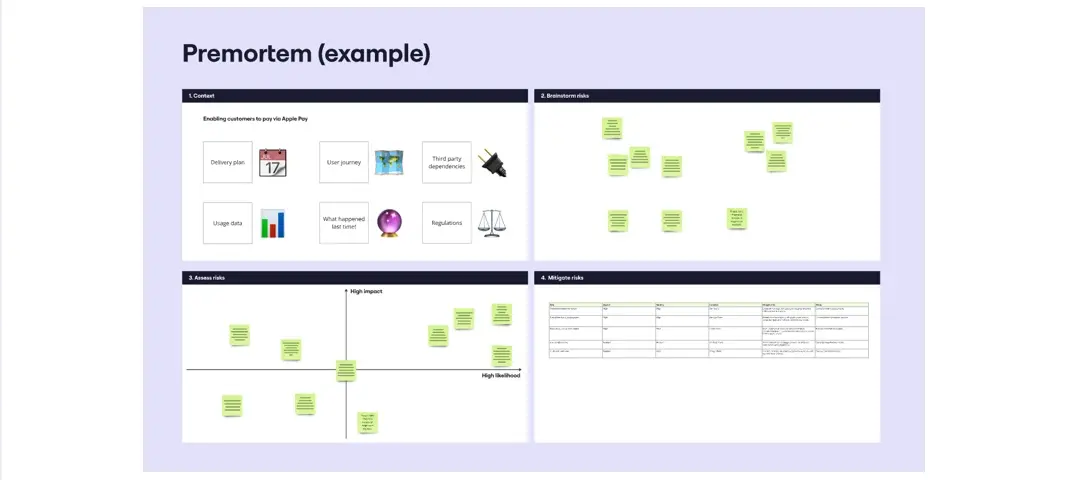
The Flow: 1. Imagine Failure, 2. Brainstorm Reasons, 3. Consolidate, 4. Plan Mitigations.
The "Trio of Trouble" Template:
Best For: Strategic business shifts.
The Categories: Group failure into Technical (it didn't work), Market (nobody wanted it), and Operational (we couldn't support it).
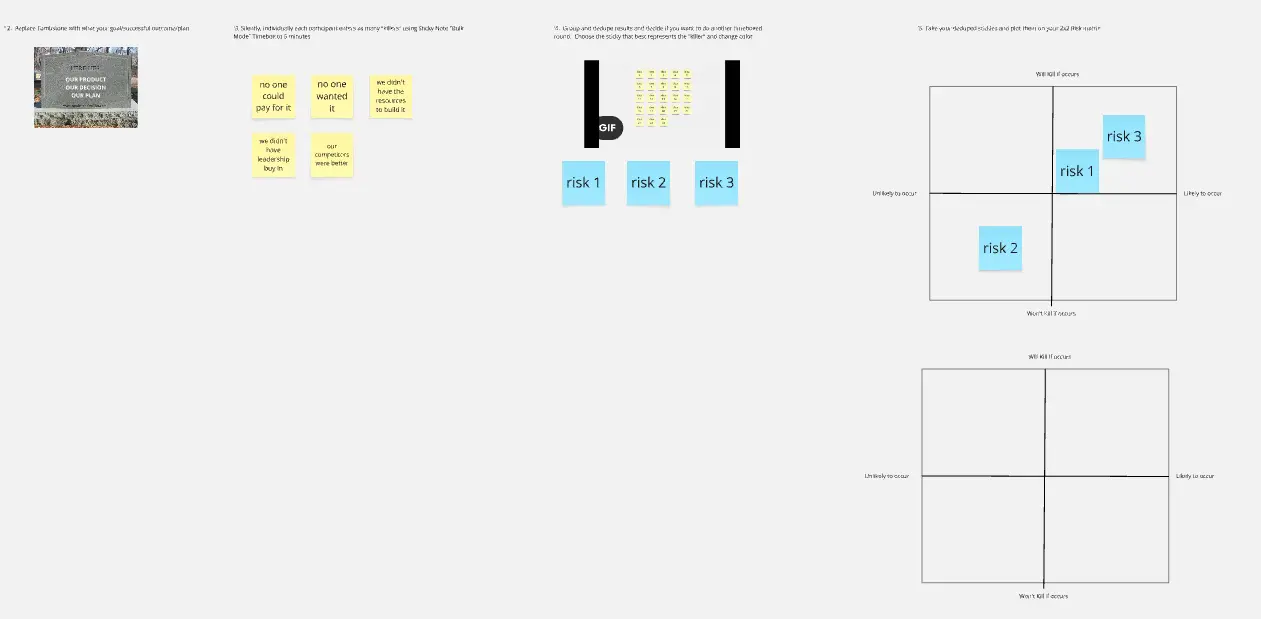
The "Post-It" Grave-Site:
Best For: Visualizing the "End of the Project."
The Goal: To literally draw a "Tombstone" for the project and write the "Cause of Death" on it to break the emotional attachment to the idea.
A high-performance Pre-mortem Board requires these five core elements:
The Disaster Scenario: A vivid description of the failed future state.
The "Candidate" Causes: A raw list of every potential reason for the failure.
The "Looming" Threats: A prioritized list of the top 3–5 risks that are most likely and most damaging.
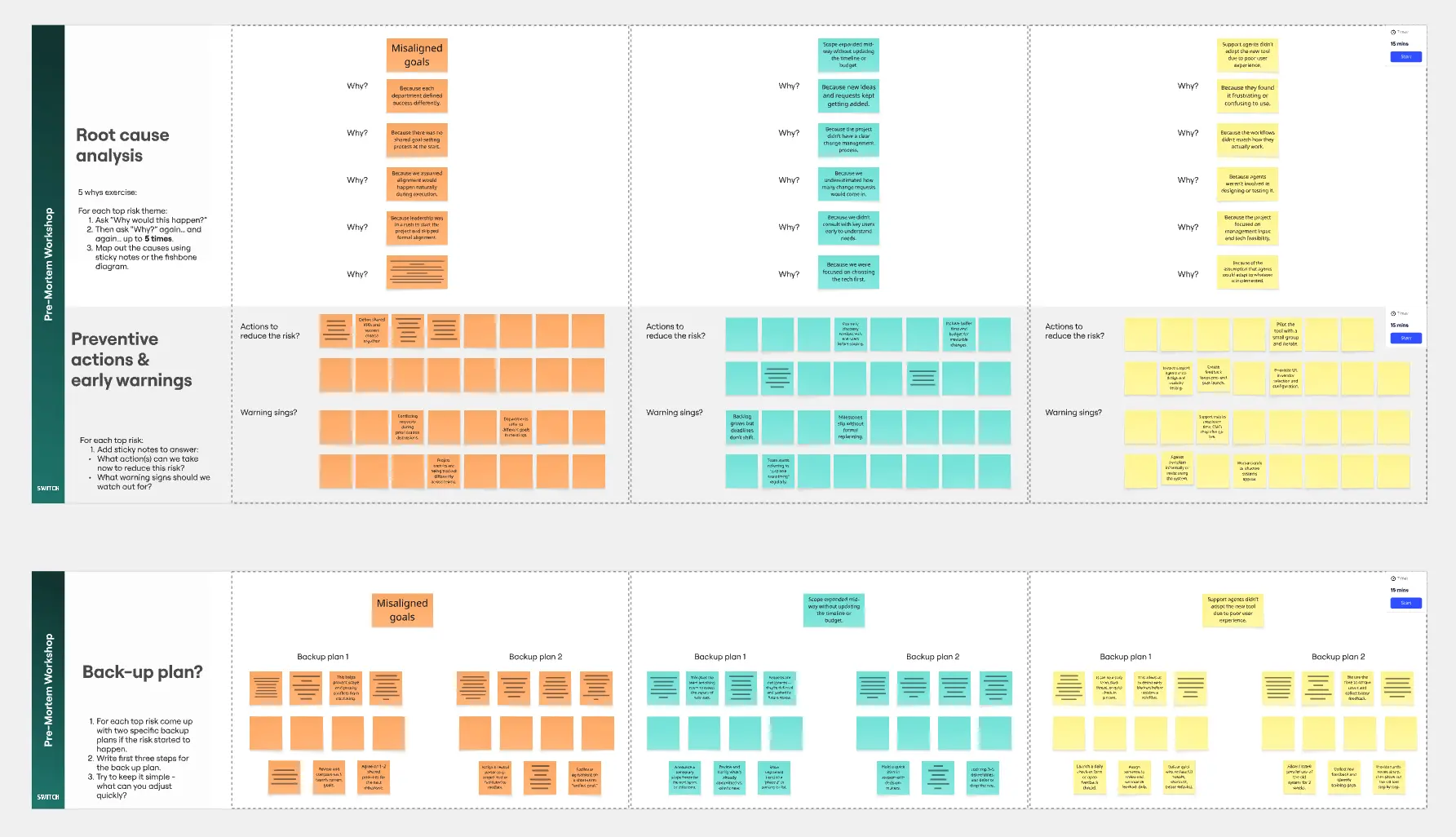
The Mitigation Roadmap: Specific tasks added to the current project plan to prevent the imagined failure.
The "Red Flag" Indicators: A list of "Early Warning Signs" (e.g., "If we haven't hit 1,000 users by Month 2, we are on the path to failure").
The "Check-the-Box" Exercise: Doing it because a process says so, but not actually changing the project plan afterward.
The Fix: Every "Reason for Failure" must result in an Action Item. If you identify that "Lack of Documentation" killed the project, you must assign someone to write the documentation this week.
Defensiveness: Feeling that a pre-mortem is an "attack" on the project's vision.
The Fix: Frame it as "The Ultimate Act of Support." A team that does a pre-mortem cares more about the project's actual success than their own comfort.