The Product Marketing Launch Process Map is a high-level strategic framework designed for Product Managers (PMs) and Product Marketing Managers (PMMs) to orchestrate complex Go-to-Market (GTM) strategies. In fast-paced SaaS and product-led environments, this visual workflow ensures that cross-functional workstreams remain synchronized, gated by quality checks, and aligned with the ultimate launch date.
What Problems Does the Product Marketing Launch Process Map Solve?
Launching a product without a unified map often leads to "market-product misalignment" and broken customer experiences. This template mitigates those risks by providing:
Cross-Functional Synchronization: It breaks down the "silo" effect between Product, Content, and Sales, showing exactly how a "Feature Freeze" in Engineering triggers "Enablement" in Sales.
Gate-Driven Quality Control: By incorporating decision diamonds (Gates), it prevents teams from wasting resources on marketing assets before the strategy is approved or the product is stable.
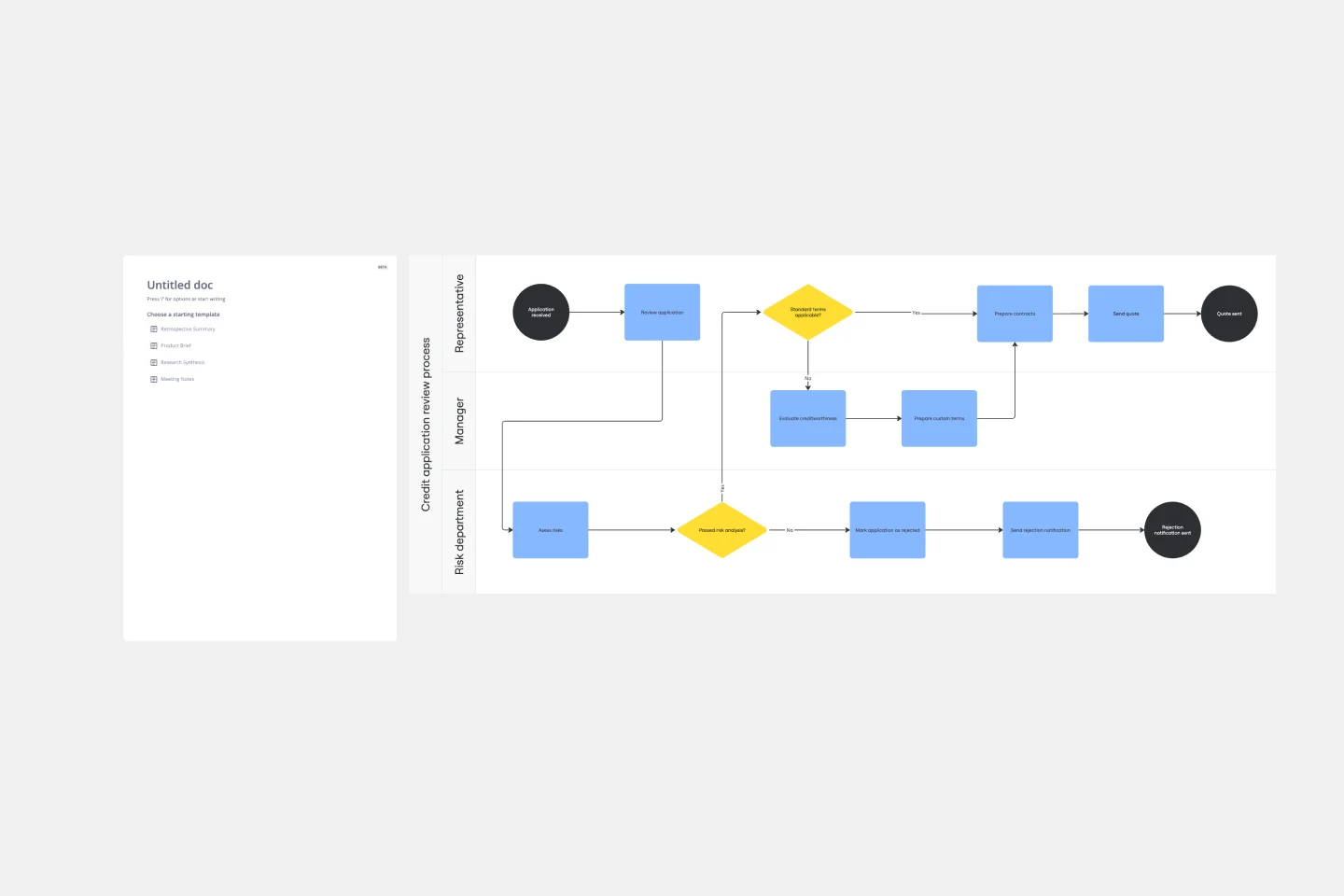
Clear Ownership & Accountability: The swimlane architecture clearly defines who is responsible for what, eliminating the "who’s doing the landing page?" confusion.
Dependency Visualization: It maps out the critical path, showing that "Narrative Design" is the mandatory precursor to both "GTM Production" and "Sales Enablement."
How to Use the Product Marketing Launch Process Map (The 5-Phase Lifecycle)
To maximize launch impact and operational precision, structure your GTM execution using this professional phase-gate framework:
Phase 1 & 2: Strategy & Messaging (The Foundation)
Initial Strategy: Define your Launch Tier (1, 2, or 3), ICP, and Personas.
Decision Gate 1 (Strategy Approved?): Stakeholder sign-off on the "Who" and "Why" before any creative work begins.
Narrative Design: Crafting the Core Messaging Document and Value Proposition that will feed all future assets.
Phase 3: GTM Execution (The Build)
Parallel Workstreams: While Product finalizes assets (Screenshots/Demos), Content builds the "GTM Production" (Landing pages, Emails) and Sales prepares "Enablement" (Battlecards, Training).
Decision Gate 2 (Product Ready?): A technical check to ensure the feature is stable enough for the marketing claims being made.
Phase 4: The Launch (The Big Bang)
Decision Gate 3 (Go/No-Go): The final executive alignment. Are the ads ready? Is the deploy successful? Is Support briefed?
Live in Production: The actual release, accompanied by distribution efforts like Social Media pushes and Paid Ads.
Phase 5: Optimization (The Tail)
Frequently Asked Questions (FAQ)
What is the difference between a Tier 1 and a Tier 3 launch in this map?
A Tier 1 launch (Major New Product) would utilize every box in this map, including heavy PR and Sales training. A Tier 3 launch (Minor Bug Fix/Update) might skip the "GTM Production" and "Distribution" phases entirely, moving straight from "Product Readiness" to a simple "In-App Notification."
How do we handle a "No" at the Go/No-Go Gate?
The map includes a "Feedback Loop." If the product or assets aren't ready, the workflow directs teams back to the GTM Execution phase. This prevents "soft launches" that damage brand reputation due to bugs or missing documentation.