106likes
553uses

Explore Pitch Deck templates and examples from Miro. Free editable templates ready to use for teams, online and collaborative.
5 templates
Pitch Deck Template
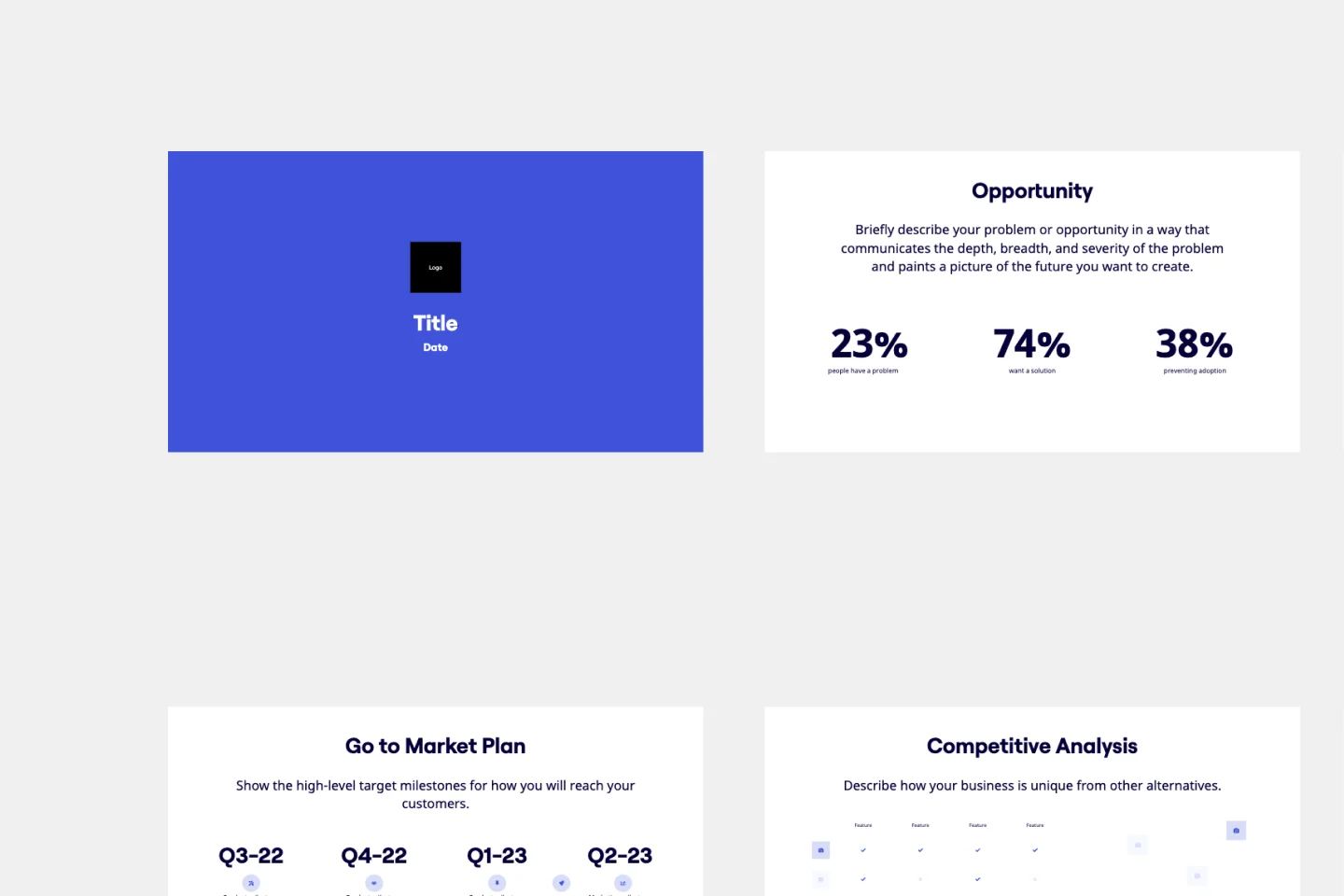
Stand out and leave a lasting impression with the Pitch Deck Template. Make people care about your idea and gain supporters everywhere.
A Pitch Deck template is a high-stakes, strategic visual workspace designed for founders, startup entrepreneurs, and corporate innovators to distill a business vision into a compelling, investor-ready narrative. When raising capital, you are competing for an investor's limited time—the average venture capitalist spends less than three minutes reviewing an initial deck. By utilizing a standardized Miro template, fundraising teams can map out their narrative arc, balance visual weight, structure financial metrics, and ensure their slides follow an unshakeable storytelling sequence before exporting to a final presentation format.
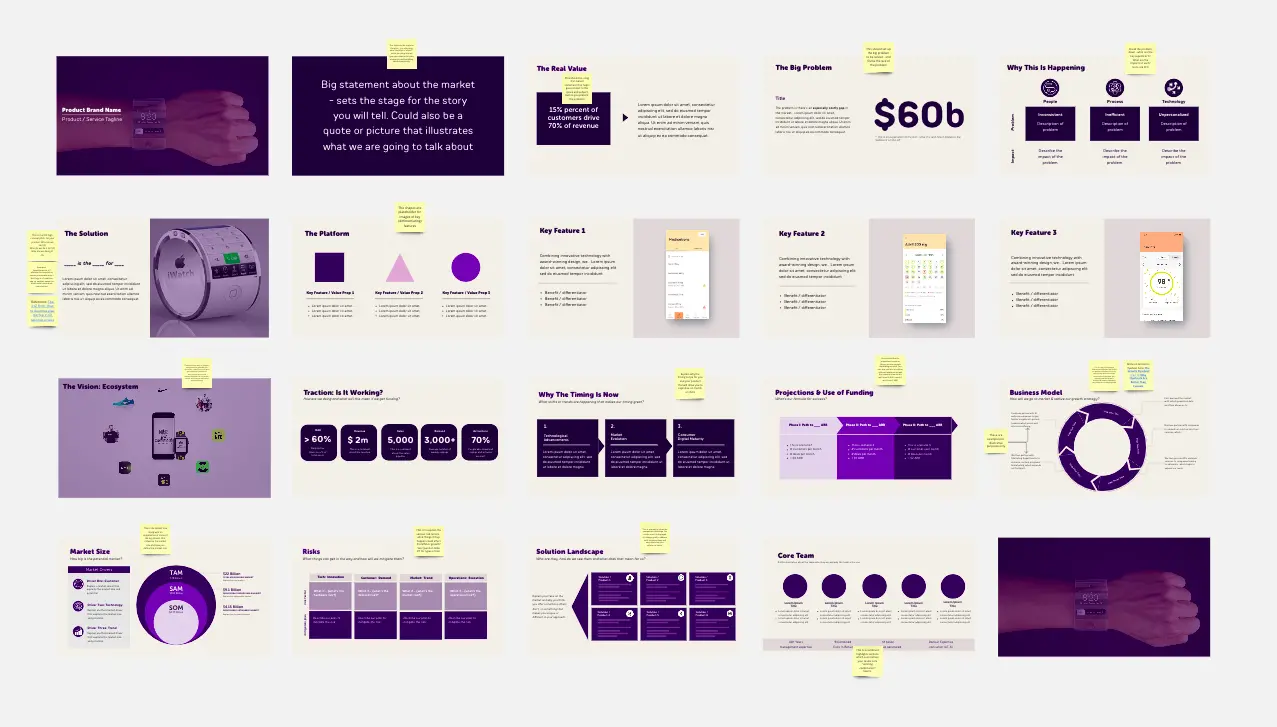
A professional fundraising blueprint replaces text-heavy slides with clear, scannable data visualization zones. Every actionable Miro pitch deck board should include these ten core structural slide frames:
The Hook (Vision & Value Prop): A clean opening canvas to state your company name, a one-sentence elevator pitch, and a high-impact background visual.
The Problem Sandbox: A frame dedicated to illustrating a severe, validated customer pain point, anchoring the market need with concrete numbers.
The Solution Canvas: A modular showcase mapping your product's core features directly to the pain points identified on the previous slide, complete with app screenshots or hardware mockups.
Market Size (TAM, SAM, SOM) Rings: A nested geometric framework used to visualize the Total Addressable Market, Serviceable Addressable Market, and Serviceable Obtainable Market.
The Business Model Balance: A clear structural zone detailing your pricing matrix, customer acquisition strategies, and target unit economics.
The Traction Timeline: A chronological visual row tracking historic revenue metrics, user growth curves, pilot programs, and major product development milestones.
The Competitive Landscape Grid: A 2x2 matrix or comparative feature checklist that establishes your unique, defensible advantages over direct and indirect competitors.
The Go-To-Market Playbook: A forward-facing roadmap detailing the specific marketing channels, sales funnels, and partnership networks you will deploy to capture your target market.
The Team Core Grid: A dedicated profile area featuring headshots, core titles, and brief bullet points highlighting the previous institutional successes and domain expertise of the founders.
The Ask & Financial Horizon: A bold closing container detailing the specific funding amount you are raising, how that capital will be allocated across business departments, and your 3-year growth projections.
1. Initialize the Presentation Scope and Frame Baseline Open your Pitch Deck template in Miro. Before drafting copy, document your fundraising baseline parameters in the configuration metadata block (e.g., “Series A Round, Target: $5M Raise, Lead Facilitator: CEO”). Lock the structural slide frame containers to keep the presentation layout uniform.
2. Run a Collaborative Problem Brainstorm Gather your founders, product leads, and user researchers on the board. Direct them to the Problem slide frame. Use digital sticky notes to list real-world customer quotes, market research data, and economic losses that prove the target problem is painful, growing, and unsolved.
3. Build the Solution Visual Alignment Move to the Solution Canvas. Drag and drop low-fidelity mockups or screenshots of your product directly into the frame. Use simple connector lines to connect a specific product feature to the corresponding customer pain note from Step 2, proving an exact problem-solution fit.
4. Quantify the Market Dynamics and Business Moats Calculate your TAM, SAM, and SOM metrics and display them clearly inside the Market Size Rings. Next, navigate to the Competitive Landscape Grid and map out your competitors. Use distinct sticky notes to call out your "Unfair Advantage"—the technological moats, proprietary data loops, or exclusive partnerships that competitors cannot buy.
5. Structure the Financial Ask and Capital Allocation Fill out the Ask & Financial Horizon slide frame. Use a clear layout block (like a pie chart placeholder or structured data card) to illustrate exactly how the funding will be split across operational categories (e.g., 40% Engineering Hire, 30% Marketing Acquisition, 20% Operations, 10% Legal).
6. Conduct a Five-Second Narrative Critique Switch the Miro board view to full-screen presentation mode and cycle rapidly through your slides. The visual weight should lean heavily toward clean typography and bold data charts. If any slide frame resembles a dense text essay, stop and break down the paragraphs into crisp, single-sentence bullet points.
7. Finalize, Lock, and Export for Design Production Review the completed pitch outline across all internal executives and advisors. Once the narrative structure and metric points are fully aligned, lock all components on the canvas to prevent editing conflicts. Export the frame collection as a high-resolution PDF template to guide your graphic design team or slide-building software.