0likes
4uses
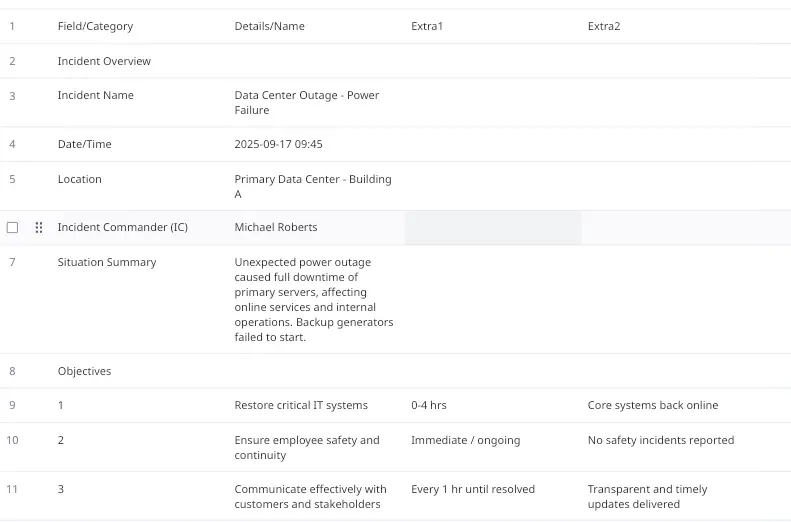
An Incident Action Plan is a critical emergency management document that provides a structured framework for coordinating response efforts during any organizational incident. It establishes clear objectives, assigns specific responsibilities, defines action steps with timelines, and ensures effective communication across all response teams. This template enables rapid, organized incident response by documenting essential incident details, resource allocation, personnel roles, and communication protocols in a standardized format that all stakeholders can follow during high-pressure situations.
Captures fundamental incident details including Incident Name/ID, Date, Incident Type, Location, Operational Period (start and end times), and Prepared by (person's name and title).
A text area for explaining the goals that need to be met during and after the incident, including primary containment objectives and secondary recovery goals.
A structured table with four columns: Task (specific actions to be taken), Timeline/Schedule (when each task occurs), Person or Team Responsible (who executes the task), and Resources (equipment, personnel, or materials needed).
A table documenting Name & Title, Responsibilities (specific duties), Phone, and Email for all key personnel involved in the response.
A text section listing who will be informed about the incident and how, including internal teams, external stakeholders, emergency services, regulatory agencies, and media contacts.
A designated area for adding maps, diagrams, facility layouts, or other visual materials that support situational awareness.
Start by completing the Incident Information header immediately when an incident is identified, assigning a unique incident ID and documenting the basic facts. In the Objective section, clearly articulate both immediate containment goals and longer-term recovery objectives. Fill the Action Plan table by breaking down the response into specific, measurable tasks with realistic timelines, assigning clear ownership, and identifying required resources for each action. The Roles and Responsibilities table should document all key personnel with complete contact information and specific duties to avoid confusion during response. The Communication Plan should specify notification methods, timing, and recipients for all stakeholder groups. Finally, attach relevant visual materials in the Incident Map section such as facility layouts, evacuation routes, or hazard zone diagrams.
The provided example demonstrates a warehouse electrical fire incident (WH-FIRE-2024-037) at a distribution center. It shows a 16-hour operational period with coordinated actions including immediate personnel evacuation, employee accounting, backup operations activation, perimeter security, incident command establishment, and fire suppression. The action plan details six specific tasks with precise timelines ranging from immediate (14:00-14:15) to ongoing operations. Six key personnel are documented including the Emergency Operations Manager, EHS Specialist, Fire Chief, Safety Director, Security Manager, and Operations Director, each with full contact details and specific responsibilities. The communication plan comprehensively addresses employee notifications, family hotlines, executive updates, emergency services coordination, media relations, customer communications, insurance notification, and regulatory reporting requirements.
This template serves multiple emergency scenarios:
Workplace fires and hazmat incidents
Natural disasters (floods, earthquakes, severe weather)
Cybersecurity breaches and IT system failures
Workplace accidents and medical emergencies
Active threat situations
Public health emergencies and disease outbreaks
Supply chain disruptions
Facility evacuations
Environmental spills and contamination events
Power outages and utility failures
Security breaches and unauthorized access incidents
Equipment failures affecting operations
Business continuity events requiring coordinated organizational response
Cheers!
Khawaja Rizwan

Rizwan Khawaja
ICT Solution Architect @ NUST
I hold master's degrees in computer science and project management along with trainings and certifications in various technologies. All this is coupled with 25+ years of industry experience.