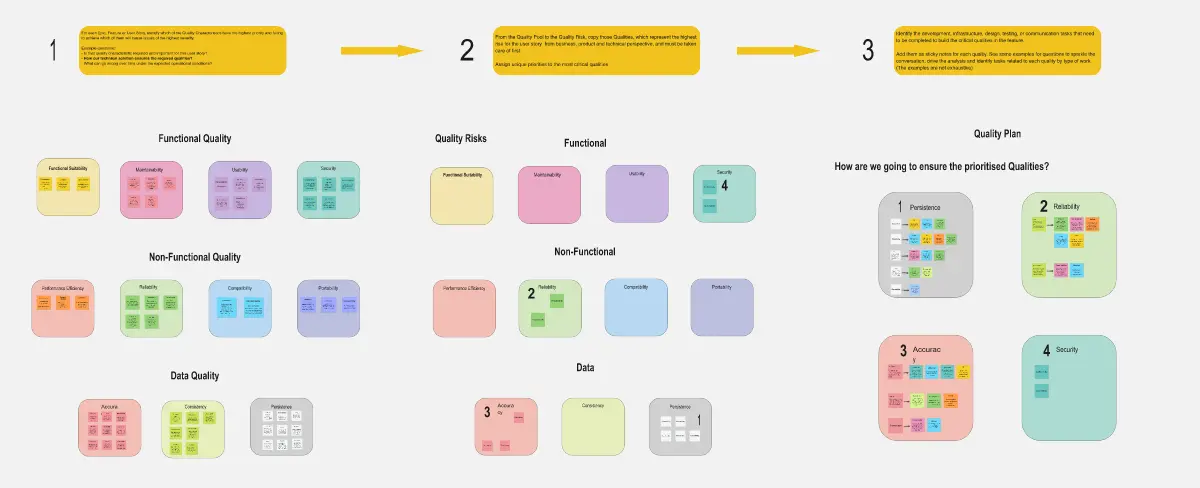
The Product Quality Control Gantt Chart is a strategic roadmap designed for Product and Operations Teams to synchronize software development with rigorous quality gates. In complex digital ecosystems. This tool ensures that every release is stable, scalable, and bug-free before reaching the end user.
What Problems Does the Product Quality Gantt Solve?
This template eliminates that risk by providing:
Elimination of "End-of-Cycle" Bottlenecks: It prevents the common mistake of leaving QA for the last week, distributing testing activities across the entire sprint or project.
Structured Validation Gates: It categorizes quality tasks into a Pre-Dev to Post-Launch framework (Requirements Review, Automated Testing, UAT, and Smoke Tests).
Resource & Dependency Clarity: It helps PMs identify when environment setups (Staging/Sandbox) or hardware availability (Scanners/Handhelds) are critical path blockers.
Cross-Functional Sync: It aligns Engineering, QA, and Operations on exactly when a feature is "Production-Ready."
How to Use the Product Quality Control Gantt (The 4-Phase Framework)
To maintain professional-grade standards in your SDLC, structure your Gantt chart with these core phases:
Phase 1: Quality Strategy & Shift-Left (Pre-Coding):
Requirements Hardening: Reviewing User Stories for testability.
Test Plan Design: Mapping out edge cases for warehouse workflows.
DoD (Definition of Done) Setup: Aligning the team on "Zero Critical Bugs" criteria.
Phase 2: Continuous Validation (During Development):
Unit & Integration Testing: Developers validating logic in real-time.
Automated Regression Suites: Running scripts to ensure legacy warehouse features remain intact.
Code Quality Scans: Automated checks for security vulnerabilities and technical debt.
Phase 3: Deep QA & Acceptance (Pre-Release):
End-to-End (E2E) Testing: Simulating a full order cycle from App to Warehouse.
UAT (User Acceptance Testing): Final sign-off from operational stakeholders.
Bug-Fixing Sprints: Dedicated buffer time to resolve "Blocker" and "Critical" defects.
Phase 4: Release Readiness & Monitoring (Post-Launch):
Smoke Testing: Immediate validation in the production environment.
Performance & Load Testing: Ensuring the system handles peak warehouse hours.
Observability Setup: Configuring Dashboards and Error Logs (Datadog/Sentry) for real-time tracking.
Frequently Asked Questions (FAQ)
How do I handle "Hotfixes" in a Gantt Chart?
While Gantt charts are for planning, you should always reserve a 15% Quality Buffer in your timeline. This allows for unplanned critical fixes without delaying the entire product roadmap.
When should I move from QA to a full Production Rollout?
Only after the Sign-off Gate in your Gantt chart is 100% complete, meaning all "High" and "Critical" bugs are resolved and verified in a staging environment that mimics your warehouse's real-world conditions.