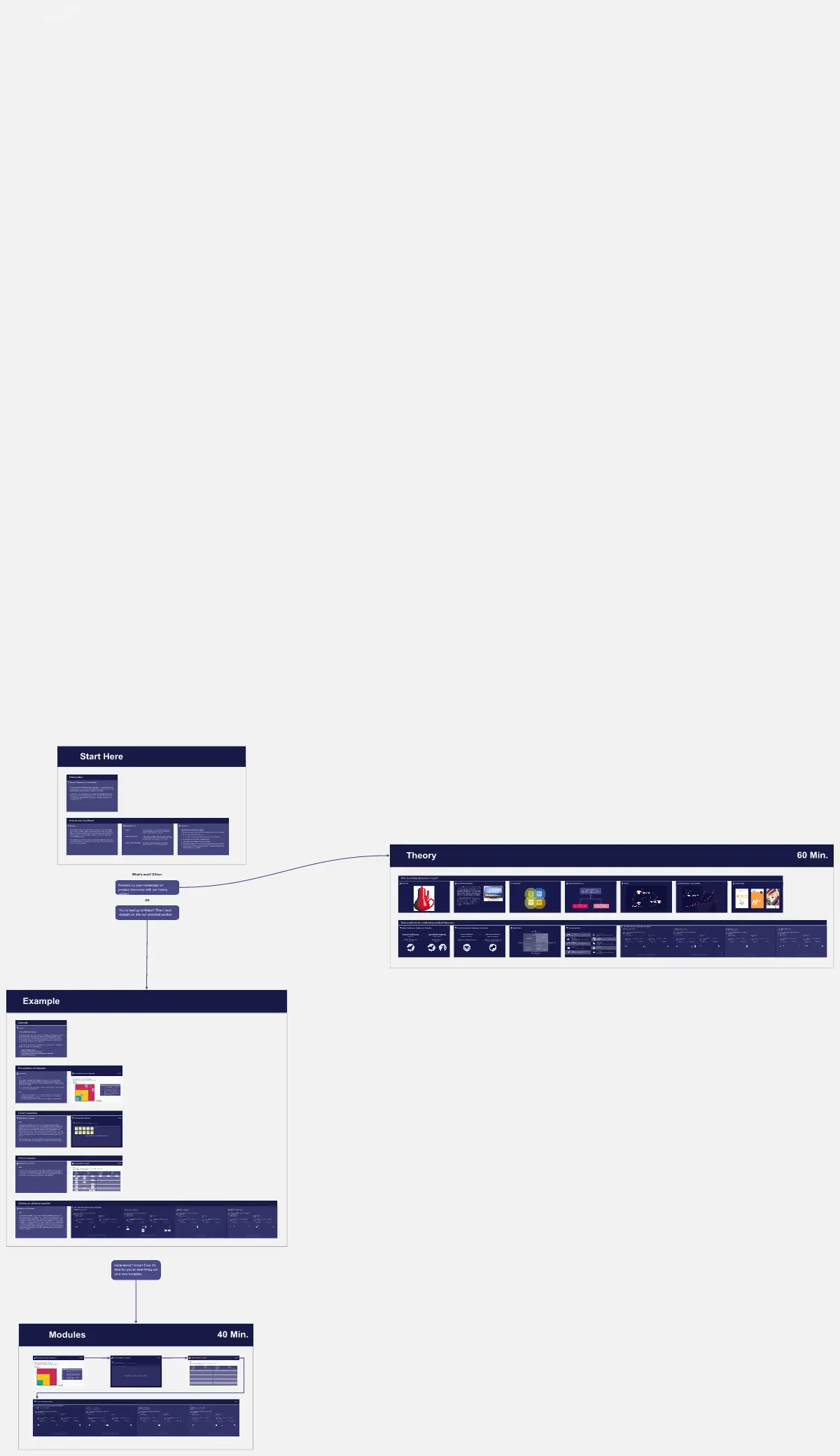
What is a Product Discovery Template?
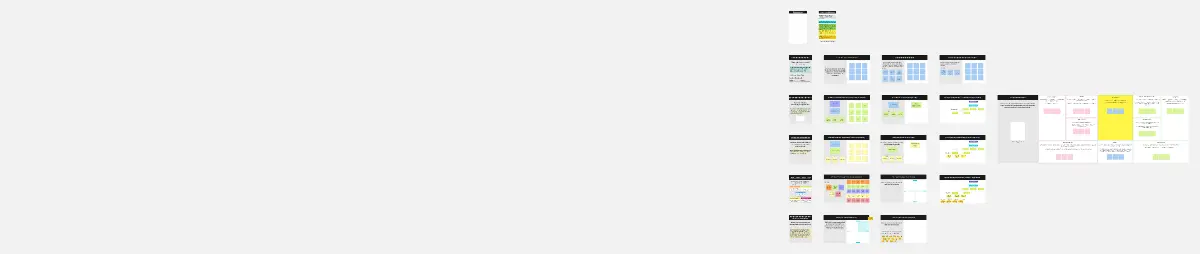
A product discovery template is a structured workspace used by Product Managers, Designers, and Engineers to explore user needs and test business opportunities.Unlike "Delivery" (which is about building the solution), "Discovery" is about identifying the Desirability (do they want it?), Viability (should we build it?), and Feasibility (can we build it?). It provides a visual trail of evidence that moves a team from "I think" to "We know."
The "Evidence" Audit: 3 Ways to Stop "Guess-Driven" Development
Discovery is a de-risking engine. Before moving a discovery item into your development backlog, apply these three expert "health checks":
1. The "Problem vs. Solution" Audit
The Audit: Is your discovery board filled with "Feature Ideas" instead of "Customer Pains"? The Fix: Audit your Entry Point. Professional discovery starts with a Problem Statement, not a solution.Use your template to document the "Current Struggle" of the user. If you can’t describe the pain without mentioning your app, you haven't discovered a problem yet; you’ve just invented a requirement.
2. The "Leap of Faith" Assumption Mapping
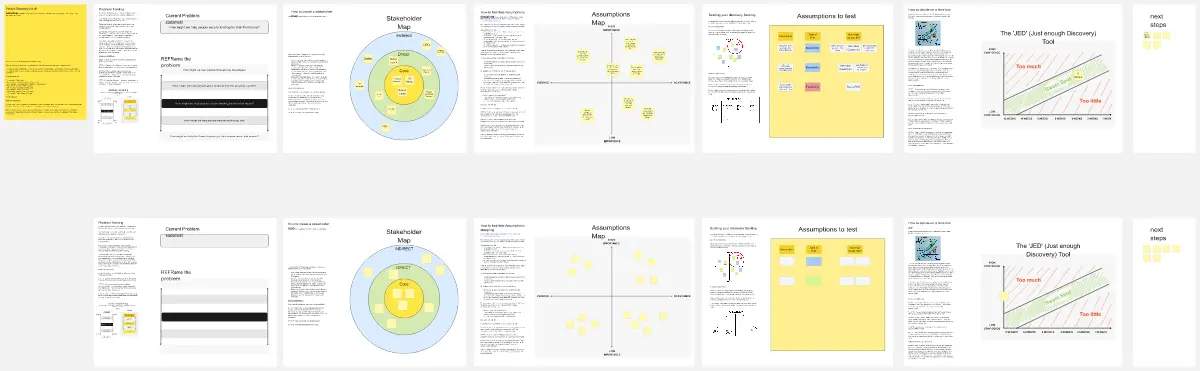
The Audit: Are you testing the easy things while ignoring the "Killer Risks"? The Fix: Audit for Critical Assumptions. Use a 2x2 matrix to plot assumptions based on Importance vs. Certainty. The items in the "High Importance / Low Certainty" quadrant are your "Leaps of Faith." Your discovery template should force you to run experiments on these high-risk items first. If these fail, the whole project should be killed or pivoted immediately.
3. The "Signal-to-Noise" Test
The Audit: Are you over-valuing what users say and ignoring what they do? The Fix: Audit your Experiment Types. User interviews are great for empathy, but "Prototype Testing" or "Concierge Tests" provide behavioral data. A high-level discovery template should track the Strength of Evidence. A customer saying "I'd buy that" is a weak signal; a customer pre-paying or giving you their data is a strong signal.
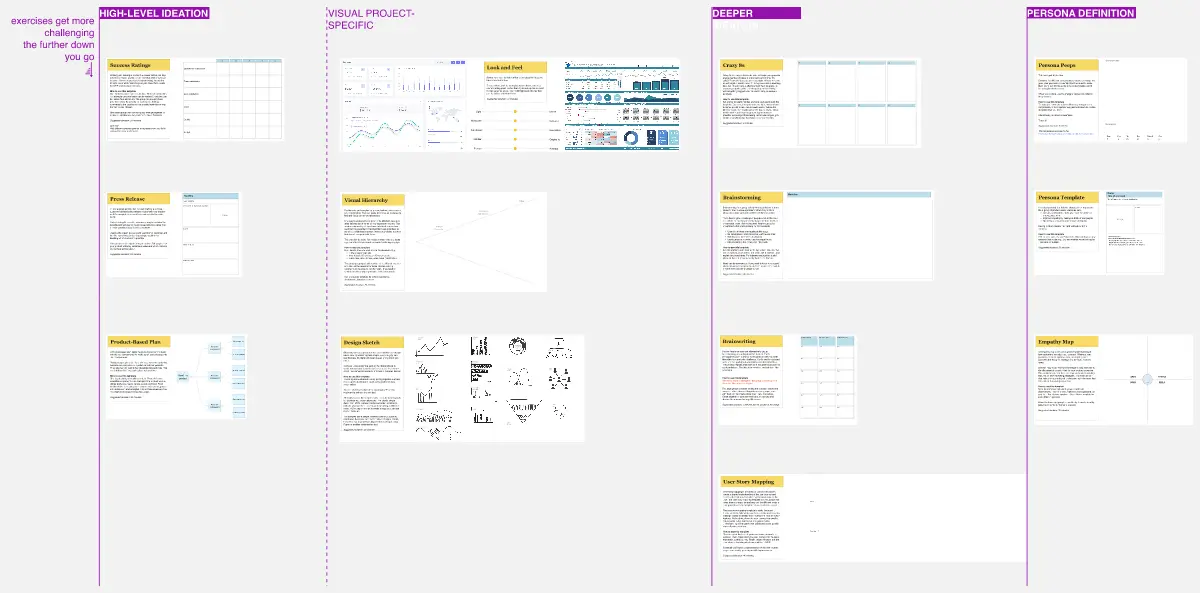
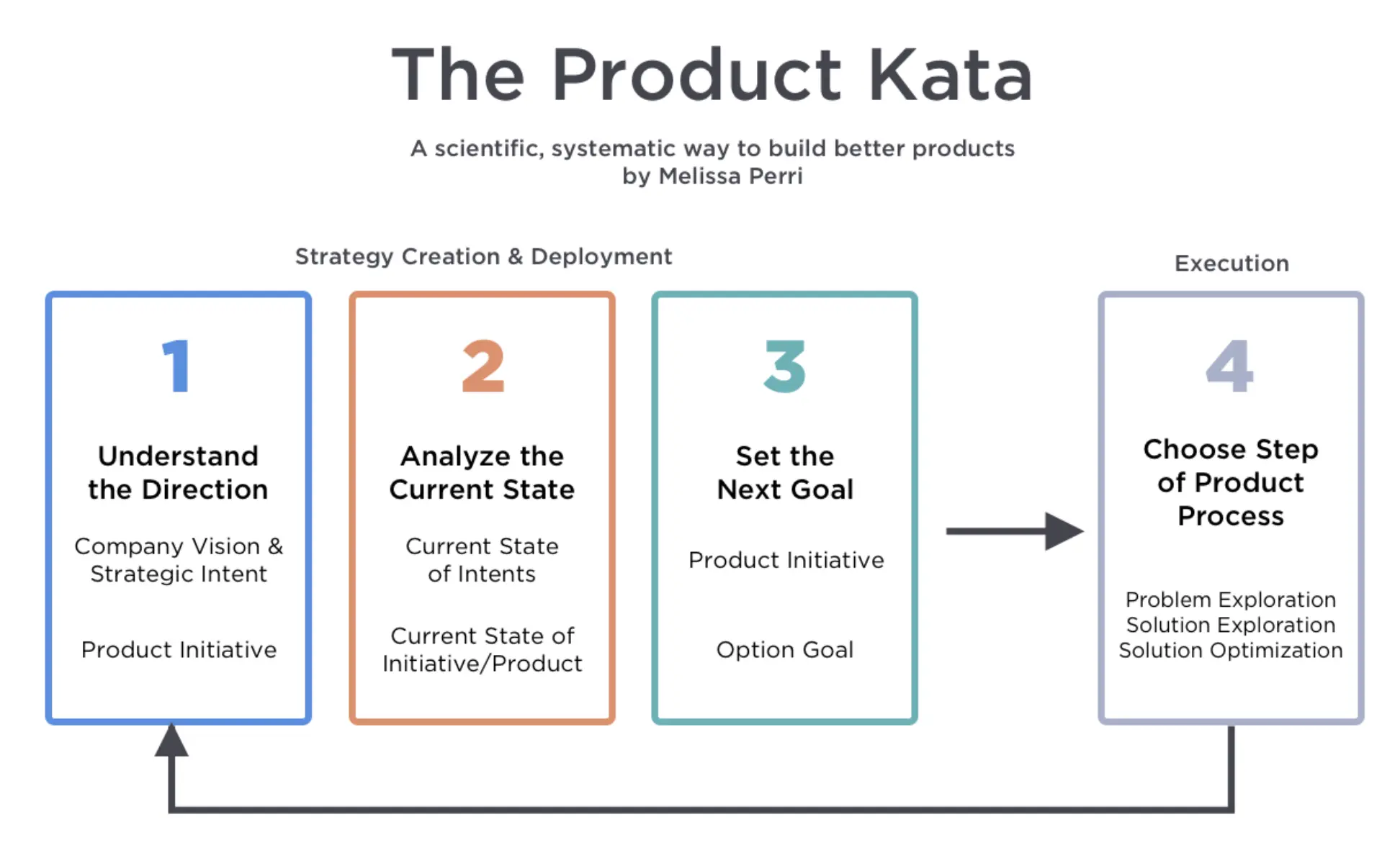
Strategic Frameworks: Which Discovery Template Do You Need?
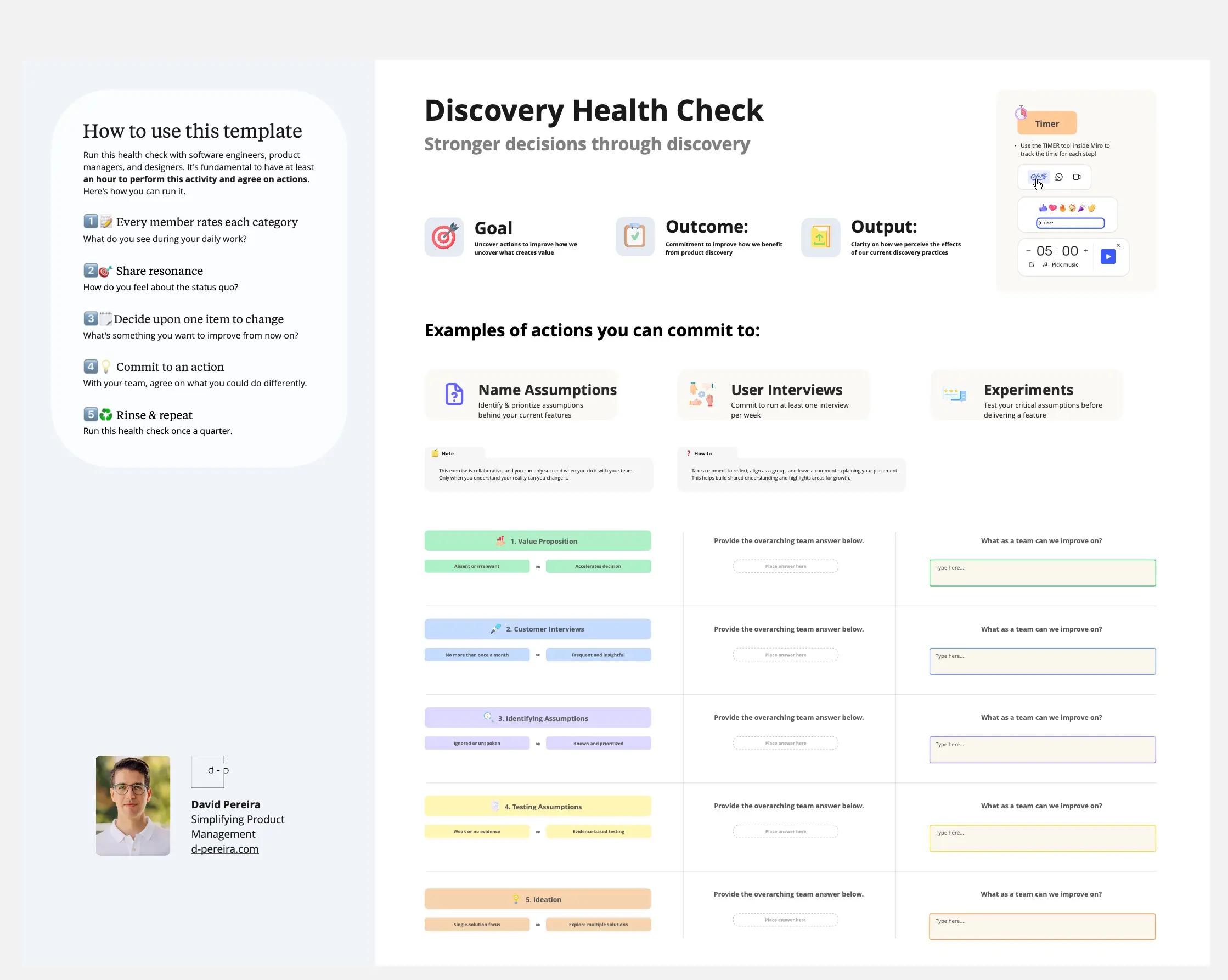
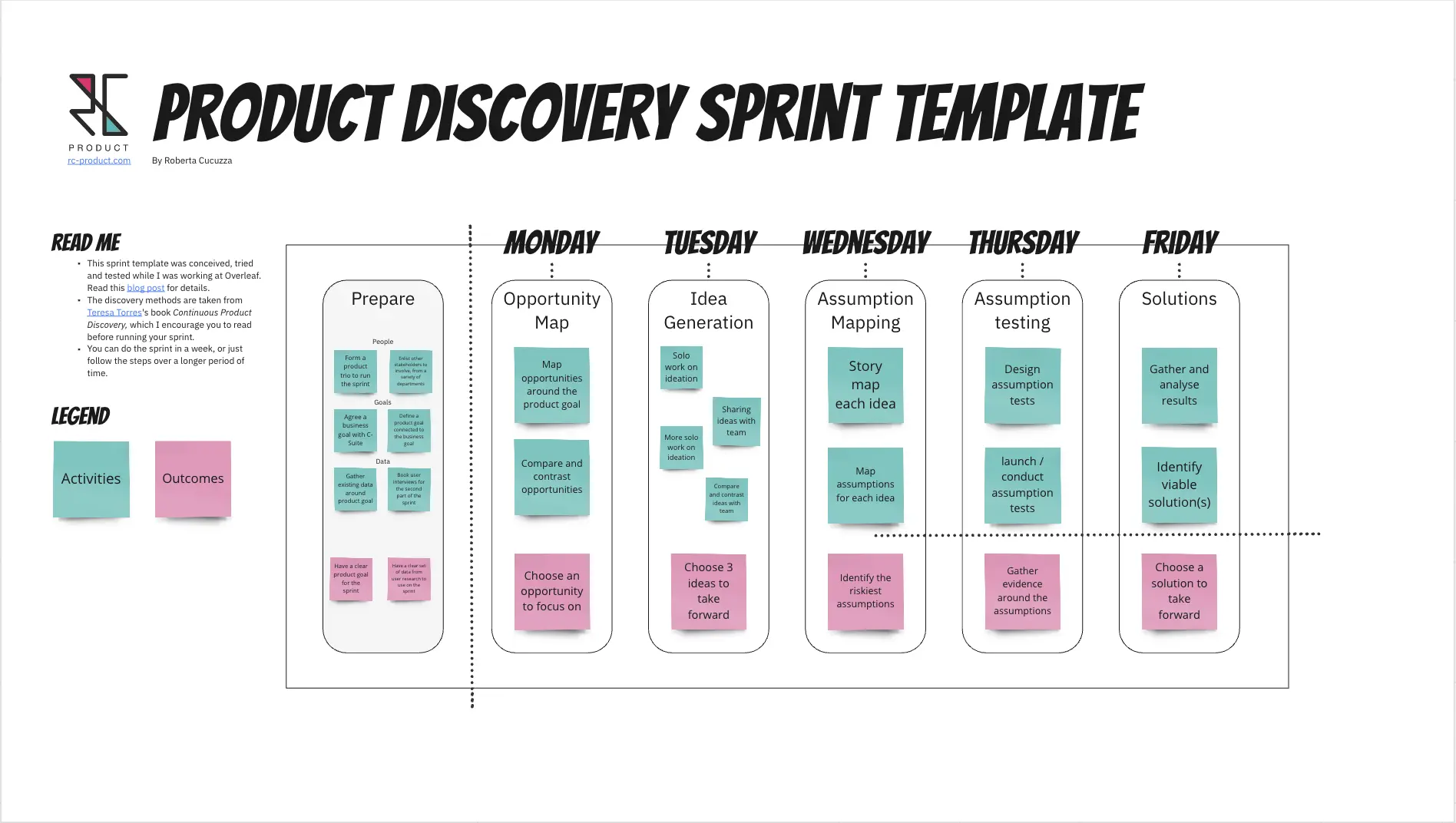
Select the Miro template that matches your team’s current level of uncertainty:
Key Components of a Product Discovery Template
A high-performance Miro board for Product Discovery requires these five core elements:
The Research Repository: A space to pull in user quotes, screenshots, and support tickets.
The Hypothesis Tracker: A table formatted as: "We believe [User] has [Problem], and if we [Solution], we will see [Metric Change]."
The Experiment Log: A record of what you tested, the results (pass/fail), and the "Key Learning."
The Prototype Sandbox: A low-fidelity area to sketch wireframes or embed Figma links for quick feedback.
The "Decision Log": A chronological record of why certain ideas were killed or promoted to the roadmap.