What is the Go-To-Market Strategy Whiteboard?
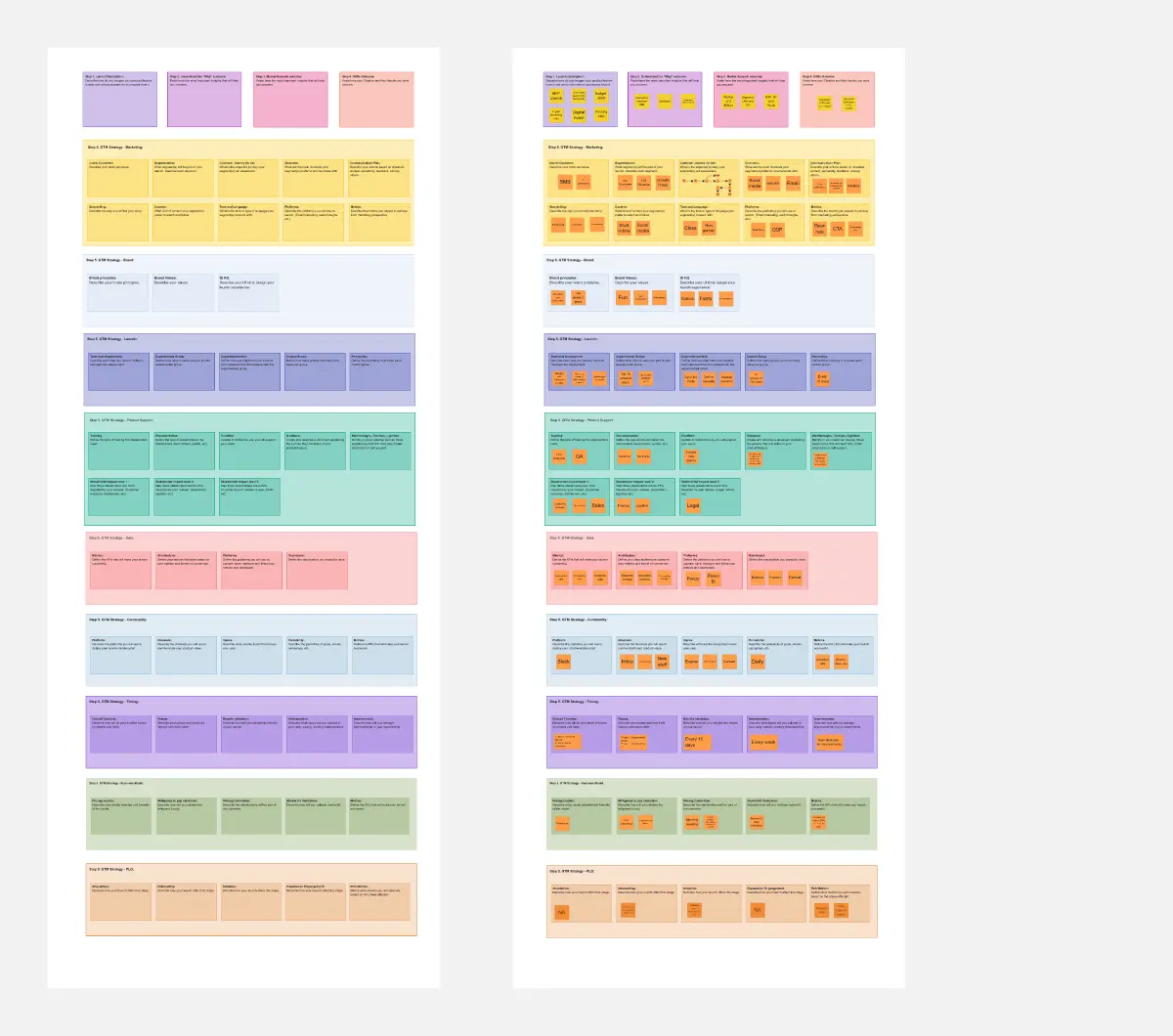
The Go-To-Market Strategy Whiteboard is a structured, end-to-end visual workspace designed to help you build, test, and refine your go-to-market (GTM) strategy.
It guides you through the full journey—from understanding your market and defining your ideal customer, to crafting your value proposition, selecting channels, planning your launch, and continuously improving based on real-world feedback.
Rather than jumping straight into tactics, this whiteboard helps you connect strategy with execution, ensuring that every action is grounded in clear customer insight and aligned decisions.
How to use it effectively
This template works best as a living, collaborative workspace—not a one-off document.
Start by working through the sections in order:
Begin with market understanding to ground your thinking in real needs
Narrow your focus through customer segmentation
Clarise your value proposition and positioning
Validate before scaling through testing and feedback loops
Then move into channels, messaging, and launch planning
A few practical tips:
Use sticky notes to capture ideas quickly and visually
Involve different perspectives (product, marketing, sales, leadership)
Keep answers concise—clarity beats complexity
Revisit and update regularly as you learn from the market
Most importantly: treat this as an iterative tool. Strong GTM strategies evolve—they are not fixed.
Who is it for?
This template is designed for anyone responsible for bringing a product, service, or initiative to market, including:
Start-ups and founders preparing for launch or early growth
SMEs introducing new offers or entering new markets
Innovation and product teams testing new ideas or features
Consultants and facilitators running strategy workshops
Marketing and sales teams aligning around a shared GTM approach
It is especially valuable for teams that:
Need alignment across functions
Want to move from ideas to structured execution
Are looking to avoid common GTM mistakes (like unclear positioning or scaling too early)