1 likes
139 uses
This Cross-Functional Network Org Chart is a high-level strategic framework designed for Heads of Product, Operations, and Business Leaders to visualize how modern, agile organizations operate beyond traditional hierarchies. In fast-paced digital environments, this visual network ensures that specialized departments remain interconnected, transparent, and aligned with the central company strategy.
Traditional "top-down" silos often lead to communication bottlenecks and misaligned priorities. This template mitigates those risks by providing:
Breaking the Silo Effect: It visualizes the "connective tissue" between departments like Data, Engineering, and Marketing, ensuring that no team operates in a vacuum.
Fluid Dependency Mapping: By using networked arrows instead of rigid vertical lines, teams can identify where Product decisions impact Commercial GTM (Go-To-Market) or where Data insights must trigger Engineering pivots.
Strategic Centralization: It places "Company Goals" at the heart of the operation, ensuring every specialized "pod" understands its direct reporting line to the overarching vision.
Enhanced Operational Agility: It creates a unified "operating system" for the company, making it easier for leadership to reallocate resources between the "Product Delivery Trio" and "Growth" streams as market demands shift.
To maximize organizational velocity and alignment, structure your network using this professional 3-cluster decomposition:
Cluster 1: The Strategic Hub (The Core Engine)
Vision Alignment: Define the central node where OKRs and long-term strategy reside.
Direct Reporting: Establish the primary connection from the Strategy Hub to the execution leads (Product Management).
Cluster 2: The Product Delivery Trio (The Build Stream)
Interdisciplinary Synergy: Grouping Product, Design, and Engineering into a single functional unit to ensure feasibility, usability, and value are addressed simultaneously.
Execution Ownership: Designating the "Trio" as the primary engine for turning strategic goals into tangible digital assets.
Cluster 3: Growth, Scale & Intelligence (The Support & GTM Stream)
GTM Integration: Connecting Marketing and Commercial to ensure the product built by the Trio has a clear path to revenue and user acquisition.
Intelligence Loops: Utilizing Data and Program Management as horizontal layers that feed insights back into the Product Trio and Marketing pods to optimize performance.
Why is the Product Manager connected to so many departments?
In a network model, the Product Manager acts as the "Integrator." They translate customer needs (Data/Marketing) into technical requirements (Engineering) and business value (Commercial), making them the natural pivot point for the network.
How does this differ from a Matrix Organization?
While a Matrix focuses on dual reporting lines (Functional vs. Project), a Network Org Chart focuses on value flow. It emphasizes how information and deliverables move between teams rather than just who signs a performance review.
Can I add more departments like HR or Finance to this template?
Yes. For a complete corporate view, HR and Finance are typically added as "Support Enablers" on the periphery, with dotted lines connecting to the Strategic Hub to represent their role in resource and budget allocation.

Rodolfo Pernambuco
Group Product Manager @ BEES | AB-InBev
Developing digital products since 2019. A creative product leader who loves teamwork and collaboration.
Cross Functional Flowchart
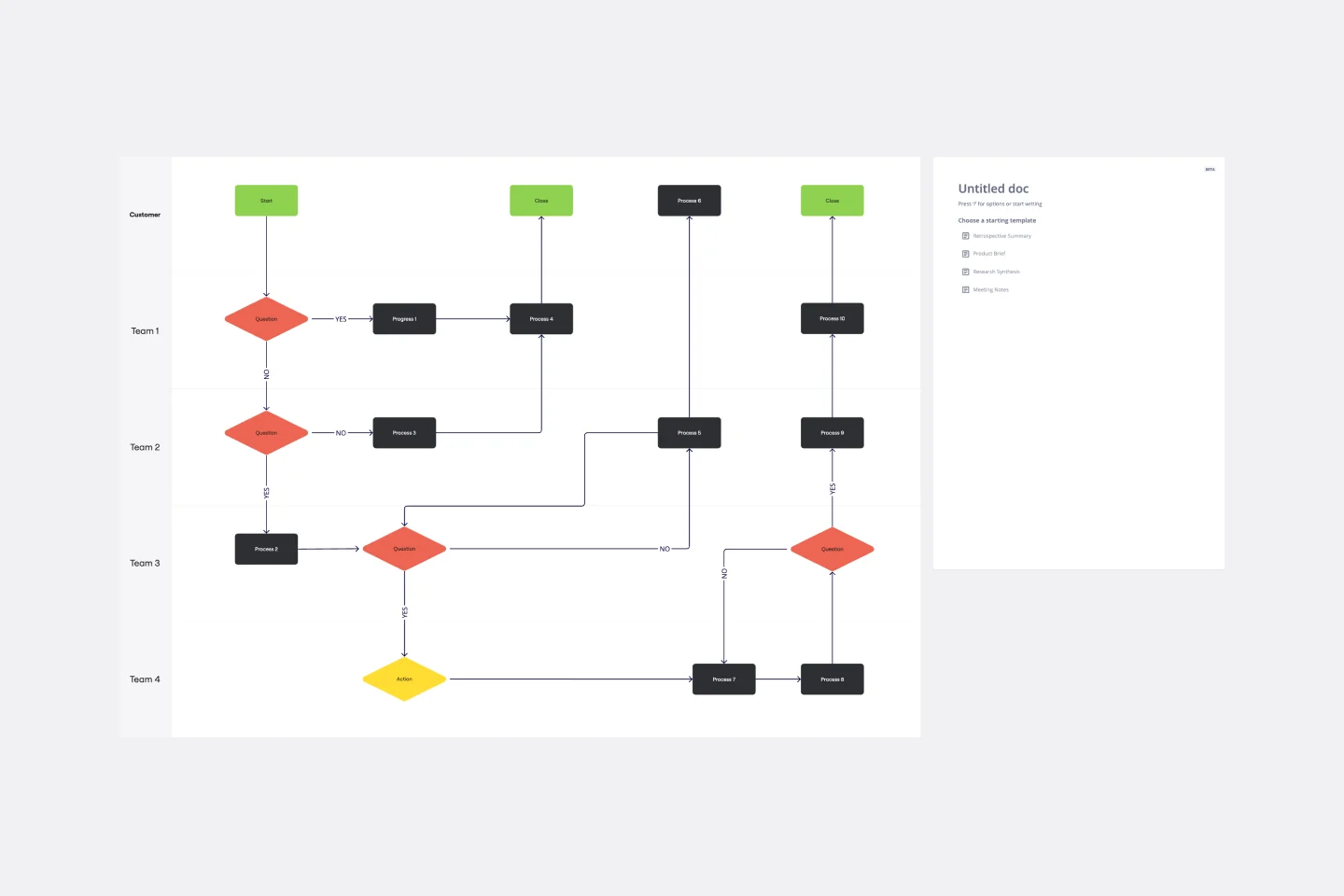
Have a quick look at everyone on a project and see exactly what they’ll contribute. That’s the clarity and transparency a cross-functional flowchart will give you. These are also called “swim lane” flowcharts because each person (each customer, client, or representative from a specific function) is assigned a lane—a clear line—that will help you visualize their roles at each stage of the project. This template will empower you to streamline processes, reduce inefficiencies, and make meaningful cross-functional relationships.
Cross Functional Flowchart
Have a quick look at everyone on a project and see exactly what they’ll contribute. That’s the clarity and transparency a cross-functional flowchart will give you. These are also called “swim lane” flowcharts because each person (each customer, client, or representative from a specific function) is assigned a lane—a clear line—that will help you visualize their roles at each stage of the project. This template will empower you to streamline processes, reduce inefficiencies, and make meaningful cross-functional relationships.