111 likes
340 uses
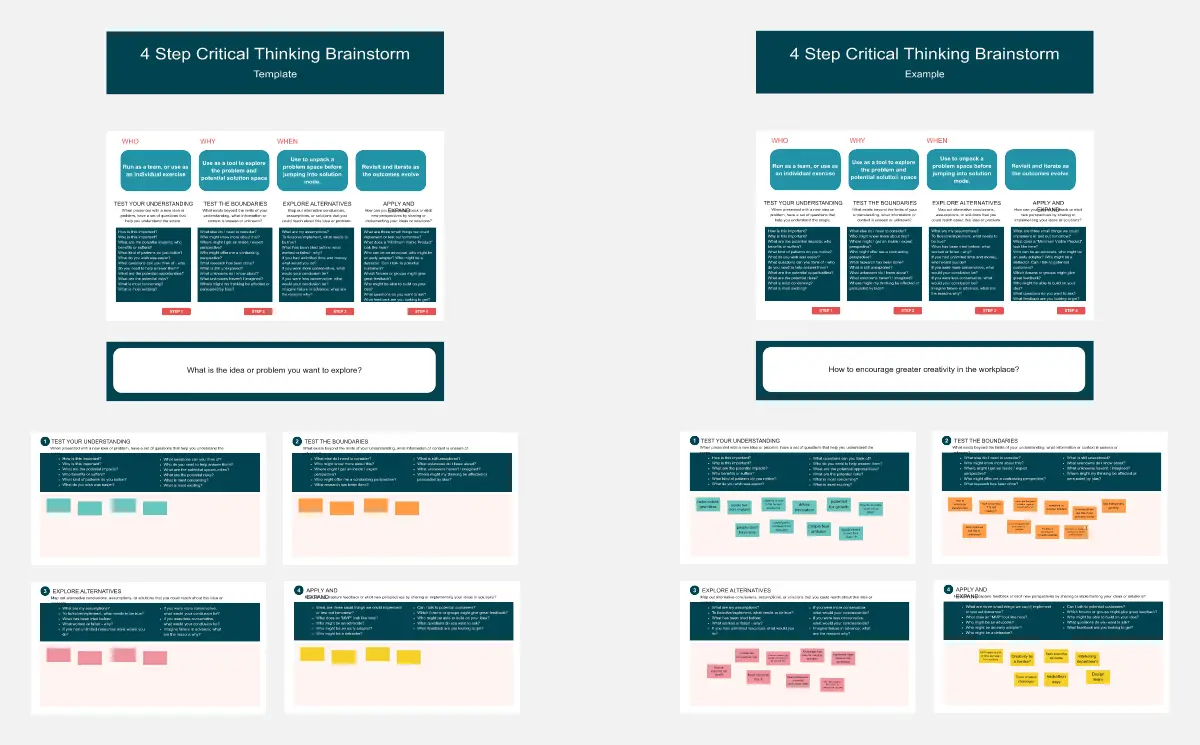
Challenge assumptions and sharpen your strategy. The Critical Thinking template provides a structured framework to deconstruct arguments, identify biases, and reach more logical, data-driven conclusions.
3 templates
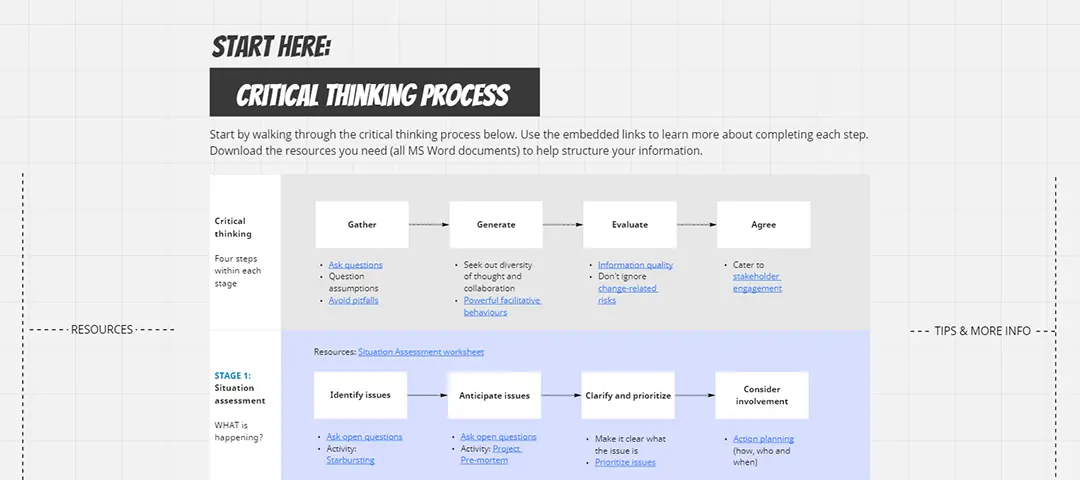
A critical thinking template is a structured mental framework used to decompose complex problems. It prevents "Reflexive Thinking" (jumping to conclusions) by forcing a "Reflective Process." Whether you are auditing a business strategy or evaluating a technical architecture, these templates provide a standardized way to pressure-test an idea before investing resources into it.
Critical thinking is the "immune system" of a high-performing team. Before approving a major project on Miro, apply these three expert "health checks":
1. The "First Principles" Deconstruction
The Audit: Is your plan based on "Industry Best Practices" or "What we did last time"? The Fix: Audit for Foundational Logic. Break the problem down to its basic truths. If you remove all "assumptions" about how things are currently done, what remains? A professional template forces you to separate Facts (verified data) from Assumptions (educated guesses). If your strategy relies on an assumption, that is your biggest point of failure.
2. The "Second-Order Effects" Test
The Audit: Are you only solving for the "Immediate Result"? The Fix: Audit for Cascade Logic. Ask: "And then what?" Every solution creates new problems. For example, automating customer support might save money (First-Order), but it might decrease user trust and increase churn (Second-Order). A high-level template maps out the "Ripple Effects" of a decision across 6–12 months.
3. The "Devil’s Advocate" (Red Teaming) Guardrail
The Audit: Is everyone in the room nodding in agreement? The Fix: Audit for Intellectual Friction. Use a "Red Team" template. Assign one person the role of the "Informer"—their only job is to find every reason why the plan will fail. This legitimizes dissent and ensures that risks are identified in a safe, structured environment rather than ignored until they become disasters.
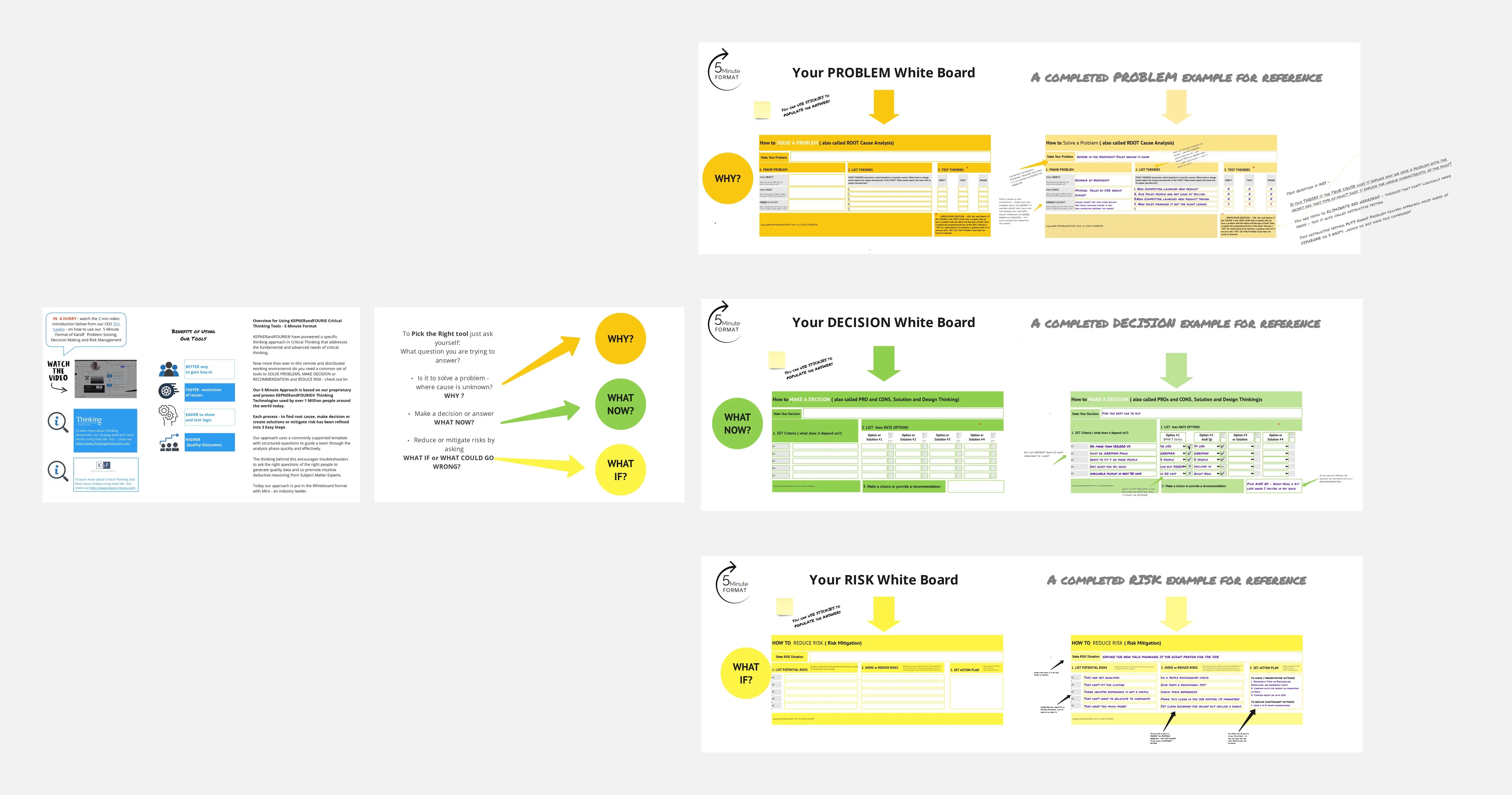
Select the framework that matches the "Risk Level" of your decision:
The Socratic Questioning Canvas:
Best For: Deep dives into a specific claim or belief. It uses six types of questions to probe the "Root Truth."
The 5 Whys (Root Cause Analysis):
Best For: Debugging a failure or a recurring organizational bottleneck.
The Six Thinking Hats (De Bono):
Best For: Group workshops to ensure a 360-degree view. (White = Data, Red = Emotion, Black = Risks, Yellow = Benefits, Green = Creativity, Blue = Process).
The Cynefin Framework:
Best For: Determining the type of problem you are facing (Simple, Complicated, Complex, or Chaotic) before choosing a solution.
A high-performance Thinking Board requires these five core elements:
The Core Thesis: A clear statement of the idea or decision being audited.
Evidence Strength Meter: A scale to rank the quality of data (e.g., "Anecdotal" vs. "Statistical" vs. "Peer-Reviewed").
The "Blind Spot" List: A dedicated space to list what the team doesn't know.
Cognitive Bias Checklist: A reminder to look for Sunk Cost Fallacy, Confirmation Bias, and Availability Heuristic.
The Counter-Argument: A section where the team must write the strongest possible case against their own idea.
Confirmation Bias: Only looking for data that proves you are right.
The Fix: Explicitly search for Disconfirming Evidence. Your template should have a box titled "What would have to be true for this idea to be wrong?"
The Sunk Cost Trap: Continuing a project just because you've already spent $100k on it.
The Fix: Use Zero-Based Thinking. Ask: "If we weren't already doing this, would we start it today with what we know now?" If the answer is no, stop.