138 likes
573 uses
Build products that create lasting habits. Grounded in behavioral science, the Behavior Design template helps you map out triggers, ability, and motivation to ensure your users take the actions that lead to success.
3 templates
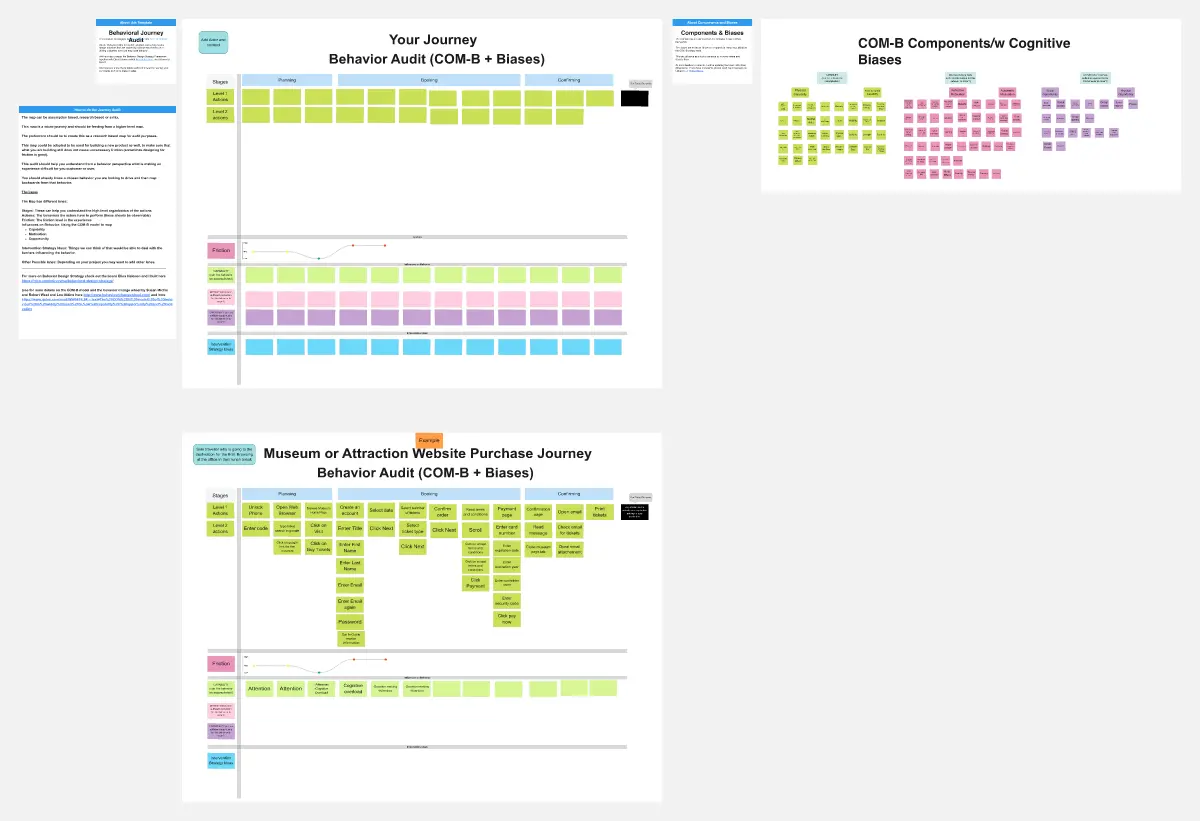
Behavior Design Mapping (Journey)
This map is a behavior micro-journey and should be feeding from a higher level map.
A behavior design template is a cognitive map used to design products that align with how the human brain actually works. It moves a designer from "hoping" for a click to "engineering" it. Based on models like BJ Fogg or Nir Eyal, these templates identify the exact intersection of Motivation, Ability, and Prompt needed to start and sustain a specific behavior.
Behavior design is about removing friction, not "tricking" the user. Before finalizing your board on Miro or Figma, apply these three expert "health checks":
1. The "Motivation vs. Ability" Audit
The Audit: Are you trying to increase "Motivation" (e.g., using big "Buy Now" banners) when the real problem is "Ability" (e.g., the form is too hard to fill out)? The Fix: Audit for Simplification. According to the Fogg Model, if a behavior is hard, no amount of motivation will make it happen. A professional template prioritizes Reducing Steps. If you want a user to start a habit, make the first step so easy they can't say no.
2. The "Variable Reward" Test
The Audit: Is your product's feedback loop predictable and boring? The Fix: Audit for Dopamine Loops. Use the Hook Model in your template. To keep users coming back, the "Reward" for an action (like checking a notification) should be variable. It shouldn't be the same every time. This creates "Cravings" and turns a one-time action into a long-term habit.
3. The "Ethical Dark Pattern" Guardrail
The Audit: Are you using "Scarcity" or "Fear" to force a decision that the user might regret later? The Fix: Audit for User Intent. A high-level behavior design template includes an Ethics Check. Ask: "Does this behavior benefit the user, or only the business?" Designing for long-term trust is more profitable than designing for a short-term "Dark Pattern" conversion.
Select the framework that matches the "Phase" of your user's journey:
The Fogg Behavior Model (B=MAP):
Best For: Analyzing why a specific action (like sign-up) is failing.
The Goal: To ensure the user has the Motivation, the Ability, and a clear Prompt at the same moment.
The Hook Canvas (Nir Eyal):
Best For: Retention and product "stickiness."
The Goal: To map the cycle of Trigger → Action → Variable Reward → Investment.
The BJ Fogg "Tiny Habits" Template:
Best For: Onboarding and education apps.
The Format:"After I [Existing Anchor Habit], I will [New Tiny Behavior]." * The EAST Framework (Easy, Attractive, Social, Timely):
Best For: Public policy or high-level service design.
The Goal: To make a desired behavior the "Path of Least Resistance."
A high-performance Behavior Board requires these five core elements:
The Target Behavior: A specific, measurable action (e.g., "Upload 1 photo," not "Be active").
Internal Triggers: The emotional state of the user right before the action (e.g., Boredom, Loneliness, Fear).
External Triggers: The notification, email, or button that prompts the action.
Friction Audit: A list of every cognitive or physical hurdle (e.g., "Too many fields," "Requires a password").
The Investment Phase: What the user "puts into" the product to make it harder to leave (e.g., Data, Reputation, Skill).