I built an AI custom sidekick assistant that helps me design workshops. Here's how you can too.
Last published
I'm Kusuma, a learning facilitator, community builder, and AI workshop program designer. Most of my work comes down to one thing: helping startups, educators, and innovators turn messy ideas into systems that actually move people forward. I run co-creation sessions, alignment sessions, and design workshops for a living, and I do almost all of it in Miro.
Collaborative AI Workflows
Join thousands of teams using Miro to build the right thing, faster.
So when I joined the July 2026 Miro AI Builders Cohort, I already knew what I wanted to walk away with: a living workflow other facilitators and founders could pick up and use the same week, not another pretty board nobody touches again.
The problem every facilitator knows too well
Nobody tells you this about facilitation: designing the workshop is almost always harder than running it.
Every new engagement starts the same way. A blank canvas, a client brief with half the context missing, and a clock ticking toward the session date. You're pulling from old templates, rewriting agendas at midnight, and trying to remember whether the exercise that worked for a 12-person product team will hold up with 40 people from three departments who've never met.
If you've ever rebuilt the same workshop structure for the fifth time because you couldn't find your last version, you know exactly what I mean. That's just busywork, and it's exactly the kind of thing workshop automation should have solved years ago.
What if your methodology could think alongside you
Now imagine a different starting point. You open a blank Miro board and describe the workshop you need: the goal, the group size, the time you have. Something that actually knows your way of working hands you a structured first draft, a canvas built around your framework, your phases, your language, instead of a generic list of icebreakers.
That's the gap I wanted to close, and writing more templates wasn't going to do it. So I taught an AI partner how I actually think about workshop design, so it could build with me instead of me building alone every single time.
Meet the AI Facilitator
This is where Miro's Sidekicks came in. A Sidekick is a custom AI partner you configure inside Miro AI, and it's one of the more underrated AI tools for workshop facilitators right now because you're not prompting a generic assistant from scratch every time. You're talking to something you trained.
I built mine and named it AI Facilitator. Here's how.
Step 1: teach it your skills, not just your topic
Before I touched the sidekick settings, I built the skill itself, and I built it modular on purpose. The core of it is anchored in Miro's own ways-of-working framework: discover, define, deliver. Everything else lives in eight sub-skill modules a facilitator can mix and match depending on the session: ways of working, AI workflows, template and AI Flow selection, workshop structure, prototyping and Miro MCP, marketplace integrations, Engage and ice-breaking, and Aura design.
A planning session might only need two of those modules. A full product development sprint might need five. The point was never to dump all eight into every workshop. It's to pick the ones that actually fit, the same way I'd pick activities for a real session.
Step 2: turn that thinking into a skills document
Once the structure held up, I generated it into a markdown file, one module per file, plus a shared prompt library that spans every scenario a facilitator actually runs into: planning the agenda, opening the room, seeding a stalled brainstorm, converging on a decision, closing with owners and dates, following up after the session, even recovering when a vote ties or the timebox blows. I used AI to draft the sub-skills under each module, then went through every section by hand to check it against how I actually facilitate. This step matters more than it sounds. An AI-generated skills doc that's 90% right is still wrong in the 10% that will show up in front of a client, so I didn't skip the review.
Step 3: configure the sidekick itself
With the markdown file ready, I set up the sidekick with a name, a clear description, and specific instructions about what it should and shouldn't do. I added a few conversation starters so anyone using it knows how to begin, and I tested different underlying models to see which gave me the most consistent, workshop-ready output.
Then I attached the markdown file as the sidekick's knowledge source. That's the piece that turns a generic AI chat into something that actually reasons like a facilitator who knows my framework.
Watching it actually work
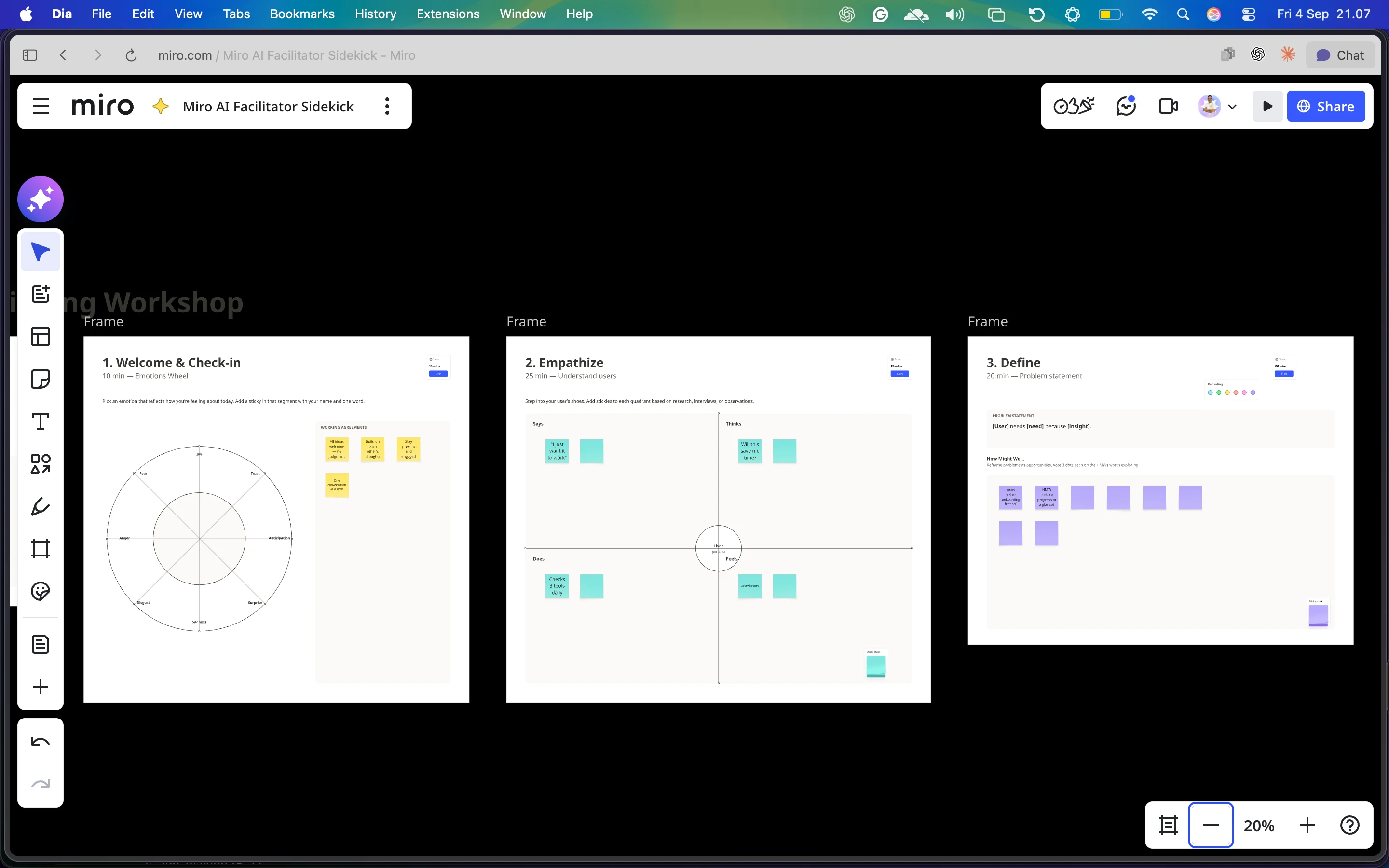
The real test came when I opened AI Facilitator and asked for a 90-minute design thinking workshop for six designers. That's all I gave it.
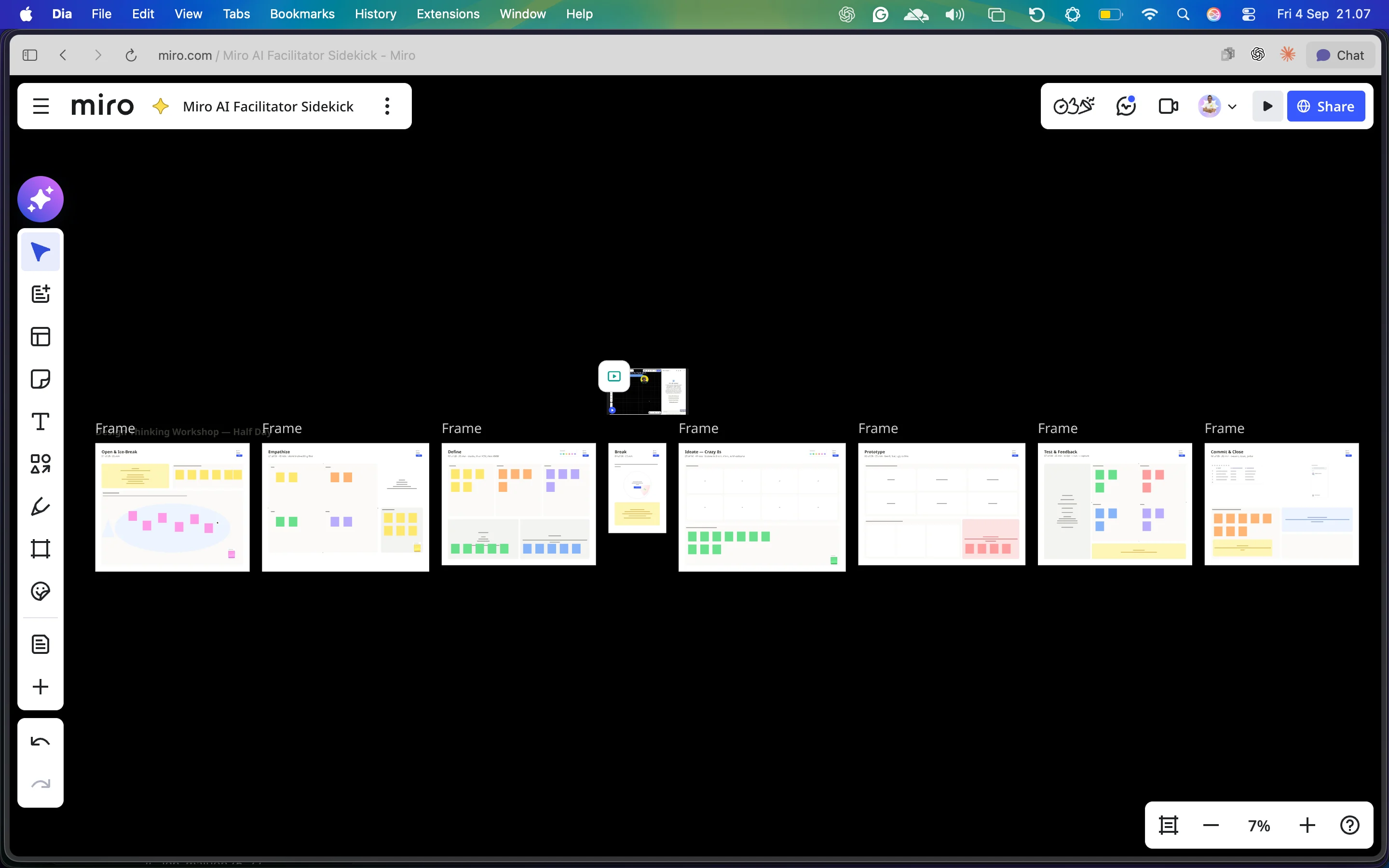
What came back wasn't a wall of text. It was a full canvas moving through Empathize, Define, Ideate, Prototype, and Test, each stage timed, each with its own instructions, and templates already dropped into place: an empathy map paired with a persona card, a point-of-view statement builder, a Crazy Eights grid, and a feedback-capture board split into what worked, what didn't, open questions, and new ideas. It closed with an action table and a "date for a date" for the follow-up review, straight out of Miro's own ways-of-working playbook. It looked like something I would have spent an hour building by hand, generated in the time it took me to describe it.
That's the part I want other facilitators to sit with. You still bring the judgment. What changes is that you stop starting from zero every time you open a new board.
Why this matters beyond my own workflow
I didn't build this just to save myself time, although it does that. I built it because facilitation is one of the few fields where "best practice" mostly lives in someone's head, not in a system anyone else can use. If you're a consultant running workshops across five clients a month, or a founder trying to run your own alignment sessions without hiring a facilitator, AI facilitation tools like this close a real gap. They're some of the best AI tools for consultants I've come across precisely because they don't try to replace your expertise. They just stop you from rebuilding it from scratch every time.
If you're a facilitator, a founder, or anyone who runs workshops and has ever thought "I wish I didn't have to start this from a blank board again," this is exactly the kind of workshop facilitation tool worth building for yourself.
Try it yourself
You don't need a full AI Builders Cohort to do this. Start small: pick one workshop type you run often, write down the phases you always follow, and turn that into a skills document. Build a Sidekick around it in Miro AI. Ask it for one workshop. See what it hands back.
I'd love to see what other facilitators build once they stop treating every workshop as a blank page.
Read more
Join our 100M+ users today


