Create and connect ideas with a concept map maker
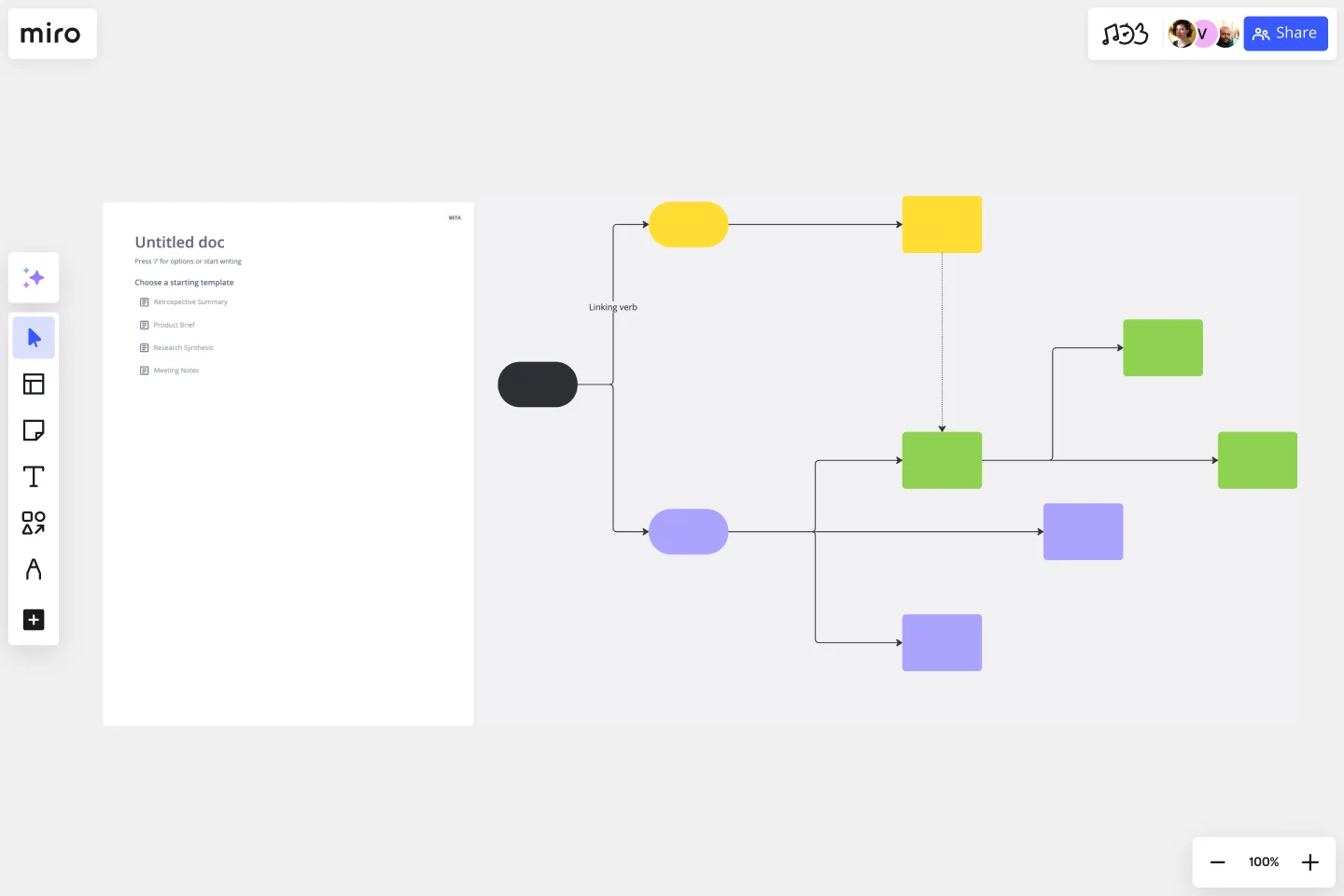


















Draw connections in seconds
When ideas live in long documents or slide decks, it's hard to see how they connect. A concept map fixes that: draw a line between two concepts, and the pattern shows up right away. That concept map then becomes the prompt for an AI Sidekick, which turns it into a brief, requirements, or a research summary, no perfect wording required. Save what worked as a Flow, so the next team can run the same steps instead of starting from a blank canvas.
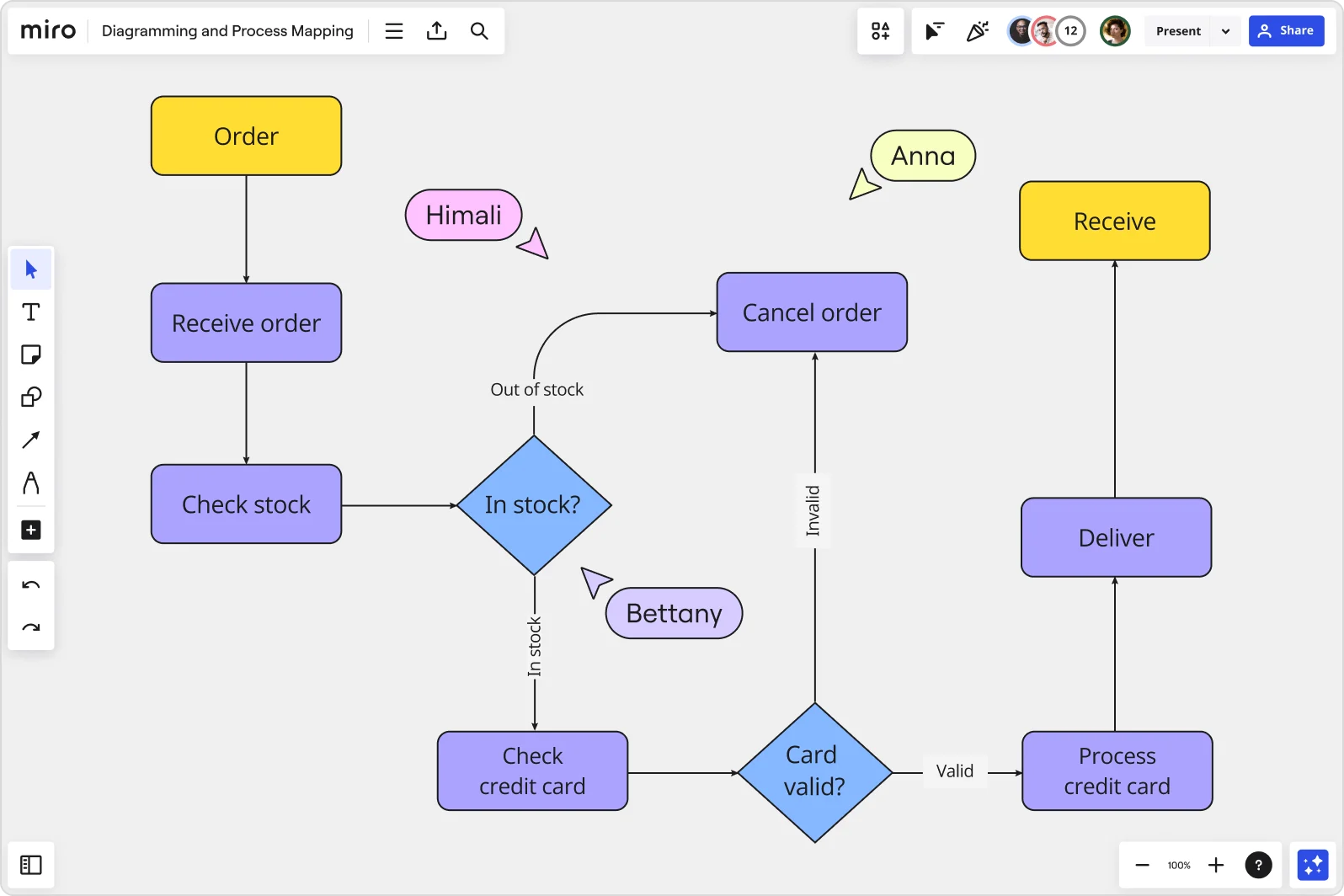
Not just any concept map creator
Complex ideas get muddled fast when teams work across different files and formats. Miro's concept map maker keeps every idea in one place: start from a concept map template or build from scratch, then customize with colors, icons, and images so connections are easy to spot. Your map stays on one shared board, so everyone works from the same version instead of duplicate files.
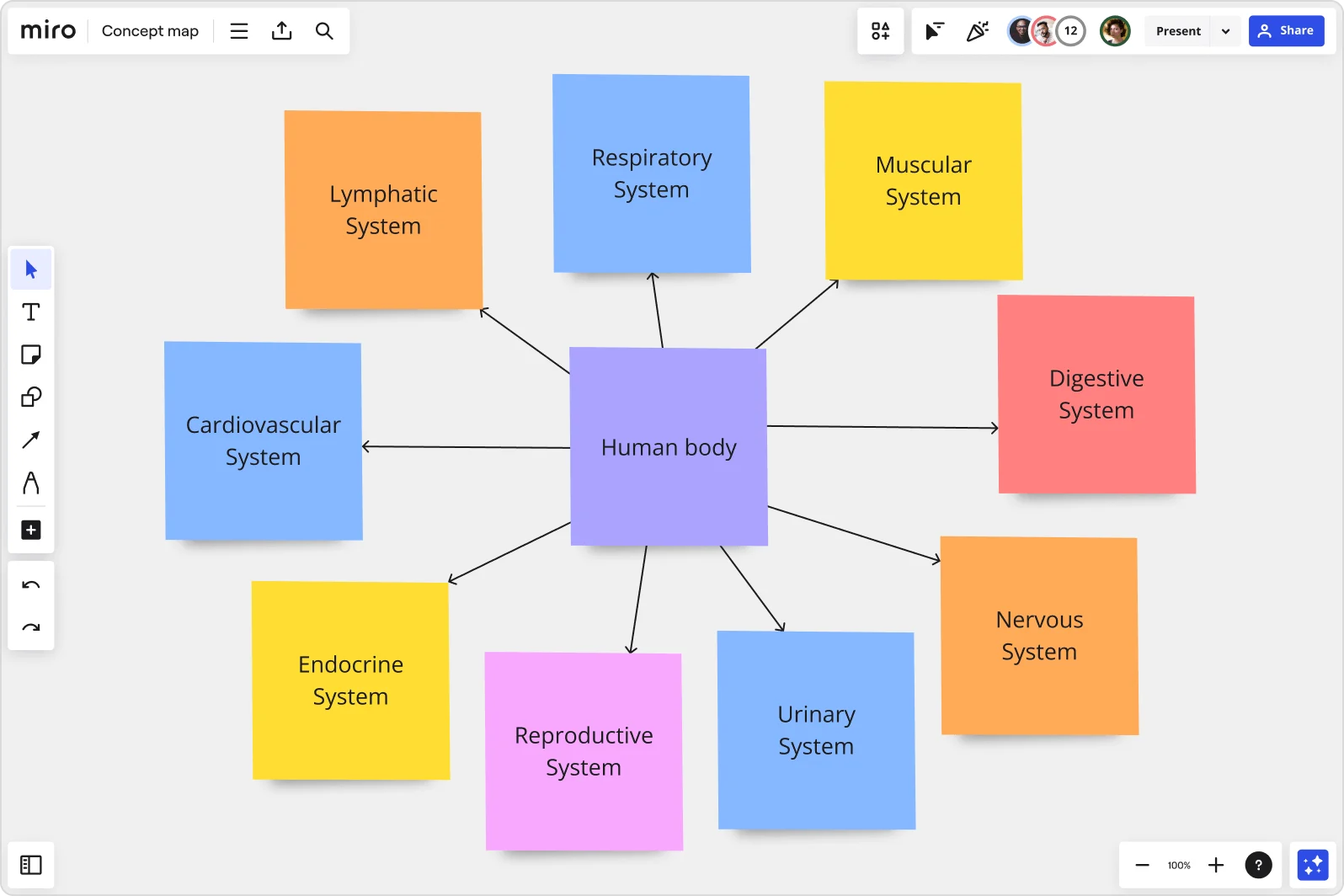
Collaborate on the spot
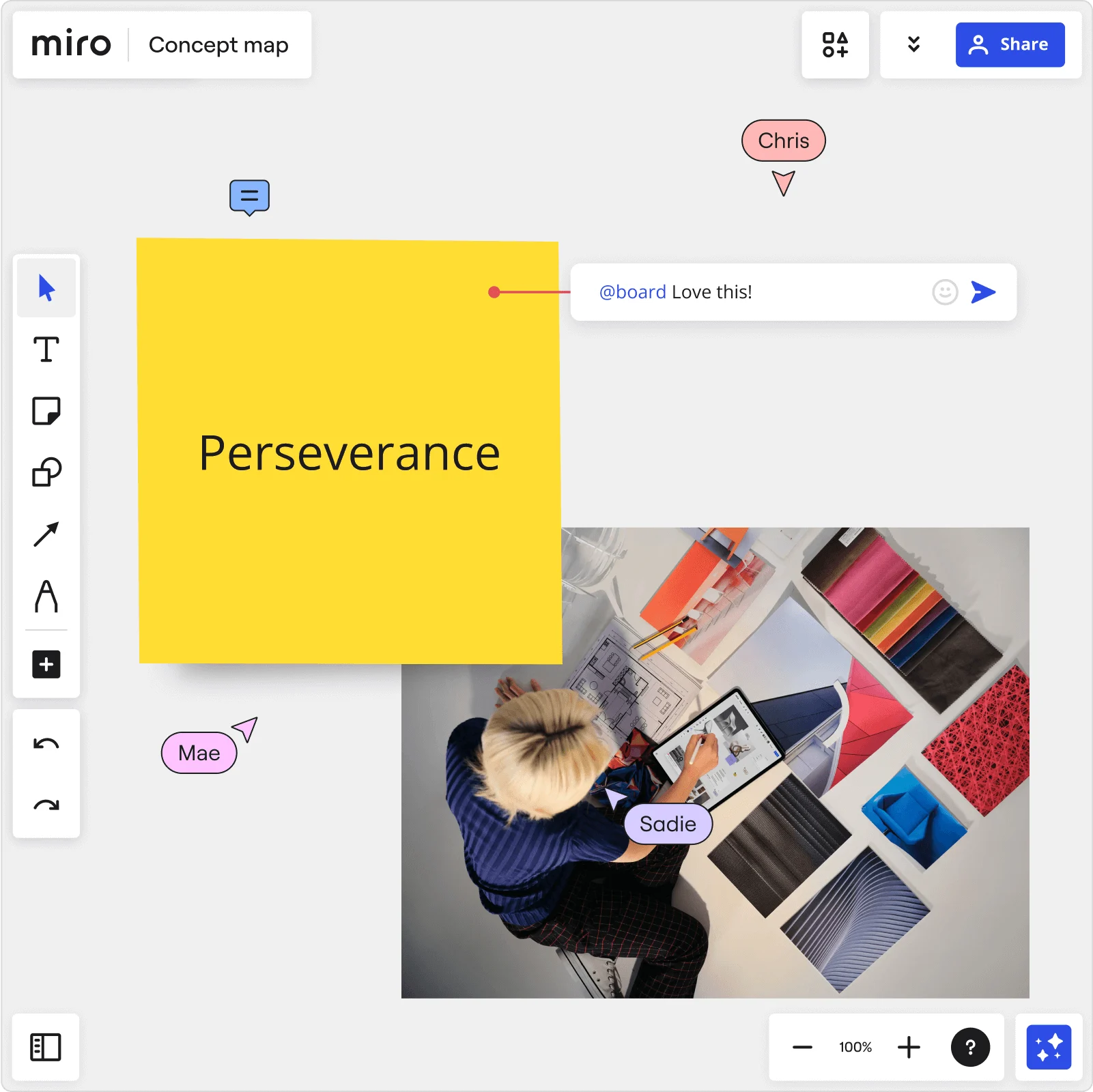
Feedback often gets stuck in email threads or static files. On Miro's concept map maker, teammates comment with @-mentions, jump into video or chat, or vote on ideas, all in the open and without switching tools. Whether you're working in a virtual workshop or async across time zones, input stays organized so decisions happen faster.
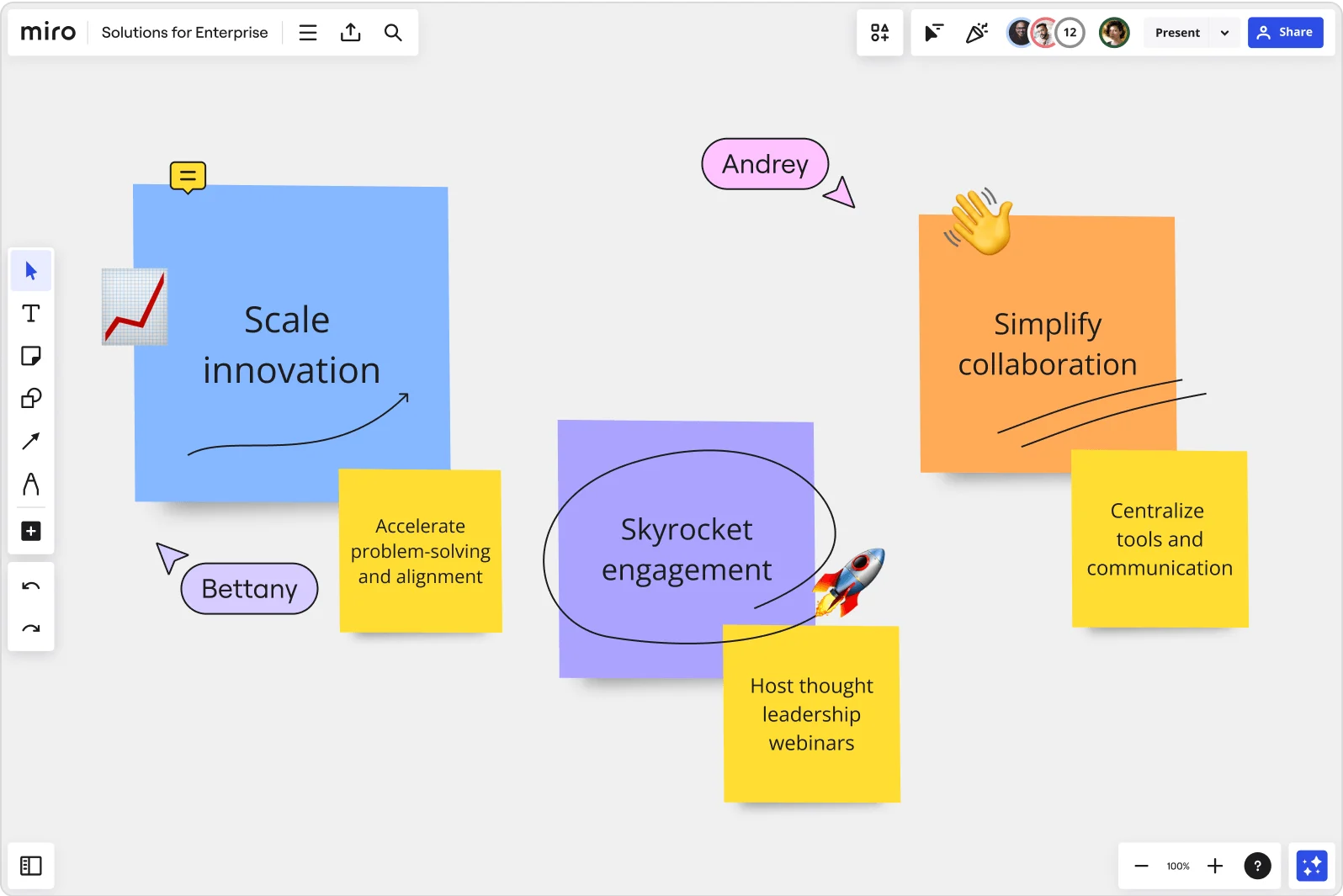
Why teams choose Miro to create concept maps
Presentation mode
Hop into presentation mode to explain your ideas to the team with the help of a visual concept map. Instead of piecing together slides, you can present directly from your board so everyone can see how concepts connect. Whether you're briefing your team, walking through a project plan, or pitching leadership, presentation mode keeps the focus on your map while simplifying complex ideas for any audience.
Creative formatting options
Bring your concept maps to life with visual cues that make information easier and faster to absorb. Use colorful online sticky notes and emojis to build maps that are easy to read and interact with. These design options help teams quickly scan for priorities, spot connections, and retain information, whether you're mapping a product plan, a research project, or a business strategy.
Integrations with your favorite tools
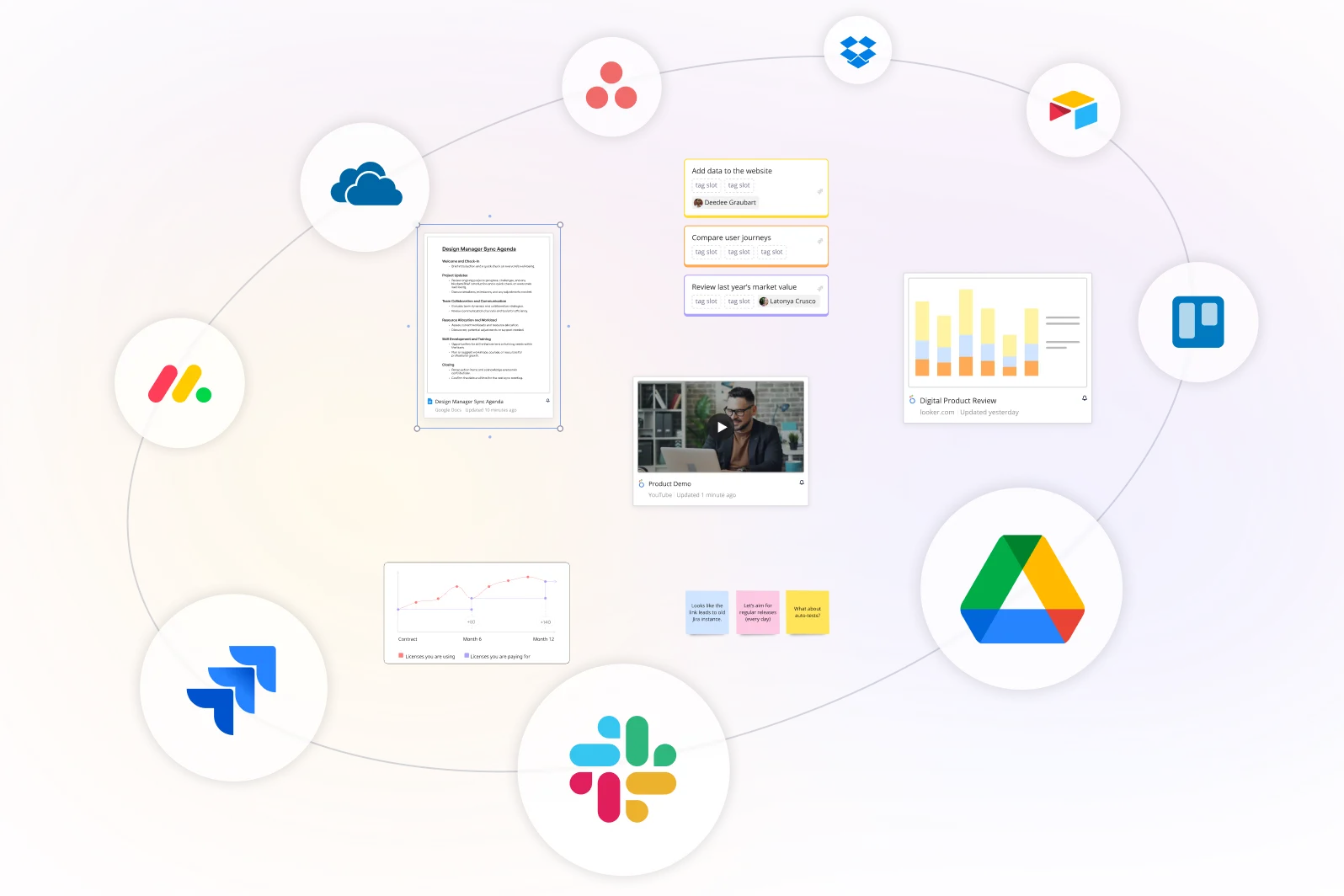
Concept mapping often pulls in data and context from many different places, and switching between apps can slow teams down. With Miro, you can connect your concept map directly to integrated tools like Jira, InVision, Sketch, Google Drive, and more. Drop supporting documents, design files, or task updates right onto your map so the bigger picture is always in one place.
Infinite canvas
Complex ideas don’t always fit into a single page. With our infinite canvas, your concept map can grow with your ideas. Build on your concept map by adding supporting content such as sticky notes, images, documents, and more — without running out of space. This flexibility helps teams capture both high-level overviews and deep context in one visual flow, making it easier to spot connections and keep everything organized in a single shared view.
Move as one team
Map ideas together in real time. Add thoughts, highlight connections, and build on each other's input without waiting for back-and-forth updates. Whether you're planning a project or coordinating across departments, everyone works from the same shared map.
AI features
Work smarter with AI-powered tools built into Miro. Use AI to generate ideas, suggest connections, or structure information so you can focus on refining your concepts. AI handles the structure, so you can focus on refining the ideas. Whether you’re brainstorming, organizing research, or simplifying complex topics, AI features give your concept map a smarter starting point for collaboration.
Integrated with your favorite tools
Related pages

Related templates

What is a concept map?
How to create a concept map with Miro
Branch out with related concepts, questions, or supporting details using shapes, sticky notes, or text boxes, and don’t be afraid to add multiple levels of detail. Let AI suggest connections, generate ideas, or organize information as you go, so you're refining rather than starting from zero. This step helps you see the bigger picture and uncover connections you may not have considered at first
Link related concepts with lines or arrows to show how they interact. You can establish a hierarchy by placing more important ideas closer to the centre and secondary points around them. Ask a Sidekick to review your concept map and flag any missing links or unclear relationships before you share it. See our guide on how to make a concept map.
Discover Miro's capabilities

The world's most innovative companies are collaborating in Miro, everyday
“With Miro, we went from project brief to in-market launch in 10 months. That usually takes 3 years at PepsiCo.”
Caroline de Diego
Senior Manager, Global Design & Marketing Innovation at PepsiCo


“Bringing everyone together to plan in Miro means the most impactful initiatives will happen at the right time.”
Lucy Starling
Product Operations Lead at Asos


“The team onboarded in 10 minutes to use Miro for workshops. Getting our organization to adopt this product was a no-brainer.”
Konrad Grzegory
Agile Transformation Lead at CD PROJEKT RED


“Miro templates helped us go from scratch to a full-fledged plan where we mapped activities, ideas, and dependencies.”
Marc Zukerman
Senior Director of Project Management at Hearst


“Miro allows all our teams to align themselves with certain tools and models: they work independently and create products that really meet our customers' needs.”
Luke Pittar
Sustainability Innovation & Design Coach at The Warehouse Group


“To be truly innovative, everyone needs to have a voice, and everyone needs to be able to iterate on each other’s ideas. Miro has made that possible for us.”
Brian Chiccotelli
Learning Experience Designer at HP


Users love Miro for end-to-end innovation. We're the G2 leader in visual collaboration platforms and are rated in the top 50 enterprise tools. Miro helps large companies get meaningful work done.
Top 50 Products for Enterprise
G2 reviews


One plan, every way to map ideas
Starter
Business
Enterprise
Custom price — from 30 members
Concept map maker FAQs
What is the best tool for making a concept map?
Look for a tool that's easy to use, lets you customize the look of your concept map, and makes it simple to bring others in. Miro checks all three, plus AI that can generate a starting concept map from a prompt and suggest connections as you build. All on a canvas your team can edit together in real time or async.
Is Miro's concept map maker free?
Yes, it's free to start, no credit card needed. You get 3 editable boards and enough AI credits to try generating a concept map with Miro AI. Upgrade if your team needs more of either.
What should I use a concept map for?
A concept map is a tool to visualize complex ideas and concepts and uncover links between them. Use Miro’s free concept map generator to connect the missing dots of your strategy, plan, and project. With a concept map, organizing complex information in hierarchical order is made easy, bringing clarity and insights about which direction a project or strategy should have.
How does Miro make complex concept maps easier to manage?
Large concept maps get cluttered fast. Miro's infinite canvas and quick connection tools keep things organized as you zoom in on details or step back for the big picture. When things get messy, Miro AI can cluster related ideas and tidy up the structure for you.
Are there resources or templates for concept maps?
Yes. The Miroverse is our community-driven library with thousands of templates created by other Miro users and industry experts. You’ll find ready-to-use concept map templates for brainstorming, project planning, research, and more, so you don’t have to start from scratch. You can also join the conversation in our Forum for tips, tricks, and free events focused on visual collaboration.
What's the learning curve for teams new to Miro AI in concept mapping?
The learning curve is minimal. Miro AI is built to be intuitive, and the canvas itself acts as the prompt. Simply select elements on your concept map like nodes, sticky notes, or connections, and tell the AI what to do. Since it builds on familiar actions like grouping, connecting, or summarizing ideas, most teams start seeing value in their first session.
Can I tailor Miro to fit my team’s concept mapping workflow?
Absolutely. You can create custom concept map templates for recurring processes or use Miro Blueprints, pre-configured Spaces with boards, templates, and tools tailored for your workflow. AI shortcuts also let you automate tasks like clustering ideas, summarizing nodes, or turning a brainstorm into a structured map, so your team can focus on refining concepts rather than repetitive work.
How secure is my team’s concept map data in Miro?
We built Miro with enterprise-grade security: data encryption, compliance certifications, and access controls that meet enterprise standards. Board owners decide exactly who can view, comment on, or edit each mind map, and admin controls give your team visibility into who has access across every board.
What is the difference between a concept map and a mind map?
A mind map radiates outward from a single central idea in a hierarchical tree structure. It's ideal for brainstorming, note-taking, and organizing information top-down. A concept map can have multiple focal points, bidirectional connections, and cross-links between any nodes, making it better suited for mapping complex systems, academic knowledge, or the relationships between many interrelated ideas. Concept maps also use labelled connecting lines to make relationships explicit, which mind maps typically don't.
When should you use a concept map instead of a flowchart?
Use a flowchart when you need to document a process or sequence of steps with clear decision points and a defined start and end. Use a concept map when you need to explore or communicate the relationships between ideas in a non-sequential, networked way. For example, when understanding how different parts of a system influence each other, or when synthesizing research findings. Flowcharts answer 'what happens next?'; concept maps answer 'how do these things relate?'