Table of contents
Table of contents
What cross-functional collaboration looks like when AI lets you skip it
Key takeaway: Cross-functional collaboration in the AI era doesn't fail because people won't talk. It fails when AI replaces the group conversation instead of feeding it. Here's what I've learned about getting that balance right, using our recent website navigation rebuild as a case in point.
Collaborative AI Workflows
Join thousands of teams using Miro to build the right thing, faster.
Most leaders will tell you AI has changed how their teams work. Far fewer will tell you it's changed how their teams work together. Forrester's research backs that up: 75% of leaders agree that most AI tools focus on individual productivity rather than team productivity, and almost half feel strongly about it.
That gap is where most of the interesting problems live right now. Everyone's using AI to move faster on their own. Not many people have figured out how to use it to move faster as a group, without losing the debate, the context, and the ownership that actually makes a decision stick.
We’ve recently been rebuilding Miro's website navigation with a cross-functional team spanning product marketing, brand, and our organic and SEO side. It's given me a pretty clear picture of what works when you bring AI into group decisions, and where it falls apart.
What does collaboration mean when a model can generate options for you?
The belief I keep coming back to is simple. Context for decisions has to come from people, not from a model alone.
AI is genuinely useful once a group has already done the work of surfacing what matters, what's non-negotiable, and where the real disagreements and trade-offs are. It's a poor substitute for that work. For deep thinking from a cross-functional group of talented and knowledgeable people.
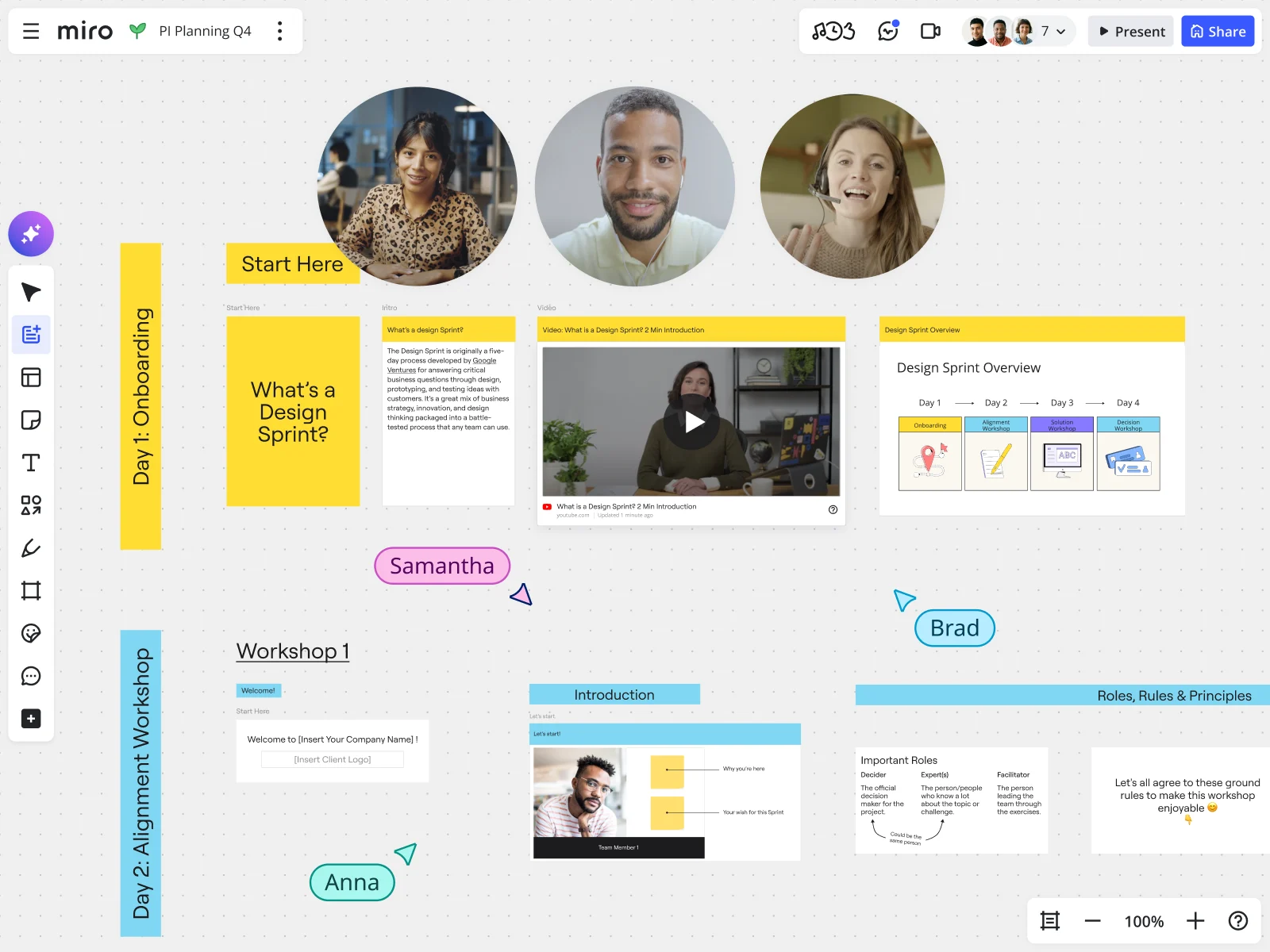
When we started redesigning our navigation, our first step wasn’t to turn to an AI tool. We opened a shared board and captured every page, idea, and constraint from it. We asked what should be included and what shouldn’t. The starting point was based on everyone's real knowledge of our customers, our product, and business goals. There was a lot of nuance to the different perspectives people brought to the table. Which led to much richer context than simply asking an AI tool to generate different permutations based on its own knowledge base (despite it having access to all the same source of information we do).
What worked: getting a distributed team into the same room, digitally
The next step was an old-school exercise done in a new way: card sorting. Historically, this means printing every page onto a card and physically grouping them on a wall. Our team is spread across time zones, so we ran the same exercise on a shared board instead, letting people move cards, group them, comment, and vote whenever their day allowed.
Two things made the digital version better than the version I used to run in person. First, everyone could take part regardless of where they sat in the world. Second, the whole history of the exercise was saved automatically. Nobody had to reconstruct who decided what or when, because it was all right there on the board.
That same shared board is also where the real debate happened. People challenged each other's groupings openly. Someone would leave a comment questioning why a page was included, and I watched people change their own minds mid-conversation once they saw a perspective they hadn't considered. Other times, people held their ground, and that was fine too. The point isn't that everyone has to agree. It's that everyone is bringing a different perspective, and a shared, visible space is what lets that collide and produce something better than any one person walked in with.
What worked: using AI to multiply options, not to replace the discussion
Once the group had done that work, AI pulled its weight. I used it to generate a handful of different navigation groupings and design concepts based on everything the team had already surfaced on the board, essentially exploring several structural approaches at once instead of committing to the first one that seemed reasonable.
It’s the order that matters. Build shared, rich context first. Turn to AI tools second. If you flip it, you're not exploring the group's thinking anymore. You're asking a model to guess at context it was never given or doesn’t know how to weight. This is easier to pull off correctly today than it was a few months ago. With Miro's MCP connectors, you can pull a board's context straight into an AI tool, which is much more efficient than manually recreating it.
What didn't work: showing a high-fidelity prototype at the wrong moment
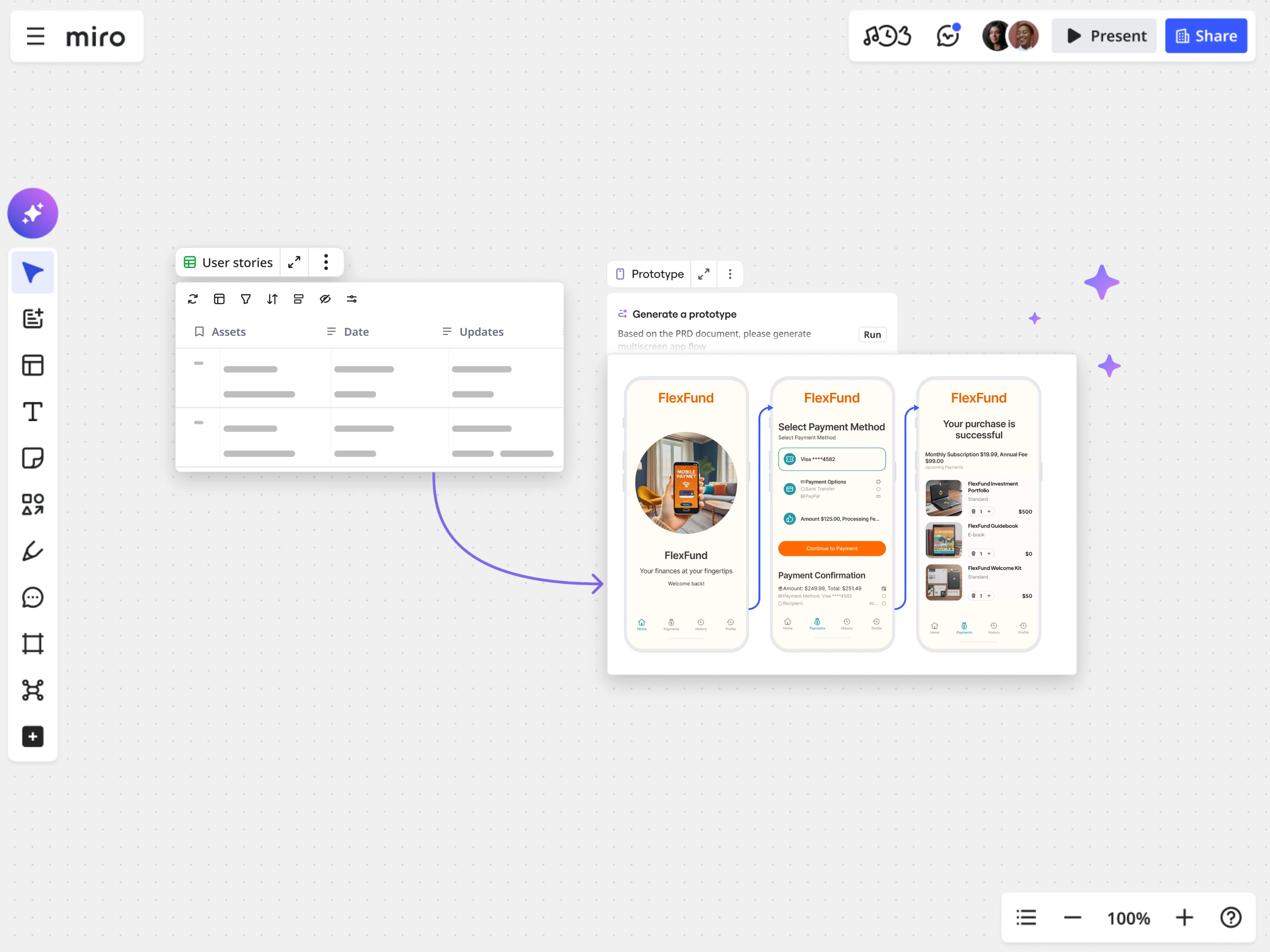
This is where I'd do things differently. Once I had a grouping I liked, I built it out as a fully clickable prototype and shared it with the wider group. It looked polished enough that people's first reaction was that the project was basically done. It wasn't.
Kendra Wilkins, one of our product directors on Miro Prototypes, made a point at a recent all-hands that stuck with me: "It's not just about the artifact existing. It's about what we can do with it and the story that we're telling."
A polished prototype tells a "this is decided" story. A rougher one, even just cards on a board, tells a "let's figure this out together" story. I used the wrong one at the wrong time, and it likely closed off some exploration we could have had with a bigger group of stakeholders, simply because the format signaled we'd already made up our minds.
What didn't work: prototyping before the group has actually talked
The flip side of that mistake is worse: building something, with or without AI, before anyone's had the shared conversation at all.
Picture a landing page that ships with no clear messaging or call to action. Because whoever built it never checked in with the rest of the team on what the page actually needed to do. That's not a hypothetical in an age where anyone working on their own can use AI tools to be the product manager, the designer, the engineer, and the marketer.
It's an easy trap, and AI makes it easier to fall into, because it lets one person go a long way on their own before anyone stops to ask whether they should. Vibe coding and AI prototyping both encourage that. Suddenly it feels like you can fill all of the roles at once. Sometimes it’s true that you can bring real value across those lines. But skip the people who actually hold the latest business context or the deep specialist skills, and you don't move faster. You just find out later (the expensive way) what you missed.
What didn't work: assuming collaboration means nobody makes the final call
Shared ownership, without one single decision-maker, works for a lot of projects. But there's a real exception: when two points of view are both legitimate and they truly contradict each other, somebody needs to make the call so the project can keep moving.
That's not the same as killing the debate. Have the debate. Let people bring their points of view and push back on each other. The way our team did on that card sorting board. But once you've heard each side out and you're still stuck, nominate someone to decide, take the risk, and move forward. You can always revisit it.
This is easier to stomach once you separate decisions into two types. A framework Amazon uses that I think about a lot (thanks to a previous manager of mine). One-way doors and two-way doors.
A one-way door is a decision that's expensive or nearly impossible to reverse. An example from my world would be taking the decision to replatform your entire website. A two-way door is one you can walk back through if it doesn't work, and most navigation and web design decisions fall firmly into that category. Once you know you're dealing with a two-way door, the smart move is to decide faster and take more risks, not fewer. Because reversing course later if something doesn’t work out as expected is easy.
My take: use AI to explain your thinking, not to skip the experts
If someone asked me how to actually bring AI into a team's work, my answer would be this: use it to articulate a point of view quickly, then bring in the people who can do it properly.
I do this constantly now. If I want to propose a new conversion path from the blog, I can mock up roughly how it would behave and share it asynchronously, so a colleague gets the idea immediately without a meeting. It's a fast, clear way to get everyone's context aligned before the real work starts. But it stops there. Every time I've handed something like that to a specialist, whether that's a designer or a developer, they've come back with something noticeably better than what I started with.
That's the whole idea, really. AI can help people and teams explore faster and articulate themselves more clearly. It can't replace the discussion, the disagreement, or the decision that a real cross-functional team has to work through together. The moment you let it try, you're not collaborating faster. You're just skipping the part where collaboration actually happens.
Want to bring your own team into one shared space before your next big decision? Sign up for Miro free and start with a board instead of a blank prompt.
Read more
Join our 100M+ users today


