Table of contents
Table of contents
By signing up, you agree to Miro's Terms of Service and Privacy Policy.
What a weekly pulse survey tells you that a yearly engagement survey can't
Summary
In this article:
- What a pulse survey is, and how it's different from an annual engagement survey
- The exact weekly format Jakob Knutzen runs with his team, plus a video walkthrough
- Why anonymity is non-negotiable for getting an honest signal
- Real examples of catching problems early, straight from Jakob's own team
- How to roll this out with your own team, including his advice on getting the objectives right from day one
TL;DR: A weekly pulse survey is a short, anonymous check-in that tracks how a team is feeling in real time. Unlike an annual engagement survey, which surfaces problems months after they started, a five-minute weekly pulse lets teams catch a dip in morale early enough to actually do something about it.
Collaborative AI Workflows
Join thousands of teams using Miro to build the right thing, faster.
The problem with only asking once a year
By the time an annual engagement survey tells you morale dropped, it's already old news. Whatever caused it happened months ago, and the people affected have had months to either work through it quietly or disengage entirely.
Jakob Knutzen has seen this gap firsthand, from more than one angle. He's now GM for Workshop Solutions at Miro, running the weekly Engage sync for his team. Before joining Miro, he spent five years building Butter, a video conferencing tool built specifically for workshops, alongside cofounders Adam and Chris. Sentiment tracking has been on his mind for a while.
"We didn't really do structured sentiment tracking before we did this weekly pulse," he says. "We would not find out that there were problems, or we would find it out outside of the weeklies, in 1:1s. So it would be way less structured."
A weekly pulse survey closes that gap. It doesn't replace the deeper, less frequent engagement survey, it catches the small stuff before it grows into the kind of problem those longer surveys eventually surface.
What is a pulse survey, and why run one weekly?
A pulse survey is a short, recurring check-in, usually just a question or two, that measures how people are feeling right now. An engagement survey takes a deep, comprehensive read a few times a year. A pulse survey takes a quick temperature check every week.
The value isn't in any single response. It's in the pattern. One low week might mean nothing. Three low weeks in a row is a signal worth acting on, and that pattern is only visible if someone's asking regularly.
Running a weekly team pulse check
🎥 See it in action: Jakob Knutzen walks through his team's actual weekly Engage sync, including the pulse check and how the AI Flow connects sentiment across weeks. [Insert video embed/link here.]
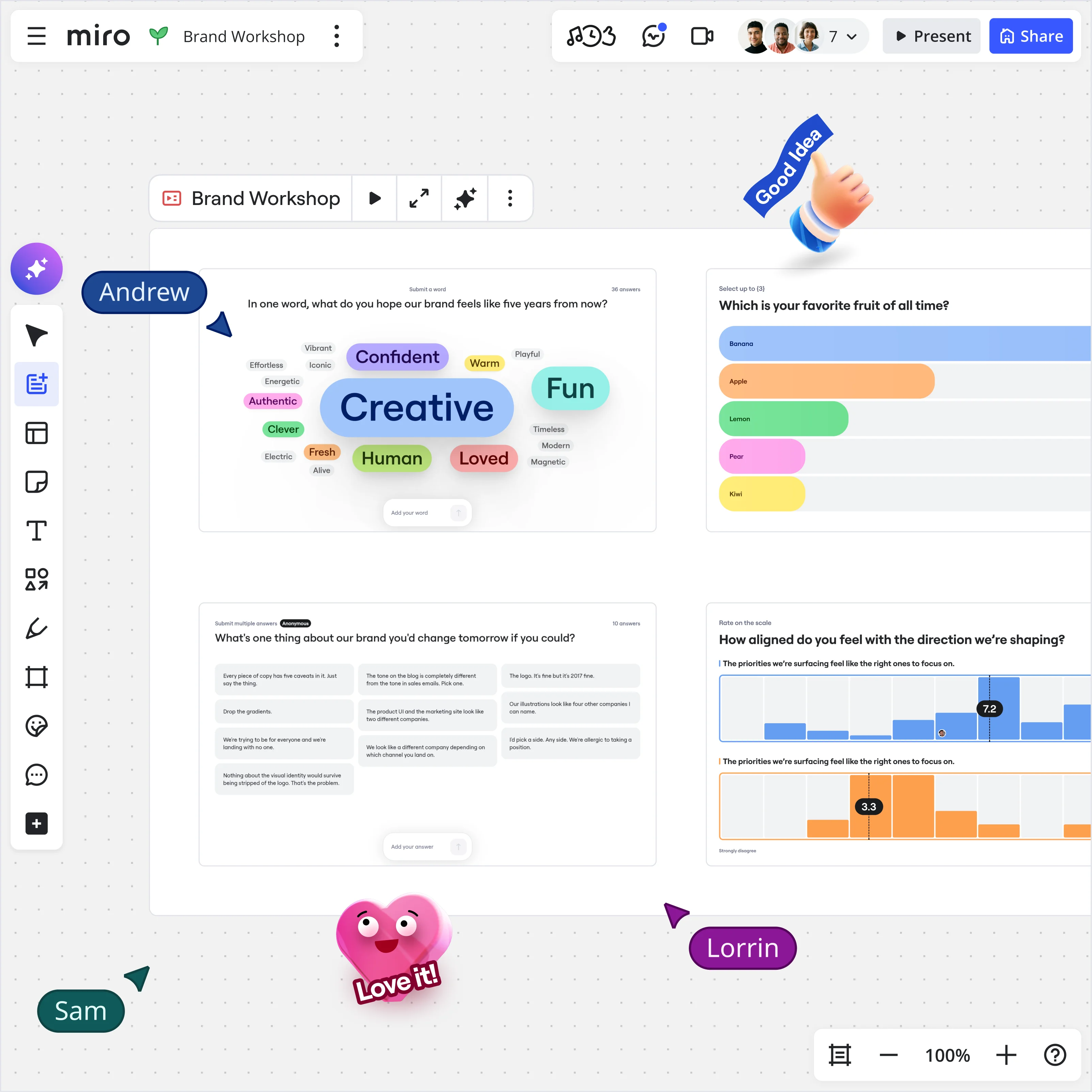
Here's the format Jakob's team runs inside their weekly Miro Engage sync:
- A short, anonymous sentiment question, asked at the same point in the meeting each week
- Optional space for context, for anyone who wants to add more than a number
- A few minutes set aside to actually look at the result together, not just collect it and move on
No names or team labels are attached to any response before it reaches the group.
A quick how-to, straight from Jakob's own sync
In the video, Jakob shows exactly how his team runs it each week:
- Zoom into the current week's board. Each Engage sync gets its own set of slides and stickies showing that week's status.
- Work through the big follow-ups from last session first, then move into overall status.
- Go team by team. Each team presents its own to-dos and metrics, so everyone sees how the pieces connect.
- Run the Engage activities. For Jakob's team, that includes things like a quick poll (his team used one to help decide on their offsite location) and the anonymous sentiment pulse.
- Close with action items, so the sync ends with clear next steps, not just a status recap.
- Let AI Flows do the connecting. A doc summary step condenses that week's sentiment, then links it to the prior week's summary and the next one, so the team can compare this week against the last several instead of judging it in isolation.
Why anonymity gets you the truth
Ask people how they're doing with their name attached, and most will give the polite answer. Ask anonymously, and the answers get real.
Jakob's seen this play out directly. Asked whether anonymous responses ever catch him off guard, he's careful with the word "surprised." "I wouldn't necessarily say surprised," he says, "but at least I'm very happy with some of the things that people feel safe to share, given that it's anonymous." A pulse survey only works if people trust that being honest won't cost them anything.
A sync that's about more than status
Jakob's team didn't retrofit sentiment tracking onto an existing meeting. The weekly sync was built with it from the start, alongside status updates, follow-ups from the previous session, and action items. The pulse check runs as one of several Engage activities inside that structure.
The difference shows up in what the meeting actually is. "The pulse check gives much more comfort around how the team is doing," Jakob says. "So it's not just a status meeting. It's also a 'how is the team feeling' meeting."
Catching problems while they're still small
Tracking sentiment every week, not once a quarter, is what lets Jakob's team see a dip forming instead of discovering it after the fact.
"The weekly trend definitely caught early indications," he says, "and it helped establish conversations around particular topics that would not have happened otherwise."
Asked what's actually changed since adopting the format, Jakob points to fewer surprises: issues get flagged and worked through early, well before they'd otherwise show up as a bigger disruption.
For a team leader still on the fence about trying this, Jakob puts it plainly: "This way of doing things allows us to catch problems in their infancy, so they don't snowball."
Getting it right from day one
For any team setting this up for the first time, Jakob's advice starts before the first pulse question even goes out. "Get the structure and the objectives right from day one," he says, "especially the objectives. Why are you doing this thing?"
The other piece of advice is less about process and more about mindset. Teams often hesitate to ask for this kind of honesty, worried it'll feel invasive. Jakob sees it differently. "Psychological safety is one of the most important indicators of performance in a team," he says. "If a team does not feel psychological safety, they will not perform. Don't be nervous about being honest. It is an absolutely essential performance enhancer."
Try it with your own team
Want to run this with your own team this week? Grab the Weekly Pulse Check template in Miro Engage and go live in minutes.
FAQ
How do you measure team sentiment anonymously? Run a short, recurring survey where responses aren't tied to individual names, and share results as an aggregate trend rather than individual answers.
What questions should a pulse survey include? Keep it to one or two core questions, typically a simple scale for overall sentiment, with optional open text for anyone who wants to add context.
How is a pulse survey different from a full engagement survey? A pulse survey is short and frequent, often weekly, and tracks real-time sentiment. An engagement survey is longer and less frequent, usually quarterly or annually, and digs into deeper drivers like career growth or management effectiveness. The two work best together, not as substitutes for each other.
How often should you run a team pulse check? Weekly works well for teams that want to catch issues early. Some teams run it biweekly if a weekly cadence feels like too much.
Can tracking sentiment over time actually catch problems early? A single low score isn't a red flag on its own, but a consistent downward trend across several weeks is a strong early signal worth investigating, well before it turns into disengagement or turnover.
This article was written in collaboration with Jakob Knutzen, GM for Workshop Solutions. Last updated: July 3, 2026
Read more
Join our 100M+ users today


