Table of contents
Table of contents
Your teams don’t have an AI problem. They have a collaboration problem.
Most product, engineering, and design teams aren’t short on AI tools. They’re short on an AI collaboration tool built for cross-functional work, not another single-player app that makes one person faster while everyone around them keeps guessing.
Look at how AI rolled out across most EPD orgs over the past two years, and a pattern shows up fast: everyone got their own copilot. PMs write PRDs with one AI tool, designers generate mockups with another, engineers ship code with a third. Individually, everyone’s moving faster than ever. But ask them to trace how a single idea moved from a Slack message to a shipped feature, and you’ll usually get a shrug. The tools multiplied. The handoffs didn’t get any cleaner.
Key takeaway:
Most AI investment stalls because it’s aimed at individuals, not teams. Real returns come from cross-functional AI collaboration, where product, design, and engineering work from one shared canvas instead of a dozen separate single-player tools, each with its own AI bolted on.
Collaborative AI Workflows
Join thousands of teams using Miro to build the right thing, faster.
McKinsey’s State of Organizations 2026 report, based on a survey of more than 10,000 senior executives, backs this up with hard numbers: 88 percent of organizations are experimenting with AI, but just as many report no significant bottom-line impact. And when leaders were asked what’s actually holding back their return on AI investment, the top two answers weren’t “the technology isn’t good enough.” They were AI being implemented for individual productivity and AI being rolled out as disconnected point solutions.
The AI itself isn’t the problem here. The operating model wrapped around it is.
That’s actually the encouraging part. You don’t need to buy more AI seats or wait for a better model to fix it. What you need is a change you can start this quarter, with the tools your teams already have: put product, design, and engineering back in one room, digital or otherwise, and let AI do its best work where the whole team can see it. The organizations pulling ahead right now aren’t the ones with the biggest AI budget. They’re the ones who figured this out first.
Why individual AI wins don’t add up to team wins
It makes sense that AI adoption started with individuals. Giving one designer a prototyping assistant or one engineer a coding copilot is an easy purchase decision and a fast win. But EPD work was never actually an individual sport. A product idea has to pass through discovery, design, spec, build, and validation, and at every one of those handoffs, someone has to rebuild the shared understanding that already existed three steps back.
McKinsey’s research puts a number on how expensive that reconstruction gets. One firm found it was duplicating 35 percent of decisions across functions, holding 60 percent more meetings than its peers, running two-month lags before data cascaded through the org, and spending more than 1,000 hours a month on manual reporting. None of that shows up as an “AI problem” on the surface. It shows up as slow launches, PMs re-explaining the same requirements in three different meetings, and engineers building against specs that were already out of date by the time they got them.
Layer individual AI tools on top of that kind of structure, and the same report notes that organizational challenges, including change management and breaking down silos, rank among the top three barriers organizations cite for scaling AI. You don’t fix the friction. You just get everyone moving faster in their own separate direction.
Why cross-functional AI collaboration is the real unlock
Here’s the shift that’s actually working for teams getting real returns on AI: instead of a PM writing a doc, handing it to design, who hands a file to engineering, who works from a spec that’s already stale, EPD functions work from the same canvas at the same time. The information lives in one place. AI works inside that shared space instead of inside a dozen separate ones.
Miro’s own CEO, Andrey Khusid, has named this exact gap: “AI leverage is locked inside private chat windows, accelerating individuals, but never reaching the organization. When every collaboration mode converges on one surface, individual speed becomes company speed, and individual clarity becomes shared clarity. A collection of 10x people pulling in different directions transforms to become a 10x company pulling in the same direction. Every organization will need to make that shift to stay competitive.”
Two customer stories, one from an 11,000-person technology consultancy and one from a global retail group, show what that actually looks like in practice.
The proof: Endava’s shift from value capture to value creation
Endava’s Regional CTO for Europe and Global Head of Dava.X AI, Joe Dunleavy, shared how the company rebuilt its AI delivery model at Miro’s Canvas 26 conference. Endava is a global technology and consulting services company with more than 11,000 people and around 60 delivery centers worldwide.
The problem: what do you sell when AI can write the code?
Three years ago, Endava’s leadership faced a live strategic question: when AI can generate code, what exactly is a software services company selling? Endava had operated for decades on one conviction, that technology and people are inseparable, and generative AI tested that conviction fast.
The fix: context quality, not code generation
Endava’s leadership landed on an answer that ran against the industry’s instinct to chase faster code output: the scarce resource in AI-assisted delivery is a structured understanding of what problem you’re actually solving, for whom, and under what constraints. That insight became Dava.Flow™, Endava’s proprietary AI engagement methodology, built around one premise: get the shared understanding right first, then let agents work.
How it works: four phases, one canvas
Dava.Flow™ runs in four phases: Signal, qualifying the right problem before any AI agent touches it; Explore, structuring and enriching that problem into inputs AI agents can actually use; Govern, keeping humans in the loop while agents do the technical work; and Evolve, feeding production telemetry back into Signal so the loop never really closes.
Dunleavy was direct about why the Explore phase matters most: “By the time you get to the agents writing code, they are working on a focused context. It’s a very managed, controlled environment. That’s where you get the higher quality of the output that is important to enterprise customers.” Miro is embedded across all four phases: the entire Dava.Flow™ knowledge base and delivery environment live on the canvas, functioning as what Dunleavy calls a “context warehouse.” Miro Sidekicks support Signal and Explore specifically, helping teams turn client conversations into structured input before any agent starts building. As Dunleavy put it: “The entire criteria, the roadmap, all of what makes up Dava.Flow™, we presented all of that information in Miro, in a way that people can actually use.”
The philosophy: value creation over value capture
Dunleavy drew a sharp line between two ways of thinking about AI’s return: “The world, at the moment, is obsessed with value capture, how do we get our ten, fifteen percent of automation? But that’s losing the point. The opportunity in AI is really strong collaboration and the creation of new things.” That distinction is also reshaping how Endava sells its work, moving toward outcome-based models that reflect what AI-assisted delivery is actually worth.
The results
Dava.Flow™ is live and already winning work, with active programs at large enterprises using the methodology to scope, deliver, and evolve AI-enabled solutions. The shift isn’t only about delivery speed: as AI handles more execution, Endava’s teams spend more of their time on problem qualification and client partnership, the work that creates new value instead of automating what already existed.
The takeaway
Dunleavy’s most candid moment at Canvas 26 was about what’s actually hard, not what AI makes possible: “The technology is ready. It’s the worst it’s going to be today, it’s only going to improve. The challenge of doing an AI transformation like this isn’t waiting for the technology to be perfect. It’s bringing people along on the journey with you.” Endava’s own list of what actually moved the needle backs that up: tiered training instead of one-size-fits-all rollouts, champions inside teams rather than top-down mandates, getting functions like Legal and HR moving alongside delivery teams, and leaning on strong partners rather than going it alone. As Dunleavy summarized: “We don’t have to do this alone. Where you’ve got strong partners, that’s the play.”
The proof: J.Crew Group’s “alignment latency” problem
Amanda Kane, SVP of Product Operations, and Tracy Love, SVP of Enterprise Technology, both at J.Crew Group, walked through a second, equally direct example on stage at Canvas 26. J.Crew Group runs three brands, J.Crew, J.Crew Factory, and Madewell, across global markets.
The problem: process optimization had a ceiling
Like most enterprise design organizations, J.Crew had already done the conventional process work. As Kane put it on stage: they’d “mapped the workflow, reduced the steps, tightened the handoffs. It helped, but it had a ceiling.” Every handoff got faster. The gaps between handoffs didn’t, and Love named the cost directly: “We made every handoff faster, but we still lost two weeks waiting for the right people to see the same thing at the same time.”
That gap had a name once the team looked for it: alignment latency, “the time between when work was created and when everyone shared an understanding of it.” As Kane put it, “We couldn’t optimize our way out of an alignment problem… it’s not solvable by process alone. It’s solvable by environment design.”
The fix: the Digital Atelier
What they built is the Digital Atelier, named for the workshop model where craftspeople work side by side and shape the work together as it evolves. Kane described it simply: “The work in the room shapes the room. The room shapes the work.” In practice, it’s a single Miro canvas, structured around products rather than the org chart, where design, merchandising, sourcing, operations, and technology all work in real time instead of in sequence.
How it works: four components, one surface
Love broke the architecture down into four pieces on one continuous surface: Miro as the primary canvas, the actual place teams do the work rather than a whiteboard opened occasionally for brainstorming; AI living inside that canvas, so cost data, material feasibility, and AI-driven insights surface in the collaboration layer instead of a separate tool someone has to leave the work to check; real-time alignment, replacing weeks of review cycles with continuous collaboration; and a system bridge connecting the canvas to J.Crew’s PLM system. As Love put it: “We didn’t replace systems. We connected thinking to execution.”
The demo Kane walked through showed that architecture end to end: starting from a seasonal concept and color palette, pulling styles from the PLM system through an integration built with Miro and Service Rocket, coloring a flat sketch with a custom Miro AI coloring tool, generating AI renderings, and synthesizing the board into a table and presentation with Miro Flows, all without leaving the canvas. The team is also starting to bring Sidekicks into the same workflow.
The philosophy: built in, not bolted on
Love was candid about the thinking behind where AI sits: “We believe that AI is best when it’s built in and not bolted on.” The risk she named is that AI tools become parallel workflows, adding a step instead of removing one. J.Crew’s approach is still in progress (“we are still on this journey, and we are not all the way there yet”), but the goal is consistent: AI surfacing options and trade-offs in the moment a decision gets made, never replacing the team’s judgment. “We think of AI as a superpower,” Love said. “The team’s always going to decide.”
The results
Kane broke the payoff into three benefits: less rework, since issues surface before work crosses multiple teams; earlier decisions, since teams converge in the moment of creation instead of a downstream review; and better outcomes overall, from more shared understanding and fewer surprises. As she summarized it: “Speed doesn’t come from cutting steps. It comes from access to the information and making better decisions earlier.”
The takeaway
Love closed with the line that ties both stories back to the point of this piece: “You cannot force speed through process optimization alone, but you can design the conditions where speed happens naturally.” Their advice for anyone considering the same shift: don’t go looking for an AI tool and then come back to the organization hunting for a problem to solve. Start with the problem. Then look for the tool.
What AI tools for cross-functional collaboration look like, day to day
You don’t need 11,000 employees or a multi-year transformation to apply the same principle. It comes down to a few concrete shifts.
Start with discovery. Instead of a PM’s doc, a Figma file, and a Jira ticket that each tell a slightly different version of the same story, EPD teams map the problem, the constraints, and the desired outcome on a single board. When an AI tool needs the full picture, it pulls from that board, not from someone’s memory of a meeting two weeks ago.
Design and engineering reviews change too: a prototype, a flow, or a data model gets built and refined on the canvas with both functions in the room together, instead of getting thrown over a wall for a “does this work?” review three days later.
Engineering benefits the most from this, since it usually inherits the stalest information in the chain. When scope shifts mid-sprint, the change shows up on the board engineers are already referencing, not in a separate doc someone forgot to update. That’s the difference between hearing about a change at standup and finding out about it three weeks later during QA.
And when a sticky-note brainstorm turns into an AI-generated doc, or research notes become an AI-drafted prototype, the output stays in the same space where the original decisions were made. No one has to reopen five tabs to check whether it actually reflects what the team decided.
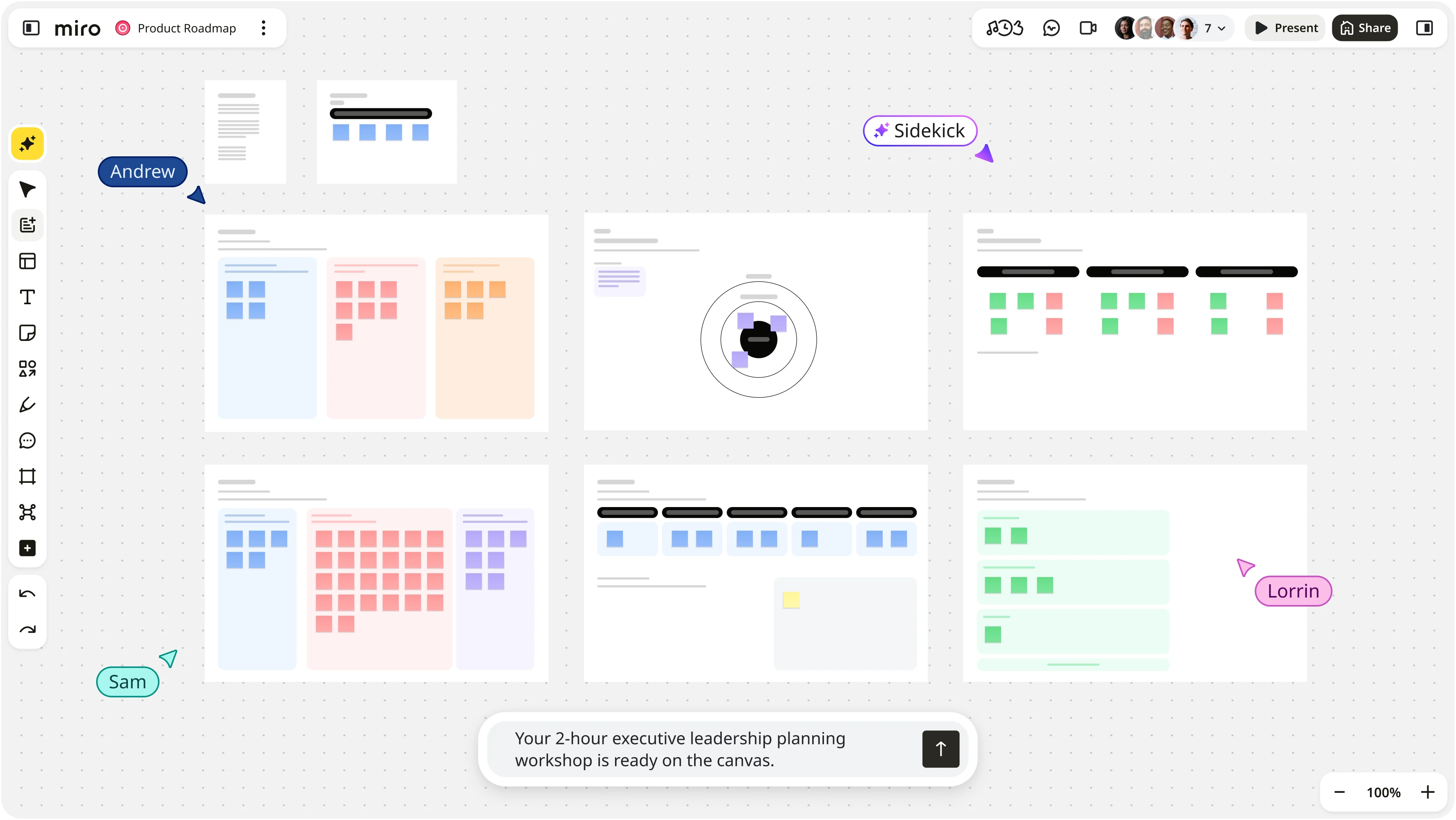
This is the pattern behind Miro’s approach as an AI-powered canvas built for exactly this kind of cross-functional work: a shared, visual space where teams bring their AI tools to bear on a problem together, instead of each function running its own AI workflow in isolation.
Silos don’t disappear on their own, and AI won’t fix that by itself
Buying an AI collaboration tool doesn’t automatically dissolve organizational silos. McKinsey’s research found that just 35 percent of leaders believe reducing organizational silos will unlock productivity in the next year or two, which means most leaders are still looking for the mechanism to actually do it. A shared canvas gives teams a place to collaborate. It doesn’t replace the harder work of deciding who owns what decision or how cross-functional reviews actually get run.
What it does is remove one of the biggest practical barriers: the fact that the information currently lives in too many disconnected places for anyone, human or AI, to work from a complete picture. Give EPD teams one shared, AI-enabled space to work from, and you take one of the most stubborn parts of the silo problem off the table before you even get to org design.
Rebuild the model around the team, not the individual
The organizations getting real returns from AI aren’t the ones with the most licenses. They’re the ones that rebuilt how product, design, and engineering actually work together before layering AI on top. That’s the difference between AI as a personal productivity boost and AI as genuine cross-functional collaboration.
If your EPD teams are still stitching information together across five different tools every sprint, that’s the gap worth closing first. Bring your discovery, your prototypes, and your AI workflows into one shared space, and see what your team can build when nobody’s reconstructing the same decisions twice.
Start building on a free Miro board and see what changes when your whole team works from the same canvas.
Frequently asked questions
What is an AI collaboration tool?
An AI collaboration tool is software where a team, not just one person, works alongside AI in a shared space. Instead of each person opening a private chat window to draft, summarize, or generate work on their own, everyone sees the same board, the same prompts, and the same AI output at the same time. The distinction matters: a tool that makes one person faster is an AI assistant. A tool that lets product, design, and engineering build, review, and decide together, with AI doing part of the work in full view of the group, is an AI collaboration tool.
What’s the difference between an AI collaboration tool and giving each team member their own AI assistant?
Individual AI assistants live in private chat windows: one person’s ChatGPT thread, another’s coding copilot, a third’s design assistant. Each speeds up that one person’s slice of work, but none of it is visible to the rest of the team until someone manually shares it, usually after the fact. An AI collaboration tool puts that same AI capability inside a shared workspace instead, so the prompt, the output, and the discussion around it are visible to everyone in real time. The output is that individual speed compounds into team speed instead of staying siloed with the person who generated it.
What are some examples of AI tools for cross-functional collaboration?
Common categories include shared visual canvases where product, design, and engineering map problems and prototypes together with AI generating drafts inside the board; AI-embedded whiteboarding tools that turn sticky notes or research into structured docs, tables, or prototypes without leaving the workspace; and connected canvas-to-system integrations that pull live data from tools like a PLM or CRM directly into the collaborative surface, so AI has full context instead of working from a static export. Endava’s Dava.Flow™ and J.Crew Group’s Digital Atelier, both covered above, are real examples of the second and third categories in production.
Does cross-functional AI collaboration only work at enterprise scale?
No. Endava and J.Crew Group are both large organizations, but the underlying problem, teams losing time to reconstructing each other’s context after every handoff, shows up at any size the moment more than one function touches a piece of work. A five-person startup with a PM, a designer, and an engineer has the same alignment gap as an 11,000-person company; it’s just measured in hours lost per week instead of thousands of hours per month. The fix scales down just as easily as it scales up: one shared board instead of three disconnected tools.
Do you have to replace your existing tools to start using an AI collaboration tool?
No. The organizations in this piece didn’t rip out their existing stack. J.Crew Group connected their shared canvas to their existing PLM system rather than replacing it, and Endava built its methodology to plug into clients’ existing environments rather than displacing them. The goal isn’t fewer tools for the sake of it; it’s making sure your discovery, design, and engineering work reference the same live information instead of exporting static snapshots between disconnected systems.
Last updated: July 14, 2026
Read more
Join our 100M+ users today


