Endava is a leading provider of next-generation technology services that recognized the business imperative of a holistic AI transformation strategy at the organizational level. They developed Dava.Flow™, an AI-native engagement lifecycle that connects how Endava senses opportunities, shapes responses, and delivers outcomes through human-agent collaboration.
See Endava’s story
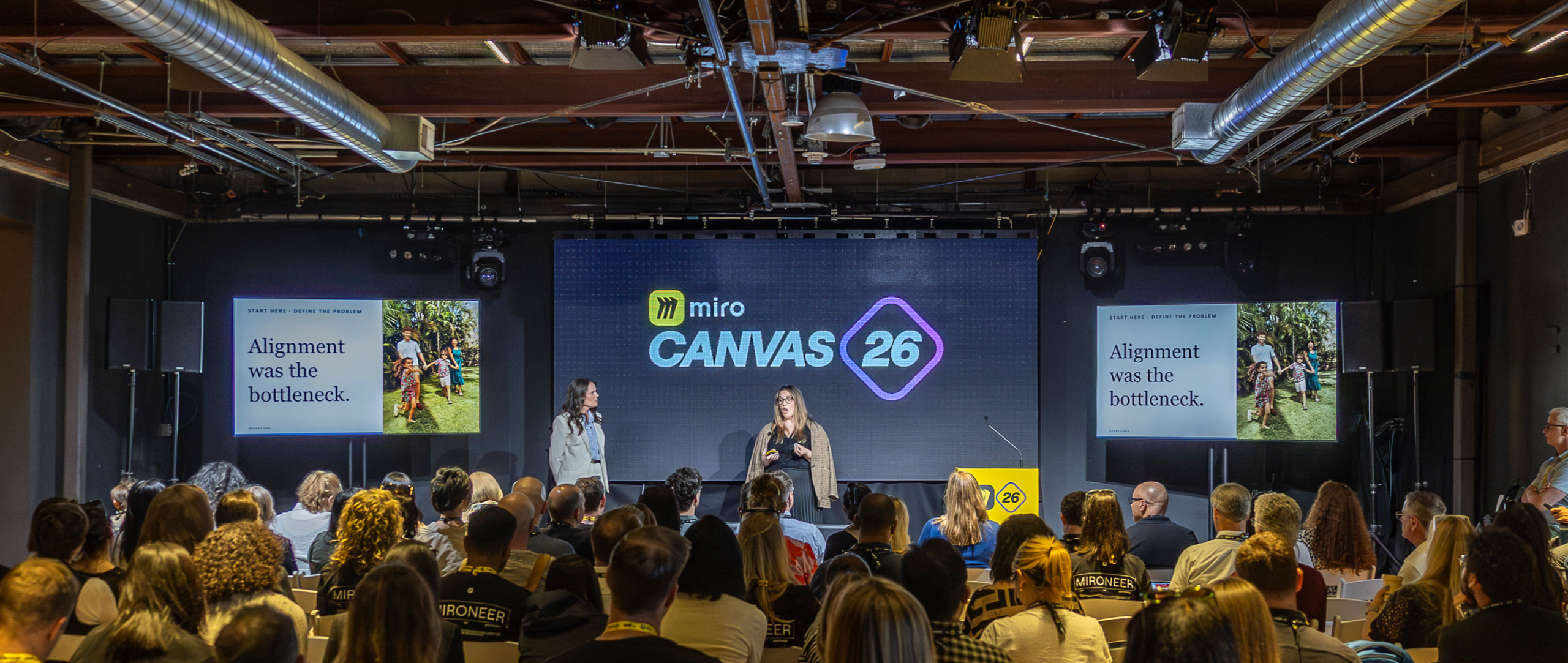
Endava at Canvas 26
Endava continued sharing its AI transformation story on the Canvas stage across three continents:
At Canvas San Francisco, Endava’s Regional CTO for Europe and Global Head of Dava.X, Joe Dunleavy, walked through how the company built Dava.Flow™ and what three plus years of transformation has actually taught them about change. At Canvas London, Global CTO Matt Cloke picked up the same thread from the top of the organization, unpacking how a 25-year-old services company decided to reinvent itself for an AI-native world. And at Canvas Sydney, Wes Fagan, Chief Design Officer and SVP of Strategy, told the story from the front lines of delivery, including the challenges they’re still navigating.
Their three talks, told from different altitudes of the same company, add up to one of the most complete accounts of enterprise AI transformation we’ve heard.
Challenge
When AI can generate code, what exactly is a software services company selling?
That’s not a rhetorical question. Three years ago, it was the live strategic problem facing Endava’s leadership, and the answer they landed on has reshaped how the company delivers, prices, and sells its work.
Endava is a global technology and consulting services company with more than 11,000 people, around 9,000 of them engineers, and roughly 60 delivery centers worldwide. For decades, they have operated on one conviction: technology is the how, and people are the why. When generative AI arrived, that conviction got tested fast.
Matt Cloke described the moment vividly at Canvas London. A few months into his role as CTO, nearly every conversation he had turned into a version of the same challenge: now that ChatGPT exists, do we even need IT services companies anymore? He framed the choice the leadership team faced as an evolutionary one.
“Did we want to be the dinosaurs, put our heads back down and carry on eating the grass? Or did we want to be the tiny little mammals that are going to evolve and plot our path as we move forward?”
Matt Cloke, Global CTO at Endava
Wes Fagan, speaking in Sydney, named the part that was hardest for a consultancy to sit with. Firms like Endava are hired for expertise, but when AI arrived, everyone was figuring it out at the same time.
“We were all learning in public. As a technology consultancy, that’s a very raw and scary place to be.”
Wes Fagan, Chief Design Officer and SVP of Strategy at Endava
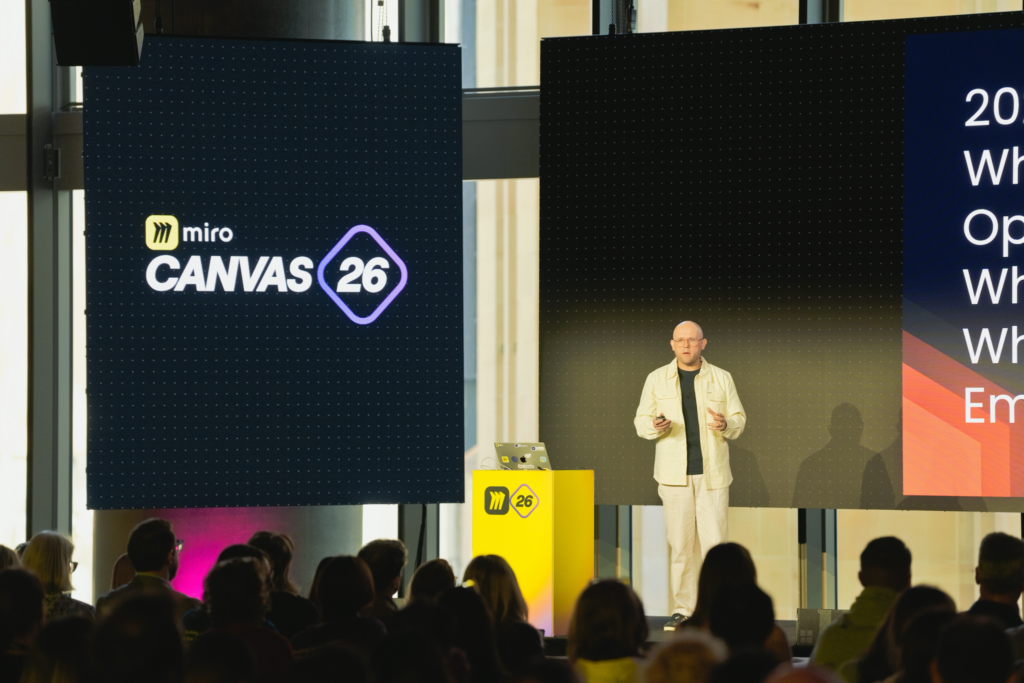
That exposure did not last long, because clients quickly moved, in Wes’s words, from curious to responsible. The questions stopped being about novelty and became enterprise questions: Where can we use this? Is it safe? What’s the cyber risk? When do we start? Endava realized that if it did not answer those questions for itself first, the market would move past it.
The answer Endava reached was not about output. As Joe Dunleavy put it in San Francisco, the scarce resource in AI-assisted delivery is not technical output. It is the structured understanding of what problem you are actually solving, for whom, and under what constraints. Context quality, not code generation, became the insight that would lead to Dava.Flow™.
Solution
Reinventing the company: the Keystone program
Before there was a methodology, there was a reinvention program called Keystone — a singular lens through which Endava. examined every part of the business. Wes described Keystone as the enablement pillar for what the team internally calls Endava 2.0, a net-new version of the company that puts strategy, talent, delivery, operations, legal, and commercial thinking all in service of an AI-native way of working. The guiding principle was deliberately ambitious.
“We weren’t looking to use AI on top of an existing process for a 10 or 15 percent incremental improvement. We were trying to think about, if I use AI, how does this completely challenge the way that I work?”
Matt Cloke, Global CTO at Endava
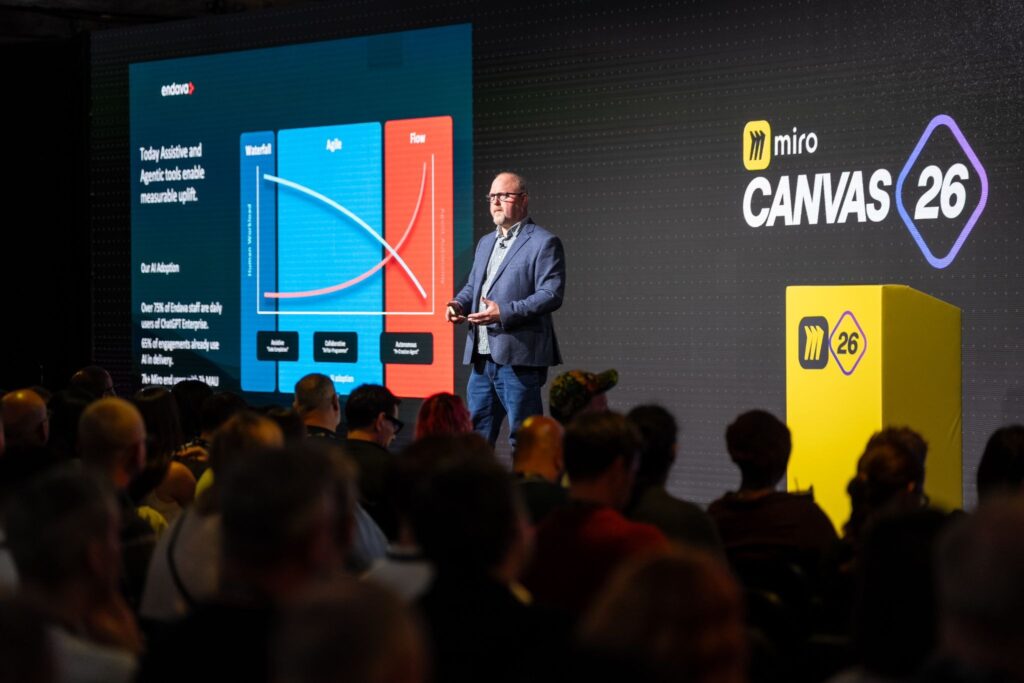
Keystone ran across several streams, from how the legal and finance teams work; to how the company’s engineers design, code, and test; to talent acquisition, sales, and Endava’s own internal IT systems. The team became what Matt called client zero, experimenting on themselves first. That experimentation surfaced a clear pattern in how AI adoption matures, in three stages:
- The first stage was assistive: simple code completions a developer accepts or rejects. Matt was refreshingly honest about how that went at first. Endava deployed 4,500 GitHub Copilot licenses to its engineers, then looked at the data and found that 70 percent of the AI suggestions were never accepted by a developer.
- The second stage was collaborative, where AI helps reason about code, check whether testing is adequate, and summarize documents.
- The third stage, where the real change happened, was agentic: a person directing an agent to do work, and agents coordinating with other agents.
That last stage broke the familiar rhythms of agile delivery, the standups and the sprints. Wes placed it in a longer arc: waterfall optimized for control, agile optimized for adaptability, and what comes next (which a growing number of teams are calling flow) optimizes for continuous value movement. The team coined that word, flow, to describe the way of working on the other side of agile.
Inside Dava.Flow
Around the time the team was exploring the flow concept, Miro invited Endava to Amsterdam to sit down and write the thinking down so it could be shared. Out of that work came Dava.Flow, Endava’s proprietary AI engagement lifecycle methodology.
Wes described it simply as a governed, continuous flow for building measurable value across the entire customer lifecycle, kept deliberately human-led: agent-to-agent coordination exists, but the core is agent-to-human collaboration. Rather than layering AI onto existing delivery processes, it reimagines the engagement around one premise: get the context right first, then let agents work. It runs as a self-perpetuating loop of four phases.
- Signal: qualifying the right problem. Before any AI agent writes a line of code, the work is anchored in a clear understanding of the business challenge, competitive context, and desired outcomes. As Matt noted, a signal can come from anywhere: a meeting transcript, a photograph, even a scribbled piece of paper. The point, Wes stressed, is not that AI writes the note. It’s that the first step in the method becomes structured and reusable.
- Explore: structuring and enriching that context. This is where information from Signal gets synthesized into the structured inputs that give AI agents the guardrails they need. Joe was direct about why this phase is critical: “By the time you get to the agents writing code, they are working on a focused context. It’s a very managed, controlled environment. That’s where you get the higher quality of the output that is important to enterprise customers.” The most important output of this phase, Matt added, is an agent-ready backlog of work.
- Govern: human oversight during delivery. Teams stay in the loop as AI agents do the technical work, iterating toward production-ready output. Endava no longer calls this building. They call it humans governing the output produced by AI agents.
- Evolve: monitoring in production. Telemetry and performance data feed back into Signal, so the system keeps learning rather than letting insight disappear after a workshop or a delivery sprint.
Crucially, Dava.Flow keeps people firmly in the loop, which matters enormously when your clients are banks, payment systems, and insurers who cannot risk, in Matt’s words, a hallucinated insurance return. Wes put the governing rule plainly: the methodology is built to be faster and value-oriented, but always human-directed. Endava encodes that into the work itself, down to the markdown files, so the leading authority is always the human and no agent can go rogue.
The methodology is also tool agnostic by necessity, since different clients prefer different models and some regulated clients cannot use certain AI tools at all. But asked for Endava’s own preference, all three leaders pointed to the same shared workspace, Miro.
How Miro powers it
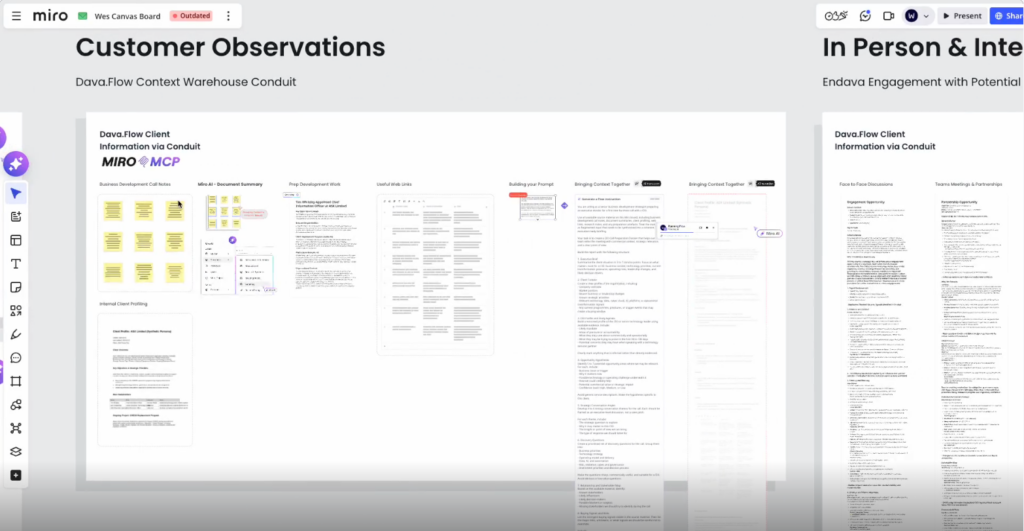
Endava built their entire Dava.Flow knowledge base and part of the delivery environment on the Miro canvas, from onboarding materials to the live working boards where client context gets captured and refined. The canvas serves as Endava’s context warehouse, the place where distributed teams collaborate on the information that makes the whole methodology work.
“We have no long-term memory at an enterprise level that’s regulated. So we use Miro as that central touchpoint, where every single piece of context exists in the board space.”
Wes Fagan, Chief Design Officer and SVP of Strategy at Endava
That central role shows up at scale. Endava now has more than 7,000 daily active Miro users, spanning commercial through delivery teams. A salesperson’s coffee conversation, the napkin sketch, the customer workshop, the prototypes, the planning, all of it lands on the same board.
From there, Endava’s stack connects the canvas to where the engineering happens. Their Miro stack brings together Prototypes, Flows, and Sidekicks alongside MCP, working in concert with their context warehouse, their internal knowledge base, and the integrated development environment (IDE). Through MCP, and a process they call Conduit, the boards and the agents in the IDE read and write back to each other continuously, so that as a board fills up over weeks of work, the agent environment stays current.
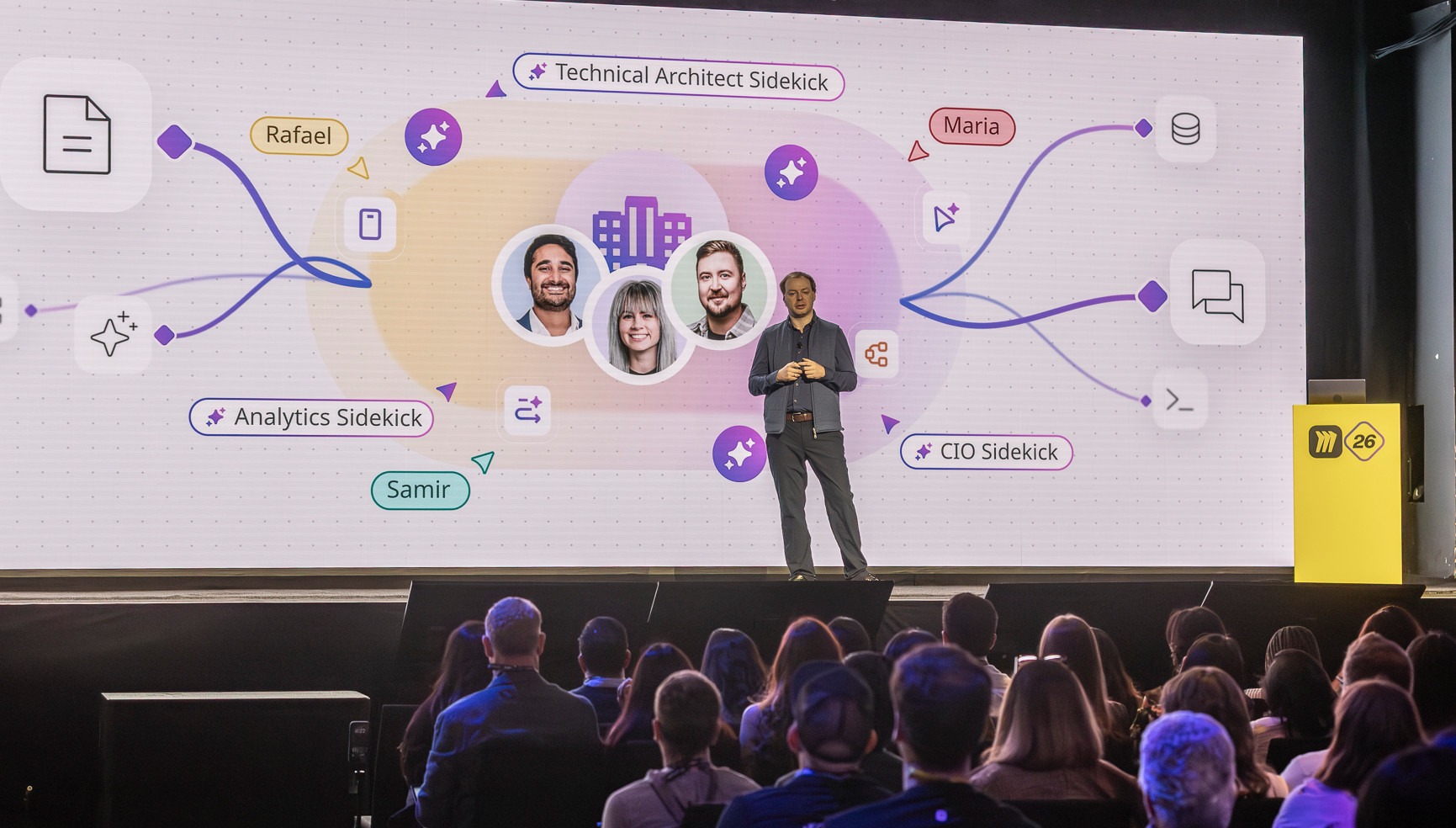
Miro’s Sidekicks do particular work in the Signal and Explore phases. Endava built its own custom Sidekicks on top of that foundation to create consistency across a global organization: anyone can bring a call transcript or a discovery workshop into a Sidekick and land on a consistent, reusable artifact that feeds the next phase. As Wes showed, the value is watching messy, unstructured information become structured signals quickly, and then carry forward, rather than relying on whoever happened to take notes or remember the room.
“The entire criteria, the roadmap, all of what makes up Dava.Flow — we presented all of that information in Miro, in a way that people can actually use.”
Joe Dunleavy, Regional CTO for Europe and Global Head of Dava.X at Endava
Impact
Dava.Flow is live and already winning work. Joe cited active programs with large enterprises, where the methodology is being used to scope, deliver, and evolve AI-enabled solutions.
Matt directly addressed a concern that many businesses have when he shared their initial qualitative results. Using independent measures and external reference points, Endava found that the quality of the output it now produces is better than the output it produced when it only had people. The reason is not that AI runs unchecked, it is that augmenting people frees them to spend far more of their time thinking about the problem, which produces a better result at the end.
Wes drew out the commercial consequence, which is reshaping how Endava sells. In a world where a team might direct hundreds of agents in a day, billing by time and materials breaks down, the work no longer takes the time it used to. Those forces push Endava toward fixed-price, outcome-based engagements that reflect the value delivered rather than the hours spent.
Underneath all of it runs the same conviction: this is about creating new value, not capturing a little efficiency. Citing Stanford d.school’s Jeremy Utley, Matt drew the line sharply in London:
“You really have to think about value creation. Invert the problem, and start thinking about how I can use this technology to take us to entirely different places.”
Matt Cloke, Global CTO at Endava
Joe and Wes made the same case from their own stages. In San Francisco, Joe warned that the industry’s obsession with capturing ten or fifteen percent of automation misses the point, because the real opportunity is collaboration and the creation of new things. And in Sydney, Wes shared that efficiency is the bare minimum, and the real advantage comes only with system-level change.
The bigger picture
The most candid moments from all three leaders were not about what’s possible with AI; they were about what’s hard.
“The technology is ready. It’s the worst it’s going to be today — it’s only going to improve. The challenge of doing an AI transformation like this isn’t waiting for the technology to be perfect. It’s bringing people along on the journey with you.”
Joe Dunleavy, Regional CTO for Europe and Global Head of Dava.X at Endava
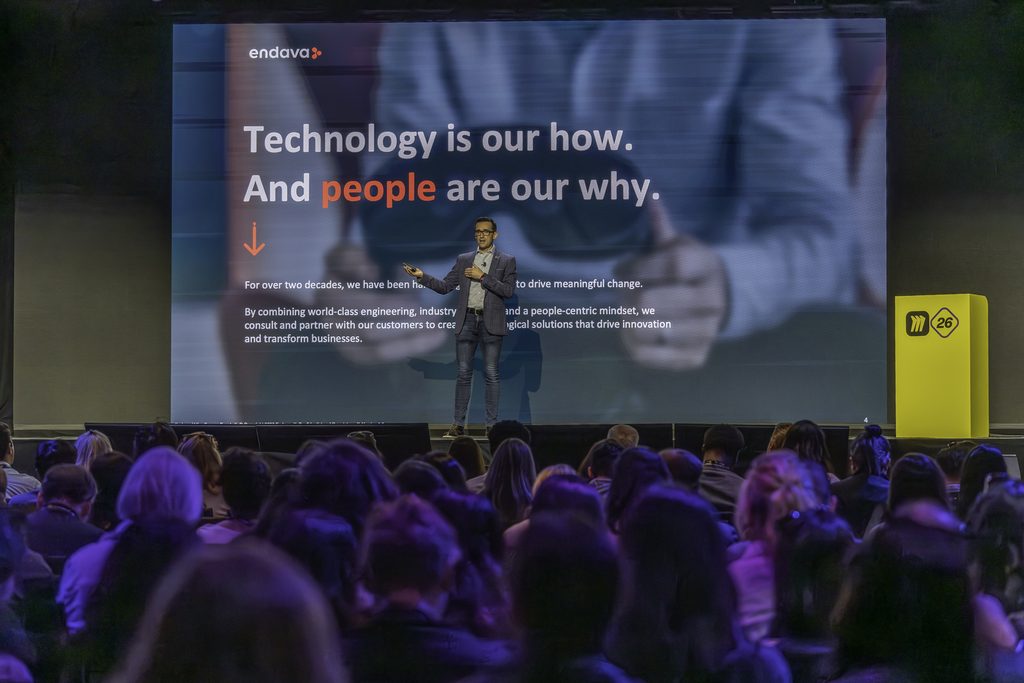
Matt reached the same conclusion from the engineering side. Making Dava.Flow work across the organization, he said, was never about handing people training material and walking away. It was about shifting mindset, which is far harder. Impressive demos tend to land the same way: people see something clever and then think, I have no idea where to start. The work is to make experimentation feel normal and to get people’s hands on the keyboard.
For a company that sells to regulated industries, it is also about reassuring clients on the unglamorous but essential ground of trust, governance, control, and auditability, a need that is about to sharpen as the EU AI Act takes effect and ideas like policy as code become standard.
As Endava continues to navigate that journey, here’s what they have found actually moves the needle:
- Tiered training works better than broad rollouts. Endava built a structured program, from apprentice-level onboarding to team-level practice, so that AI fluency could grow at different rates across different roles without leaving anyone behind.
- Champions networks matter more than mandates. Getting more than 11,000 people to genuinely change how they work requires people inside each team who believe in the direction and model the new behavior day to day.
- Groups like Legal, HR, and leadership have to move together. Adoption stalls when operational functions are not brought along with delivery teams. The organizational infrastructure is as important as the technical one.
- Strong partnerships accelerate everything. “We don’t have to do this alone,” Joe said. “Where you’ve got strong partners, that’s the play.”
The methodology is the visible output. The training programs, the champions, the cross-functional coordination, and the shared canvas where people actually do the thinking are what made it real, and what any organization attempting a similar shift will need to invest in first.
Wes offered an honest picture from the middle of that journey. He described the productivity J-curve: in any real organizational change, things slow down before they speed up. Systems break, people get frustrated, and different teams disagree about which tools to use.
“Dava.Flow has been 18 months in the making, and we are only now starting to find the upward curve.”
Wes Fagan, Chief Design Officer and SVP of Strategy at Endava
That early dip is not a sign of failure. The cost of redesigning the system is itself evidence the change is real, and the goal through all of it is not to remove people from the work but to move them up, to judgment, shaping, and governance. The climb out the other side is where the growth shows up.