J.Crew Group designs, sources, and merchandises three brands across global markets: J.Crew, J.Crew Factory, and Madewell. Inside the company, Amanda Kane leads Product Operations and Tracy Love leads Enterprise Technology. Together, they’ve spent the last several months rebuilding how design teams collaborate, in partnership with Miro and Service Rocket.
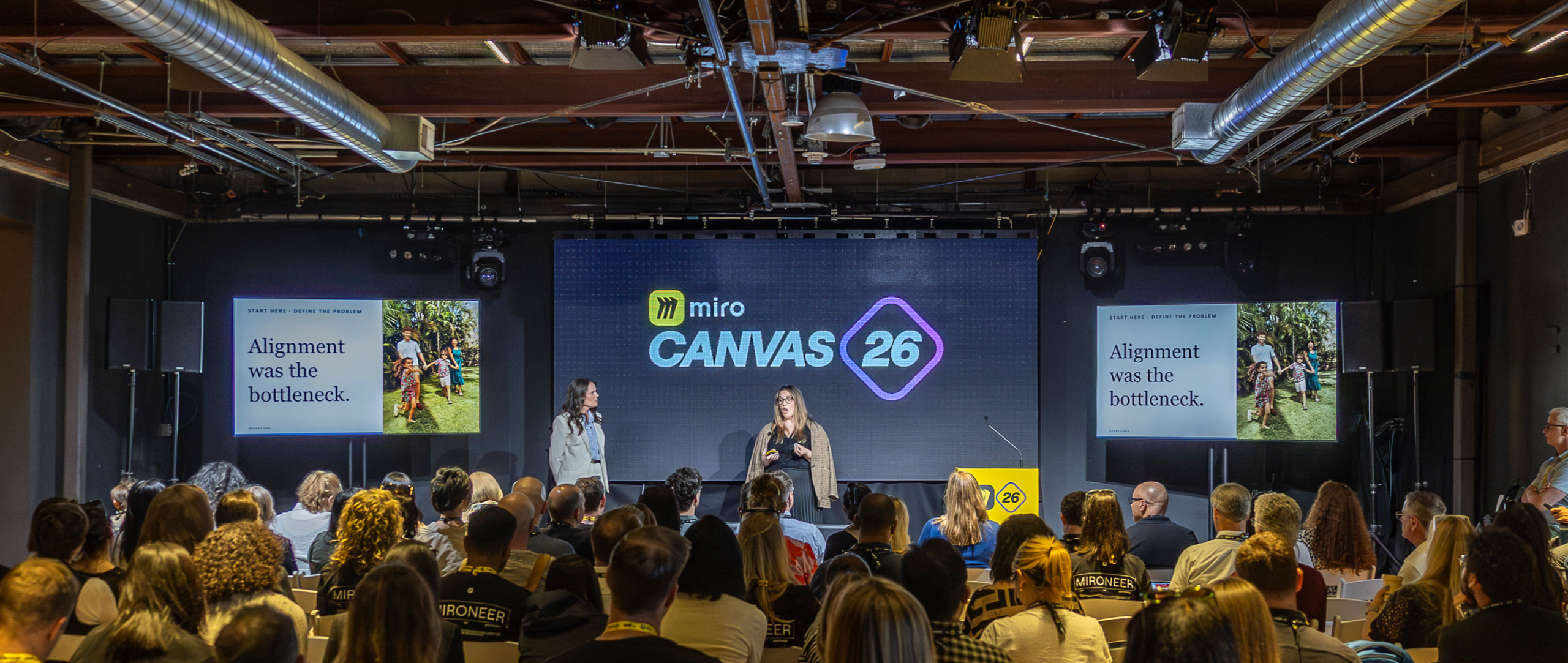
At Canvas 26, Amanda and Tracy shared the result of all that rebuilding, their “Digital Atelier.” And they got candid about their journey to get there: the problem they couldn’t process-optimize their way out of;the reframe that gave them permission to redesign the environment instead of the workflow; and the model they believe is replicable across organizations and industries.
Challenge
Like most enterprise design organizations, J.Crew Group had already done the process work. The team had mapped workflows, reduced steps, tightened handoffs, and scaled consistency across brands. None of this work was wasted, but it had a ceiling.
“Speed isn’t just about how fast each step runs. It’s about how quickly teams align.”
Amanda Kane, SVP of Product Operations at J.Crew Group
The bottleneck wasn’t execution — it was the time lapsed between when work was created and when everyone had a shared understanding of it. Feedback arrived too late to change direction without rework. People made decisions with missing context. The team was operating on the steps, but not on the gaps between them. They could make every handoff faster and still lose two weeks waiting for the right people to see the same thing at the same time.
Once they named this pattern as “alignment latency,” they could see it everywhere. And an important insight followed quickly: alignment latency isn’t an execution problem. You can’t fix it by working harder, and it isn’t solvable by process alone. It’s only solvable by environmental design.
That insight gave the team permission to redesign the environment, not the workflow.
Solution
Atelier is French for workshop or studio: a space where craftspeople and experts work side-by-side, shaping the work together as it evolves. The work in the room shapes the room. The room shapes the work.
J.Crew Group’s Digital Atelier is the modern version of that idea. It’s a shared space where collaboration is tailored to the work, not forced through a fixed process. The Digital Atelier has three qualities: it’s responsive, it’s continuous, and it’s shared. It adapts to the product, the team, and the moment, and no two sessions look the same, by design.
Under the hood, the architecture has four components on one continuous surface:
Miro as the primary canvas. This isn’t a space the team opens occasionally for brainstorming. It’s the shared surface where design, merchandising, operations, and technology do the actual work together. Boards are structured around products, not around the org chart.
AI living inside the canvas. Cost data, material feasibility, and AI-driven insights surface in the collaboration layer, not in a separate system the team has to leave the workflow to query. AI arrives before decisions are made, with the full context already on the board.
Real-time work in context. Review cycles that used to take weeks now happen continuously. Work and decision-making are no longer separate workflows.
A bridge between systems. Miro doesn’t sit outside J.Crew Group’s system landscape, it connects to it. Data from the PLM (Product Lifecycle Management) system and other core systems flows into the boards, and work is in progress to enable decisions made in the working sessions to flow back into the systems of record. The conversation becomes part of the record without anyone having to reconstruct it afterward.
To demonstrate the workflow, Amanda walked through a typical design season:
- Concept and palette. The board opens with a concept (in the demo, “summer colors of nature”) and a color palette extracted from it.
- PLM integration. The team pulls product styles directly from the PLM system via an integration J.Crew Group built in partnership with Miro and Service Rocket.
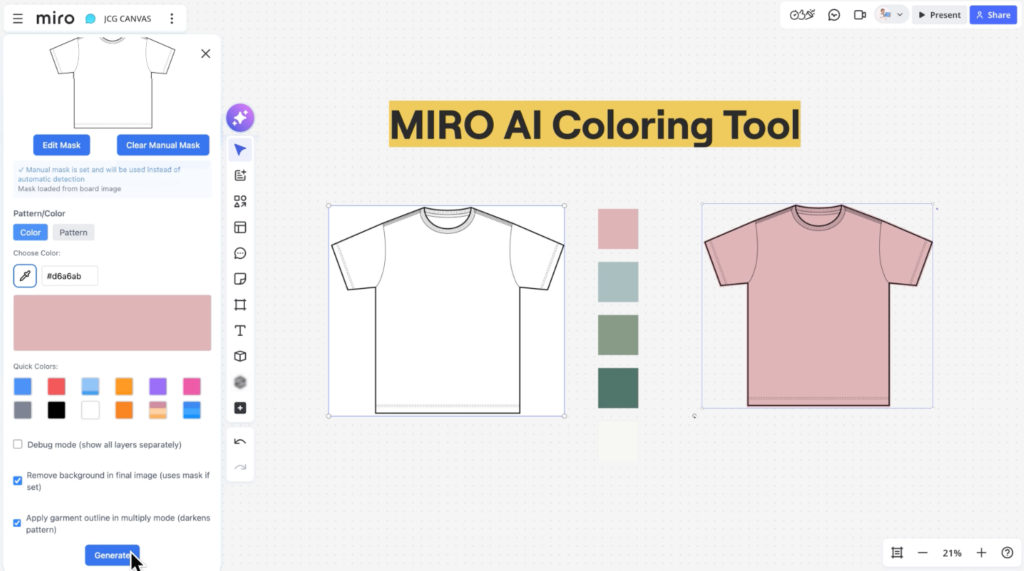
- Color application. Designers hover over the palette to select a color and apply it to a flat sketch using a custom Miro AI coloring tool built specifically for J.Crew Group’s design teams.
- AI renderings and inline comments. The team generates renderings from sketches and drops comments directly on the board.
- Synthesis with Miro Flows. Flows convert visual assets into structured data on the fly. One example from the demo: “count all styles with pink and purple hues, group by class and then by subclass.” That synthesized view can then become a presentation.
- Sidekicks. The team is starting to use Sidekicks to automate and fast-track context and decision-making.
Across the demo, the throughline isn’t any one feature. It’s that the team isn’t visiting a tool to do work; they’re living inside the environment where the work happens.
Impact
With their previous way of working, sequential handoffs meant waiting for feedback in scheduled meetings, then iterating, then meeting again before decisions actually got made. In the Digital Atelier, the team works on a live, shared Miro board with the context already present.
“Speed doesn’t come from cutting steps. It comes from access to the information and making better decisions earlier.”
Amanda Kane, SVP of Product Operations at J.Crew Group
J.Crew Group sees three concrete benefits:
- Less rework. Issues surface earlier, before work has crossed multiple teams. Teams stay on one surface instead of toggling between email, DMs, decks, and separate systems.
- Earlier decisions. Teams converge in the moment of creation, not in a downstream review. Every call is visible on the board, which creates a clear decision history. New participants who join later already have the context. They don’t have to catch up in another meeting.
- Better outcomes. More context, fewer surprises, more confidence in the final call. Agreement at the start of the work reduces divergence midstream.
It’s a different kind of speed: speed because of better collaboration, not in spite of it.
Bigger picture
Two principles shaped the way J.Crew Group built the Digital Atelier, and both of them apply beyond fashion.
AI is best when it’s built in, not bolted on. When AI lives in a separate tab or a separate tool, teams have to leave the work to ask a question, bring the answer back, and reconcile it with what’s already in flight. That adds a step, slowing teams down. J.Crew Group is deliberately building AI that surfaces in Miro at the moment of work, where the context already exists.
Tracy was candid that their journey is ongoing. Some of what they described is live today, and some is still being built. The direction and momentum are what matter, though. Their destination isn’t replacing judgment or reducing roles. It’s making sure the right inputs are in front of the right teams as they decide what’s next, using AI as a superpower.
Partnerships shape the outcome. None of this happens in a transactional vendor relationship. It requires a strategic partnership: between Amanda’s and Tracy’s teams internally; between J.Crew Group, Miro, and Service Rocket on the build; and across the business partners who actually use the environment, including design, sourcing, and external suppliers.
The team’s advice for anyone considering a similar shift was direct: don’t go looking for an AI tool and then come back to the organization looking for a problem to solve. Start by defining the problem. Then look for the tool.
For J.Crew Group, that problem was alignment latency. The Digital Atelier is the artifact. The partnership is what built it.