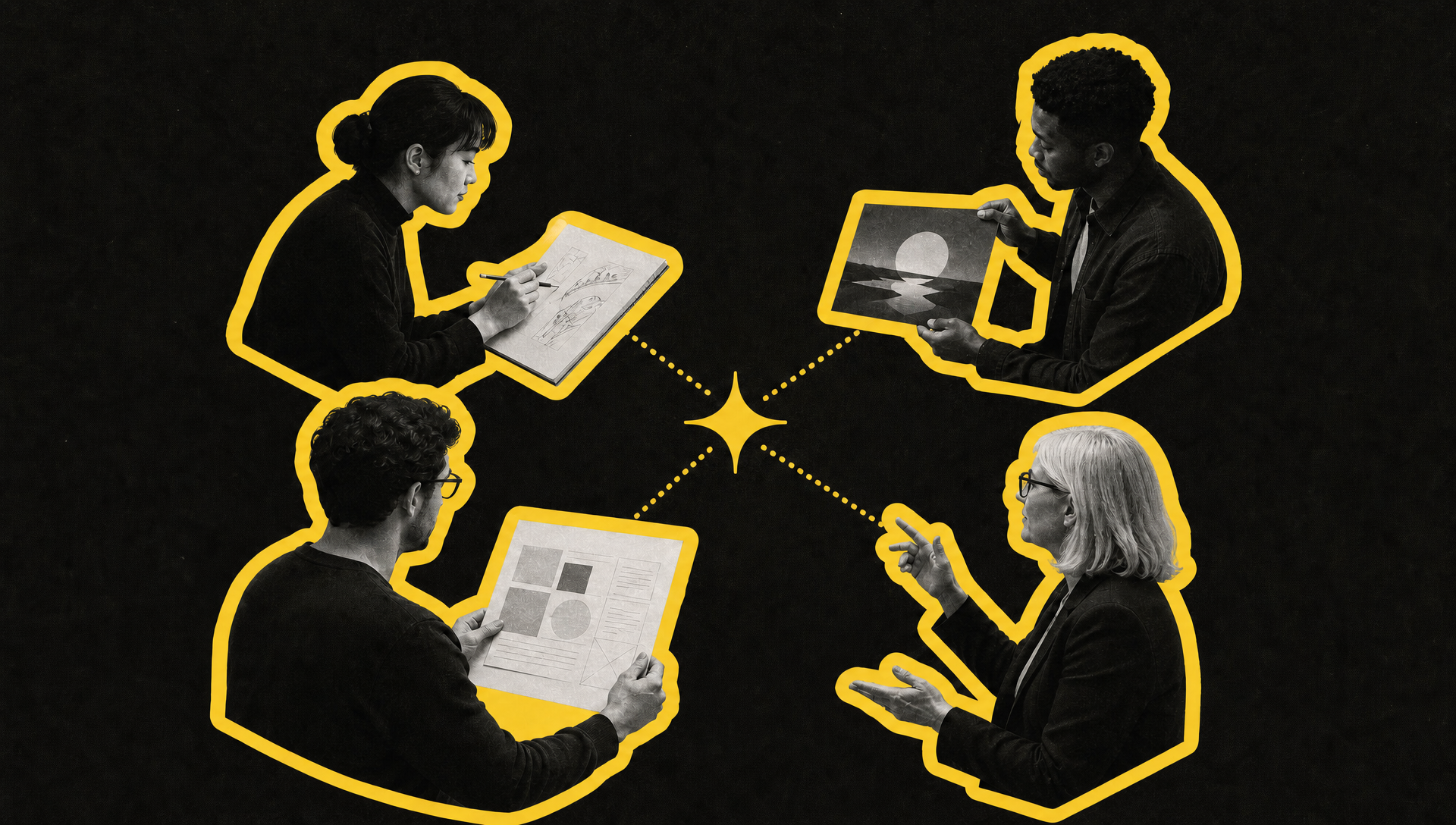
AI has delivered a step change in individual productivity across engineering, product, and design. The defining opportunity now is organizational: turning that individual speed into impact a whole team can feel.
For most of software’s history, building was the most expensive step, so teams organized themselves around it. AI has turned that on its head. An engineer can scaffold a service in minutes, a product manager can synthesize a quarter’s worth of customer interviews before lunch, and a designer can generate a dozen working prototypes in an afternoon. But while creation has scaled, decision quality, strategic clarity, and team alignment have not.
Closing the gap between individual output and organizational impact is the defining opportunity in product development right now. And the fix is more straightforward than you might expect: Embed AI inside the processes a team already shares, such as how work is prioritized or handed off, so that individual speed compounds into a shared direction.
The bottleneck has changed from building to deciding
Just because you can ship something doesn’t mean you should. Building more things faster isn’t the goal. Building the right things is. With AI permeating everyday product work, the bottleneck has moved from building to deciding; from how fast a team can execute to how well it can decide.
Product leaders feel this acutely: asked where their process most needs to improve, product leaders point to the earliest, most strategic steps — generating and evaluating ideas and validating them against the market1 — far more than to the building itself, and they rank strategic misalignment among their biggest problems.2
Moving fast in different directions
That misalignment usually traces back to how AI factors into work today: one person, working alone with an AI agent in a session that’s closed to everyone else. Each person reaches conclusions no one else sees, so those individual gains diverge instead of compounding, and the team only discovers how far it has drifted when everyone finally meets to align.
To make the org-wide impact we all want to see, AI needs to improve how teams actually work together. But in a survey of more than 2,000 product, engineering, and design professionals, only one in four respondents credit AI with enabling better collaboration.3 Worse, one in three leaders in another survey say their AI deployments are actively reinforcing silos.2
Three changes that scale AI’s impact from the individual to the organization
The everyday development cycle must be redesigned around AI, rather than layering it on top of current ways of working. That plays out at three moments where teams most often pull apart: deciding what to build, aligning on the right direction before the team commits, and giving the people and agents that do the building the full picture. Get those working together, and individual speed finally starts to add up.
Make prioritization a shared, evidence-based decision
Customer signal now arrives faster than any team can synthesize by hand, and when that synthesis stays inside one person’s AI session, prioritization defaults to whoever argues most forcefully. Bringing those insights into one space the whole team can see and respond to, with the evidence attached, empowers teams to make better-grounded, more confident decisions.
Prototype to decide, not just to produce
AI lets anyone on the team turn an idea into a working prototype quickly, so the best ideas are no longer limited to those who can craft a polished design or write the code. This presents an opportunity to use prototyping as an alignment step rather than simply a design artifact. The catch is that those prototypes come to life in different places — some as a screenshot of an existing UI, some in code, some in HTML, some in a design tool. Cross-functional teams need a shared workspace where they can bring in any prototype, wherever it originated, for stakeholders to iterate and refine together. Teams working this way can commit to a direction in a single session instead of cycling through multiple rounds of asynchronous review, sacrificing ideation, or validating the wrong variant for the sake of speed.
Give teammates and AI agents the full context
AI coding tools build from whatever context they can find, which is often incomplete or out of date. So when the architecture decision lives in a chat thread, the agreed prototype in one person’s tool, and the reasoning in a spec no agent can reach, the agent builds the wrong thing with full confidence. This is where the Model Context Protocol (MCP) earns the attention it’s getting from engineering teams: it moves context in both directions. What the agents and the codebase know flows into a shared space where the team can see it and decide together. And the team’s shared context — decisions, diagrams, prototypes — flows straight back out to the tools where building happens. The work stays connected across every handoff, and fast code becomes correct code.
Leadership sets the direction
Bringing this all together in practice comes down to a few deliberate choices from leadership, so teams know how they can work more effectively together.
- Start with a handful of high-value, low-risk use cases inside the workflows teams already run, such as synthesizing customer research during planning, or mapping a system’s architecture during a design review, rather than waiting for a wholesale transformation.
- Treat shared context — the decisions, customer evidence, and architecture a team relies on — as living infrastructure worth maintaining, rather than documentation that quickly falls out of date.
- Measure success by how well the organization decides and aligns, not by how fast its individuals work or how many AI sessions have been spun up.
Now that building anything is fast and inexpensive, alignment is what teams need to focus on to turn fast individuals into a decisive organization.
Endnotes
1 Harvard Business Review Analytic Services, survey of product-development decision-makers, commissioned by Miro, September 2025.
2 Forrester Consulting, “AI Workflows for Team Innovation,” survey of engineering, product, and design leaders, commissioned by Miro, Q3 2025.
3 Miro, “AI at Work: What Your Product Org Wants You to Know,” survey of more than 2,000 product, engineering, and design professionals, 2025.