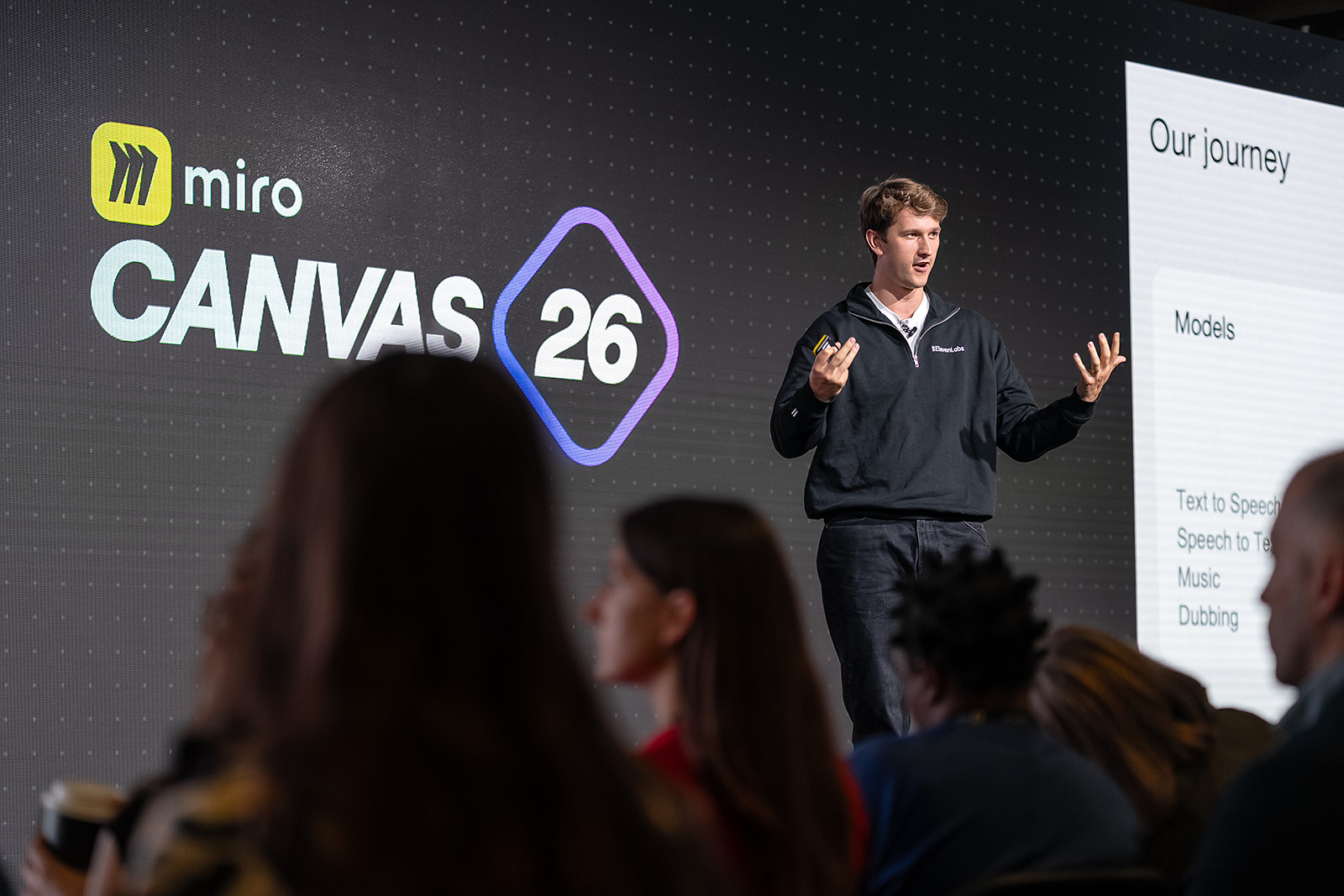
ElevenLabs went from an API and a text box to one of the fastest-growing AI companies in the world. At Canvas 26 London, growth lead Luke Harries shared the playbook: two signals for choosing what to build, small teams that own what they ship, and launches that focus the entire company on one moment.
Four and a half years ago, ElevenLabs’ first product was “an API and a small text box.” You pasted in text, picked one of 11 voices, and it read your words back with an emotional realism no voice model had managed before — it could even laugh. That text box has since grown into an agents platform, a creative platform, and an API business, with partners like Disney, Adobe, Accenture, and Harvey; $500 million in revenue; and an $11 billion valuation.
At Canvas 26 London, growth lead Luke Harries walked through how ElevenLabs decides what to build next. Parts of the playbook will look familiar to any product team. At least one part, by his own description, is controversial.
Watch both the users and the models
ElevenLabs watches two signals when deciding what to build next. The first is a familiar one: customer pull. “You really speak to your customers,” Luke said. “You’re doing anthropology mode with them,” deep interviews, jobs to be done, and “incredible Miro boards mapping out this process.” They closely watch what users do, not just what they say: “People were taking entire audiobooks, pasting it in a paragraph at a time into this little box, downloading it, stitching it together, and then uploading it onto different audiobook stores.” Nobody had asked for an audiobook product, but users were already treating the platform like one.
The second signal is the research push, and it comes from two places at once: ElevenLabs has its own researchers releasing the best AI audio models, and Luke watches the wider field just as closely. The question he asks of every new release: “What are the key unlocks where it wasn’t possible a few months before but it now is?” Video is his go-to example: Video generation quality crossed the threshold into “super realistic” only late last year, and the moment it did, products that had been out of reach quickly became feasible — such as building full video ads with AI, combining video, voices, and music.
To figure out what to ship, ElevenLabs holds the two signals up against each other: here’s what customers are already doing with the product, here’s what the newest model just made possible — where do the two intersect?
Take Eleven Flash, the company’s first low-latency voice model. The team had been paying close attention to how customers were using the API, and one pattern stood out: companies like Duolingo were building educational content with their voices. “You’re like, okay, that’s a cool use,” Luke said, “but what would be even better? What if you could have an interactive tutor that you could just speak to, and it would work all the time?” That led to ElevenAgents, their platform for building real-time voice and chat agents — powering everything from tutors to customer support. This is the exercise ElevenLabs repeats with every new model release.
So, ElevenLabs has a repeatable way to weigh the two signals and decide what to build next. But who actually holds them up against each other and makes the call?
“Controversially, we don’t have PMs yet”
Luke polled the room: how many of you are PMs? A lot of hands. “So, controversially, we don’t have PMs yet.”
The PM work itself hasn’t gone anywhere. “We do have PM-shaped people,” Luke said, adding, “And people still need to do the PM-type work.” His thesis is about where that work is heading:
“As AI gets better and enables us to do more, the PM job will roughly switch to one of two parts. Either it will become this hybrid of engineering, or it will become this hybrid of growth.”
At ElevenLabs, the split looks like this: engineering leads are fully responsible for the product — “that’s their team, that’s what they’re shipping, that’s what they control” — while growth leads own acquisition and product marketing, and are often ex-PMs. The two collaborate on the longer-term roadmap, with one of them explicitly the overall lead.
It all runs inside deliberately small containers: every product at ElevenLabs is an independent team of three to eleven people with ownership and autonomy, and a clear leader. The company has continued to follow this rule even while growing from 5 people to 600 in four years.
If that sounds like the full-stack builder future Tomer Cohen described at Canvas 26 San Francisco — roles blurring as AI absorbs the execution between them — it should. Read about his full-stack builder concept.
A shared answer to one question
Deciding what to build is half the story, but “launches really are the heartbeat of ElevenLabs,” Luke said; “one of these unique moments which allows your entire company to work together to focus on this one moment” across product, engineering, marketing, sales, and even legal. A launch gives the company urgency, an early read on the market — “you get that first boost of revenue, which helps validate what you’ve shipped” — and above all, a shared answer to one question:
“You can create clarity across the team. What are you actually shipping towards?”
ElevenLabs sorts launches into three tiers, from change-log notes up to full-scale splashes, and Luke says, “I often argue with the team: How could we turn this from a tier 2 launch to a tier 1? How could we make this something pressworthy?” The same playbook applies to case studies and funding announcements, and Luke shares the template openly on his blog. His advice isn’t to copy it, though: “What’s less important than the specifics is working out what’s the playbook that matters to you.”
Two signals, one roadmap
Strip away the specifics, and Luke’s system is a discipline any product team can run: Keep the roadmap grounded in what customers actually want, assess every new capability for what it makes possible, and decide together — in one place — what ships next.