Table of contents
Table of contents
By signing up, you agree to Miro's Terms of Service and Privacy Policy.
AI FOMO is real. Open collaboration is the cure.
AI FOMO is the nagging suspicion that a coworker already found a prompt, workflow, or shortcut you haven’t. It’s a specific kind of AI anxiety, and it’s spreading fastest in teams where people learn AI alone, behind closed tabs. The fix has less to do with better tools than most people assume. It comes down to culture: teams that learn AI together, out loud, instead of racing each other in private.
Key takeaways
- AI FOMO is the fear that a coworker already has a better AI shortcut than you. It’s rarely about the technology itself; it’s about learning in isolation.
- Research on workplace fear of missing out found the anxiety can actually improve how well people adapt, but only when leaders show real empathy and teams stay visible to each other.
- Isolation, not AI itself, is what turns that anxiety toxic. Visibility is what keeps it from getting there.
- The fix: make AI experiments visible on a shared board, protect real time to learn without demanding a deliverable, and have leaders model it in public.
Collaborative AI Workflows
Join thousands of teams using Miro to build the right thing, faster.
What AI FOMO actually looks like on your team
It rarely shows up as a complaint. It shows up as silence.
A designer rebuilds a prototype three times on her own, assuming everyone else already has an AI shortcut for it. An engineer spins up an agent on a task nobody will ever ship, just to keep his usage numbers up. A product manager stays two hours late “experimenting,” not because she has a deadline, but because she’s convinced her peers are two steps ahead and she can’t afford to fall behind.
The technology barely matters here. What’s actually driving it is the fear of being the one person in the room still doing it the old way.
Innovation researcher Dr. Lauren Ingram has been tracking this pattern closely. Speaking at the AI Summit in London, she described watching companies roll out AI and then measure success by the wrong thing entirely: how much people used it, not what they built with it. At one company, an employee had built an internal leaderboard tracking how many tokens people burned through. The most active user had run up nearly a million and a half dollars worth of usage. It made for a great story in the press. It didn’t make for better work. “Is that actually effective?” Ingram asked the room. “For me, it is definitely measuring the wrong thing.” She pointed to a poster that used to hang on the walls at a company she worked for, a picture of a rocking horse with the line “don’t mistake motion for progress,” which sums up the whole trap in five words.
When a company pushes AI adoption without giving people a shared way to learn it, employees don’t relax into the tool. They compete with it, and with each other.
Why AI anxiety turns toxic when AI use goes solo
A small amount of AI-related anxiety isn’t automatically a bad thing, and that’s the part most rollouts get wrong.
A 2026 study in the journal Behavioral Sciences, based on survey data from 442 new employees at AI-adopting companies, found that workplace fear of missing out (the researchers call it WFMO) was actually associated with better adaptive performance, not worse. People who worried about falling behind on AI tools were, on average, more likely to seek out new skills, build relationships, and adjust to change faster than people who felt no pressure at all.
But that finding came with a critical condition. The anxiety only turned into growth when it moved through two channels: role stress that pushed people to act, and cognitive reappraisal, meaning the mental trick of reframing “I’m behind” as “I have something to learn.”
Both of those channels depended almost entirely on one thing: how much empathy employees felt from their leaders. When leader empathy was high, the study found the connection between AI anxiety and stronger adaptive performance was significant and real. When leader empathy was low, that same connection all but disappeared.
In other words, AI FOMO isn’t the problem by itself. Isolation is. Give people a reason to believe someone has their back while they catch up, and the anxiety becomes fuel. Leave them to sort it out alone, competing for the same scraps of validation, and it curdles into exactly the kind of toxic pressure Ingram describes: job hugging, burnout, and people pretending to use AI just to look busy. Even she isn’t immune to it. “I also feel the same FOMO, right?” she told the audience. “Even if you dedicated all of your time to learning the new tools and how to go deep with them, there literally aren’t enough hours in the day.” Coming from someone who works in AI adoption full time, that admission carries some weight.
Leader empathy matters here, but it’s not the whole story. Peer visibility carries just as much weight. If your only view of how your team uses AI comes from your manager checking in on you, you’re still learning in a vacuum. Closing that gap means making your teammates’ AI workflows visible to you, and yours visible to them, by default.
Picture a team that learns AI out loud
Now picture the alternative.
A new hire joins a team and, within her first week, can see exactly how her colleagues are using AI: which prompts worked for a customer research summary, which Sidekick someone built to draft release notes, which format someone tried and abandoned because it didn’t add anything. She doesn’t have to guess whether people are ahead of her. She can see the whole map.
That team isn’t measuring AI success by how many people are “using the tool.” They’re measuring it by what gets built, decided, and shipped, together. When someone finds a workflow that saves real time, it doesn’t stay a personal trick. It becomes something the whole team can pick up and run with. Nobody’s afraid to ask a question, because asking a question isn’t a confession that you’re behind. It’s just how the team works.
Ingram was pointing at exactly this when she pushed past just handing someone a login and wishing them luck. “Can you get them thinking about redesigning workflows instead?” she asked. It’s also exactly what the research on leader empathy was hinting at: when people feel supported and see how others are adapting in real time, uncertainty turns into direction instead of dread.
Collaboration turns “fear” into “certainty”
The tool you build your work in actually starts to matter at this point.
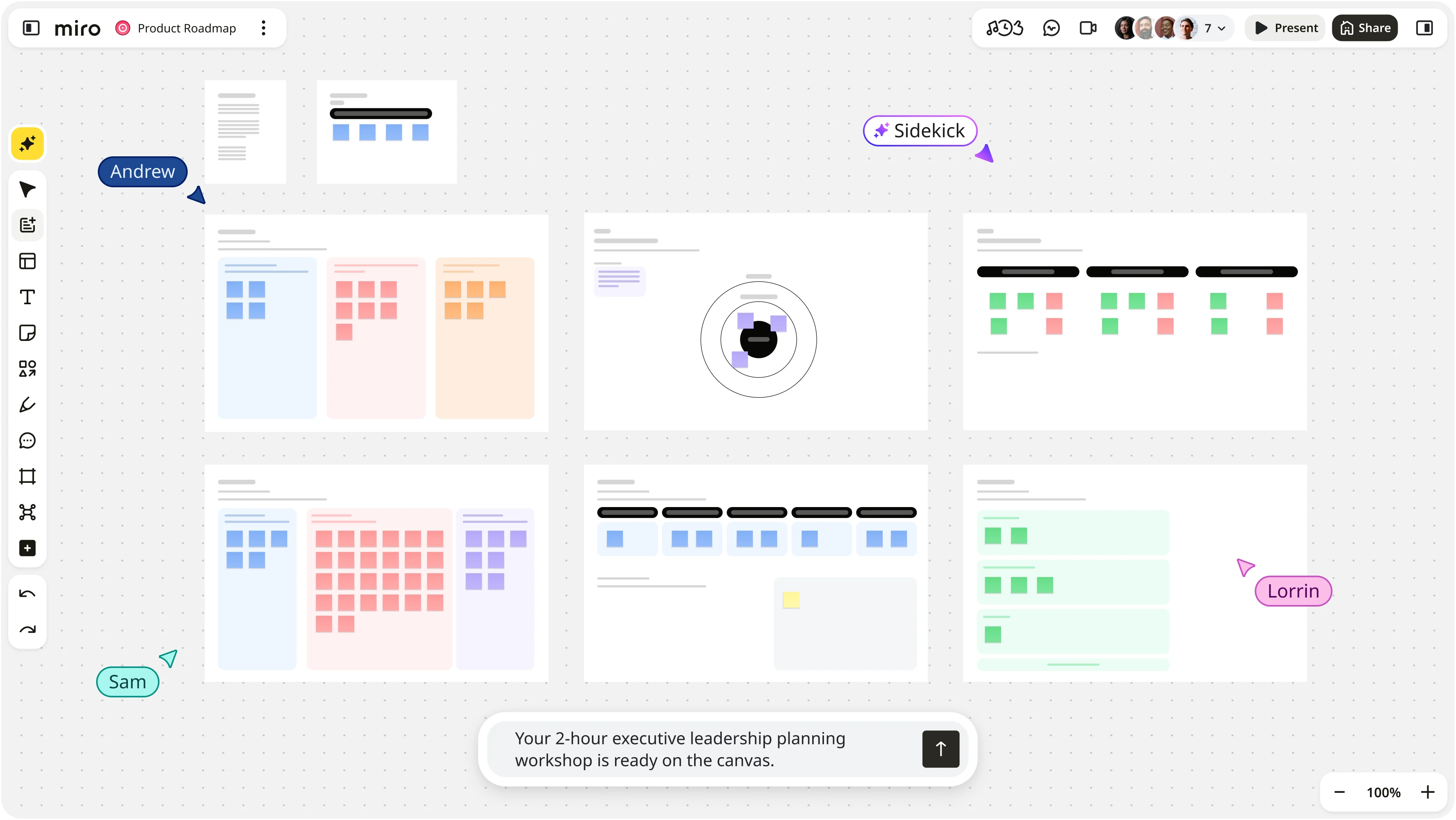
Miro is an innovation workspace built for exactly this kind of shared learning, in real time when your team is in the same working session and asynchronously when they’re not. Instead of AI experiments living in someone’s private chat history or a folder only they can see, they live on a shared, AI-powered canvas that anyone on the team can open, build on, and learn from.
That’s a small shift with a big effect: when AI work happens in the open, on a board the whole team can see and edit, “did you try this yet?” stops being a threat and starts being a normal Tuesday question. A teammate’s AI-drafted sticky-note brainstorm, mind map, or prototype isn’t a secret weapon. It’s just the next thing to build on. And because a Miro board doesn’t require everyone to be online at the same moment, someone can leave notes on their AI workflow at 4pm and a teammate in a different time zone can pick it up the next morning without losing any context.
The real answer to AI FOMO has nothing to do with mandates to use AI more. It comes down to a culture where using it, and talking about how you use it, is just part of how the team works. That’s what turns the fear of missing out into the certainty of learning together.
A simple way to redesign a workflow with AI
You don’t need a company-wide AI strategy to start. Jesse Greenhouse, a Miro solutions lead who walks enterprise teams through exactly this problem, laid out a five-step approach in a recent webinar on redesigning workflows between humans and AI. It works just as well for a single team as it does for a whole org:
- Map the process as it actually works today. Not the version in the handbook. What people really do, step by step.
- Decide where AI belongs. For each step, ask honestly: should AI augment it, automate it, or stay out of it entirely? Not every step needs AI, and pretending otherwise just adds noise.
- Build a version and test it. Small and rough is fine. The goal is a working first draft, not a finished product.
- Standardize once it’s proven. Once the team has validated it actually works, that’s the point to roll it out more broadly, not before.
- Keep modernizing it. A workflow you fixed six months ago is probably already due for another look. The tools change fast enough that this can’t be a one-and-done exercise.
Advice for rolling this out without triggering AI FOMO
Three things matter most here: making the work visible, protecting real room to learn, and having leaders model it themselves.
Start with visibility. If someone builds a useful Sidekick or maps out a workflow, have them drop it on a shared Miro board instead of a personal file, so one person’s shortcut becomes everyone’s starting point instead of a private advantage nobody else knows to ask about. Pair that with a short, recurring show-and-tell, fifteen minutes every other week where two or three people show what they tried, including what didn’t work. The recurrence matters more than the polish here. A one-off session just adds another thing people feel behind on. And while you’re at it, change what you measure. A leaderboard of AI usage tells you who’s busy, not whether the work is any better, so track what shipped faster this month, or what decision got made with more confidence, and let usage numbers stay in the background where they belong.
None of that works without giving people actual room to learn. That means space to experiment without demanding a polished output in return. Miro’s own team has used a bigger version of this: giving an entire team 48 hours completely off their normal workload, with nothing owed at the end, just room to build something with AI. Attach a deliverable to that time, and it stops being exploration and starts being one more thing to prove. It also helps to normalize asking AI how to use AI itself.
Asking a model to walk you through a workflow like you’re five, or to help you write a prompt you don’t know how to write yet, is a much smaller ask than admitting out loud that you’re behind, and it’s a habit worth encouraging openly rather than something people figure out quietly on their own. And none of it lands if leaders don’t model it themselves, in public. When leaders show up with genuine support instead of just directives, that same AI anxiety that could burn someone out instead pushes people to adapt. Sharing your own half-finished experiments, including the ones that went nowhere, does more to lower the temperature than any reassurance speech.
What this looks like in practice
Endava is a useful example on a much bigger scale. The global technology and consulting firm has more than 11,000 people, and when generative AI made code cheap to produce, leadership faced an obvious question: what exactly do you sell when anyone can generate code? Their answer became a company-wide methodology called Dava.Flow, built around one idea: context quality matters more than code output, so get the context right before agents start working. Endava built the whole thing, from onboarding materials to live working boards, on Miro’s canvas, using Sidekicks to help teams turn client conversations into the structured input AI agents actually need.
The more interesting part for this conversation is how Endava avoided turning that rollout into a competition. Instead of mandating adoption company-wide, they built tiered training so people could grow into it from different starting points, rather than everyone feeling instantly behind. They leaned on champions inside teams to model the new way of working day to day, rather than expecting a memo to change eleven thousand people’s habits overnight. And they made sure operational functions like Legal and HR moved alongside delivery teams, so nobody was left trailing by months. Endava’s Regional CTO, Joe Dunleavy, put it simply at Miro’s Canvas 26 conference: the technology was never really the hard part. Bringing people along with it was.
Leadership modeling the behavior in the open is what made the difference. Learning happened together, at scale, instead of in isolation. Moving on this now, before the next AI shift widens the gap, is what actually pays off.
Common questions about AI FOMO and AI anxiety
What is AI FOMO? AI FOMO is the fear of falling behind coworkers who seem to have found better AI tools, prompts, or workflows. It’s a workplace-specific version of fear of missing out, driven by the sense that others have a “secret edge” you don’t.
Is AI anxiety always a bad thing? Not necessarily. Research on workplace fear of missing out found that moderate AI-related anxiety can actually push people toward learning new skills and adapting faster, but only when they also feel supported by an empathetic leader. Without that support, the same anxiety tends to curdle into stress and burnout instead.
How can leaders reduce AI FOMO on their team? Make AI use visible instead of private. Share workflows and experiments on a common board, run short regular show-and-tells, measure outcomes instead of activity, and be visibly supportive rather than just directive. The goal is to make sure nobody’s dealing with that anxiety alone, not to eliminate it entirely.
Does collaboration actually reduce AI anxiety? Yes, in a very practical sense. When AI experiments happen on a shared canvas that the whole team can see and build on, employees stop guessing whether others are ahead of them. They can see exactly what’s been tried, what worked, and what didn’t, which turns quiet competition into shared progress.
The bottom line
Same thing we said at the start: none of this requires a company-wide AI strategy. It starts with one team deciding to stop learning AI in private.
Ingram’s talk and the study on workplace fear of missing out are pointing at the same thing from two different angles, and it’s the same thing we opened with. The anxiety was never really the problem. Isolation was. A team that maps its own workflow, decides honestly where AI helps, and shows its work in the open doesn’t need to out-compete anyone. It’s already ahead, together, which is a much better place to be than ahead, alone.
Ready to trade the guessing game for real momentum? Start a free Miro board and run your next AI experiment out in the open, today.
Read more
Join our 100M+ users today


