Table of contents
Table of contents
By signing up, you agree to Miro's Terms of Service and Privacy Policy.
Agile roles and responsibilities: an overview
Summary
In this guide, you will learn:
- Key Agile roles: Product Owner, Scrum Master, Development Team, and their responsibilities.
- How to structure Agile teams for success
- Importance of clear Agile roles for reducing confusion and enhancing collaboration.
- How Agile roles differ from traditional project management, emphasizing flexibility and iterative progress.
- Miro's role in supporting Agile processes with templates, digital Scrum boards, and integrations.
Agile methodology has transformed how teams work, fostering collaboration, flexibility, and efficiency. However, for Agile to work effectively, clearly defined roles are essential. In this guide, we’ll break down the key Agile roles, their responsibilities, and how they work together to deliver value-driven results. Whether you’re new to Agile or refining your processes, understanding these roles is a cornerstone of success.
What is Agile?
Agile is a dynamic approach to software development and project management that emphasizes iterative progress, cross-functional collaboration, and responsiveness to change. Instead of a rigid top-down structure, Agile empowers teams to self-organize and adapt to evolving priorities.
Ambiguity can derail even the most talented teams. Clearly defined Agile roles ensure that responsibilities are evenly distributed, reducing confusion and promoting accountability. By giving each team member a specific focus, Agile roles enhance productivity and drive successful outcomes.
Agile teams take on a very different structure and workstyle than what you’d see in traditional project management. In waterfall projects, for example, team structures focus on centralized authority, clear hierarchies, and top-down task delegation.
In Agile, roles are defined by accountability, rather than authority. Each role is accountable for a specific group of tasks and outcomes that they can accomplish how they see fit. This empowers teams to self-organize and independently iterate on their processes and outputs.
This Agile approach to team alignment has three key positive effects:
Project success.
Agile’s team structure ensures a continuous delivery of outcomes by promoting adaptability, clear priorities, and effective collaboration.
Team dynamics.
It fosters a culture of trust, open communication, and shared responsibility, enhancing team cohesion and problem-solving.
Individual accountability.
Clear role expectations empower team members to take ownership of their contributions, driving commitment and personal responsibility.
While Agile teams are inherently more flexible and dynamic, they do follow a common structure.
The 3 key Agile roles
Here are the key Agile roles a team typically team consists of:
1. Product Manager or Product Owner
The Product Manager, also known as a Product Owner, is responsible for defining the product vision, prioritizing features with input from clients and stakeholders, setting and managing the backlog, and ensuring the end result meets user needs.
In this role, product owners act as the key liaison between stakeholders and the team. As the project unfolds, they communicate stakeholder feedback, and continuously refine backlog items to keep the project on-track and relevant.
2. Scrum Master
The Scrum Master facilitates the Scrum process, helping to ensure that the team develops and improves upon their ways of working through Agile principles and values. They support and sometimes facilitate Agile events, promoting collaboration, removing obstacles, and improving workflows.
Scrum Masters enable the team to focus on delivering value to the customers incrementally and efficiently, and driving toward continuous improvement goals.
“Scrum Masters are not Scrum Police. They don’t enforce Scrum practices, but rather champion them. As such, Scrum Masters should be seen as servant leaders who earn respect and influence over their Scrum teams due to their impact, rather than their authority.”
— Dave Ross, Chief Agile Evangelist @ Miro
3. Development team member
The development team should be laser focused on developing the product. They’re the technical experts and craftspeople on the team who bring the product vision to life, with the goal of delivering the highest-quality end product possible.
These teams self-organize, plan, build, test, and adapt their workflows over the course of numerous work cycles to achieve their central project goals. Their responsibilities include collaborating to implement prioritized backlog items, ensuring deliverables meet the definition of done, and maintaining transparency through tools like daily stand-ups.
Extended Agile team roles
- Agile coach: an Agile Coach goes beyond a single team, helping the entire organization embrace Agile principles. They provide mentorship, facilitate Agile transformations, and promote a culture of continuous improvement.
- Stakeholders: stakeholders, including customers, business sponsors, and executives, play a key role in defining project goals. While not part of the core team, their input shapes the vision and success of the product.
- Business analyst: business Analysts bridge the gap between stakeholders and the development team. Their responsibilities include: analyzing requirements and documenting workflows, ensuring the product meets business needs and collaborating on user stories and acceptance criteria.
Structuring Agile teams for success
No team is perfect when they first form. It takes trial, error, and refinement to reach the point where a team is operating at peak efficiency and efficacy. To reach this stage, you need to structure your teams for success from the beginning.
Here’s how:
Foster cross-functionality.
Create Agile teams with diverse skill sets so that they can handle all aspects of product development, from design to delivery.
Encourage self-organization.
Empower teams to make decisions about task allocation and workflow management independently. This allows them to self govern and use their expertise to improve processes, and pull their work — rather than having it assigned or “pushed” from a central authority figure.
Define clear roles.
Assign clear responsibilities and ensure all contributors are fully informed of their positions to reduce overlap and confusion.
Promote collaboration.
Facilitate open communication through daily stand-ups and regular retrospectives to build trust and alignment.
Limit team size.
Keep teams small (typically seven to 10 members) to maintain agility, effective communication, and focus. Be precise and deliberate about who you invite to the Agile team.
Build trust over time.
Agile contributors should have the power to make decisions and take ownership of their tasks to enhance motivation and productivity. This requires trust and safety being built over time.
The work, however, doesn’t stop once an Agile team is assembled and structured. You still need to maintain close collaboration between team members throughout the product lifecycle and beyond.
How to foster collaboration in Agile teams
The Agile methodology offers a set of tools to help foster collaboration and communication between teammates. These come in the form of Agile events — meetings that occur at regular intervals during a workcycle.
These events include Sprint planning, daily stand-ups, post-Sprint reviews, and Sprint retrospectives. Following this meeting structure is the best tool you have for keeping teams aligned.
You can also:
- Establish clear communication channels, and implement specific tools like messaging apps, video conferencing, and project management software to keep the team connected and aligned. This can be agreed to and codified in a team working agreement — a mutually agreed-upon set of guidelines that define how team members will collaborate, communicate, and work together effectively throughout the project. .
- Encourage active participation by making a point to engage with all team members at each meeting, and building an open environment for idea sharing. Be mindful of different working and communication styles and adapt as necessary.
- Organize team-building activities like social events and informal gatherings to strengthen relationships and build camaraderie on the team.
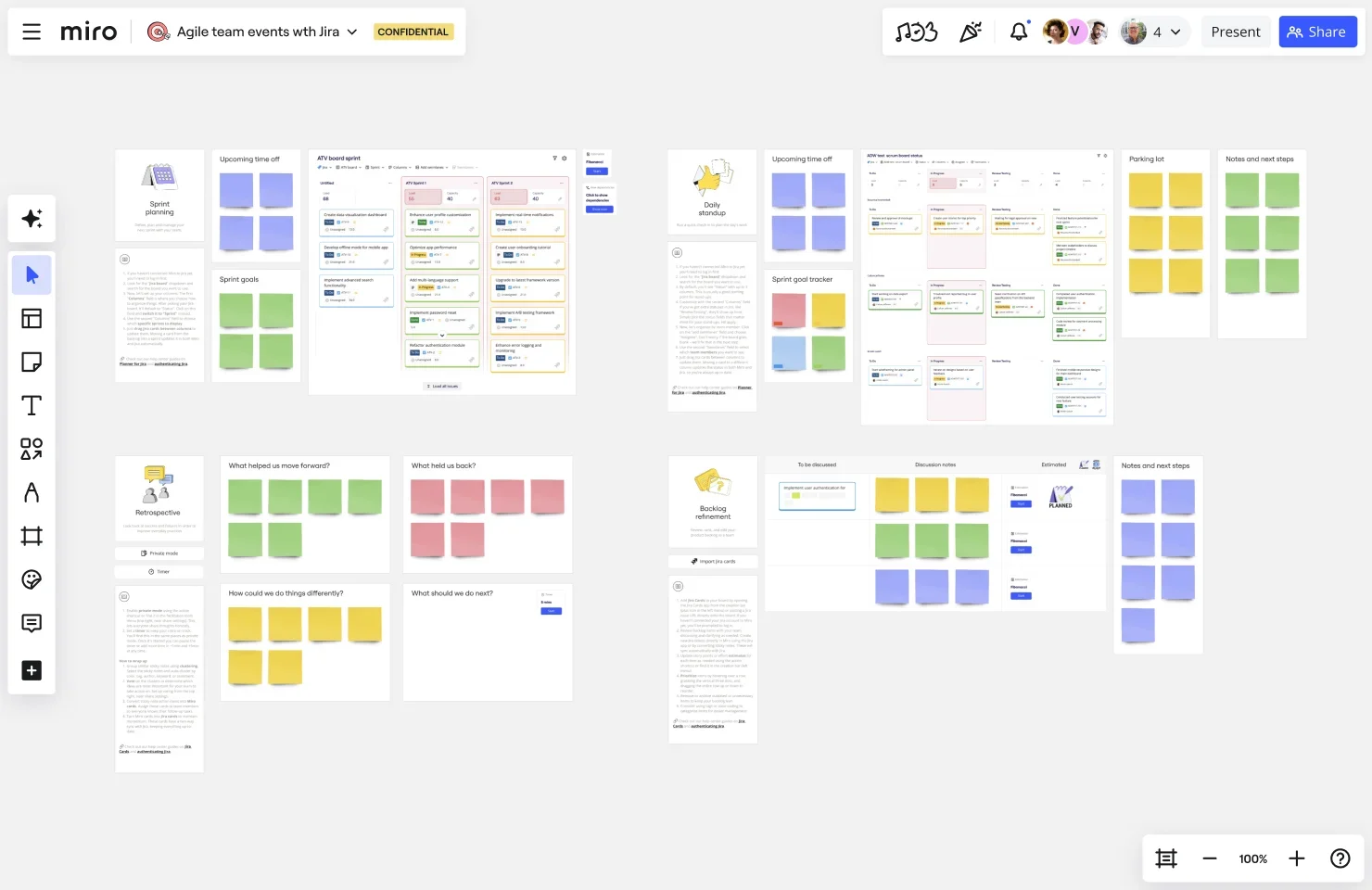
- Use collaboration tools like Miro to organize and manage Sprint events, creative collaborative documents, capture and organize stakeholder feedback, and facilitate better retrospective and planning sessions.
Collaboration in Agile teams comes from three fronts: structured events, proper tooling, and good old fashioned bonding. Balance these three and you’ll have a close-knit team that can tackle any challenge.
Tip: Miro offers a digital Scrum board and Agile toolkit that can be used to align your Agile teams and boost collaboration.. These tools, alongside dozens of pre-built Scrum templates, help drive better productivity, communication, and alignment through work cycles, helping you create a better and more complete product for your stakeholders.

Helpful tools include:
- A Sprint planner that integrates with Jira and Azure Devops to create custom views of tasks and work streams for the Sprint team.
- Workflow status trackers, which chart interconnected tasks, risks, overlapping work, and dependencies.
- Private Mode, which allows Agile team members to add comments and feedback during meetings without influence from others on the team.
- Forecast timelines that help you visualize an entire week, quarter, or year of work.
- An estimation app that helps you estimate scope of work, resource requirements, and costs.
- A timer that’s displayed on screen, helping to keep events within the desired timeframe.
Adapting roles to specific Agile methodologies
We mentioned earlier that roles and responsibilities may differ depending on the type of Agile methodology that you’re using. Let’s explore those differences now.
Scrum
The roles and responsibilities of a Scrum team follow closely what we’ve outlined in this article.
- The Product Owner is responsible for managing the backlog, defining priorities, and ensuring alignment with stakeholder goals.
- The Scrum Master facilitates Scrum events like Sprint planning and retrospectives, removes impediments, and ensures adherence to Scrum principles.
- Development team members are cross-functional and self-organizing, delivering increments of value during each sprint.
This structure promotes accountability, teamwork, and iterative progress through Sprint cycles.
Kanban
Kanban, however, de-emphasizes formal roles and instead focuses on the team’s collaborative effort to optimize workflows. The central tool in this methodology is the Kanban board, which allows teams to self-manage and visualize work items. This emphasizes flow efficiency, limits work in progress (WIP), and has explicit process policies for when work is ready to start and when it’s completed.Roles such as Service Delivery Manager and Service Request Manager may emerge to oversee process optimization and stakeholder communication, but these are not mandatory.
SAFe
In the Scaled Agile Framework (SAFe), roles expand to manage more complex and large-scale projects. On top of the roles we outlined above, you also will have:
- The Release Train Engineer (RTE), who coordinates multiple Agile teams (Agile Release Train) to ensure alignment with the broader program.
- The System Architect, who oversees technical designs and system integration.
The Product role is split between a Product Owner and a Product Manager.
- The Product Manager focuses on the overall program backlog, is forward looking to ensure product viability and manages the relationship with business stakeholders
- The Product Owner focuses on the team-level backlog and direct collaboration with the team, and ensures the near term feasibility of the increments being delivered
These roles support scaling Agile principles while maintaining a consistent delivery cadence across teams and business units.
Scrum: Scrum is an Agile framework focused on iterative, time-boxed Sprints to deliver value incrementally.
Kanban: Kanban is an Agile method centered on visualizing workflows, limiting work in progress (WIP), and optimizing flow efficiency.
SAFe: The Scaled Agile Framework (SAFe) is a methodology for applying Agile practices at an enterprise scale.
Agile teams: the driving force behind project success
To create a successful Agile product, you need the right team — the right people assigned to roles with clear responsibilities. This process all begins with understanding how Agile teams come together, stay aligned, and collaborate throughout work cycles. Repeat, improve, repeat.
Challenges and solutions
Defining agile roles can be challenging, particularly when misunderstandings about role overlaps arise, leading to conflicts and misaligned expectations. These issues can be mitigated through regular communication and clear documentation, ensuring everyone understands their responsibilities. Additionally, when team members transition into new roles, thorough training and mentorship are essential to maintain team cohesion and avoid disruptions to workflow.
Comparing Agile Framework roles
Comparing roles across Agile frameworks highlights the flexibility and adaptability of Agile methodologies, allowing organizations to choose structures that best suit their needs.
Scrum vs. Kanban roles
Scrum is a highly structured framework with defined roles such as Product Owner and Scrum Master, which ensure clear accountability and efficient coordination. These roles guide teams through iterative sprints, enabling them to deliver incremental improvements.
In contrast, Kanban is less prescriptive, focusing on visualizing workflows, managing work in progress, and ensuring continuous delivery without assigning specific roles. Teams using Kanban prioritize adaptability and flow over rigid role definitions, making it ideal for projects requiring flexibility.
Scaled Agile Framework (safe) vs. LeSS
When scaling Agile practices, frameworks like Scaled Agile Framework (SAFe) and Large-Scale Scrum (LeSS) offer distinct approaches.
SAFe introduces a hierarchical structure with additional roles such as Release Train Engineers and Solution Architects, tailored for large organizations managing complex portfolios. This framework provides clarity in role responsibilities across multiple teams, ensuring alignment and scalability.
Conversely, LeSS simplifies scaled Agile by extending Scrum principles to larger teams, emphasizing minimal additional hierarchy and maximizing collaboration. This approach fosters shared leadership and streamlined decision-making, making it suitable for organizations seeking agility without excessive layers of management.
Boost your Agile practice with Miro
Understanding Agile roles is just the first step in fostering a high-performing team. Tools like Miro make Agile events more efficient and engaging. From visualizing workflows to facilitating retrospectives, Miro helps teams stay aligned and productive. Sign up today to explore how Miro can simplify Agile collaboration for your team.
Author: Brendan McConnell, Contributing Writer Last update: June 11, 2026
Read more
Join our 100M+ users today


