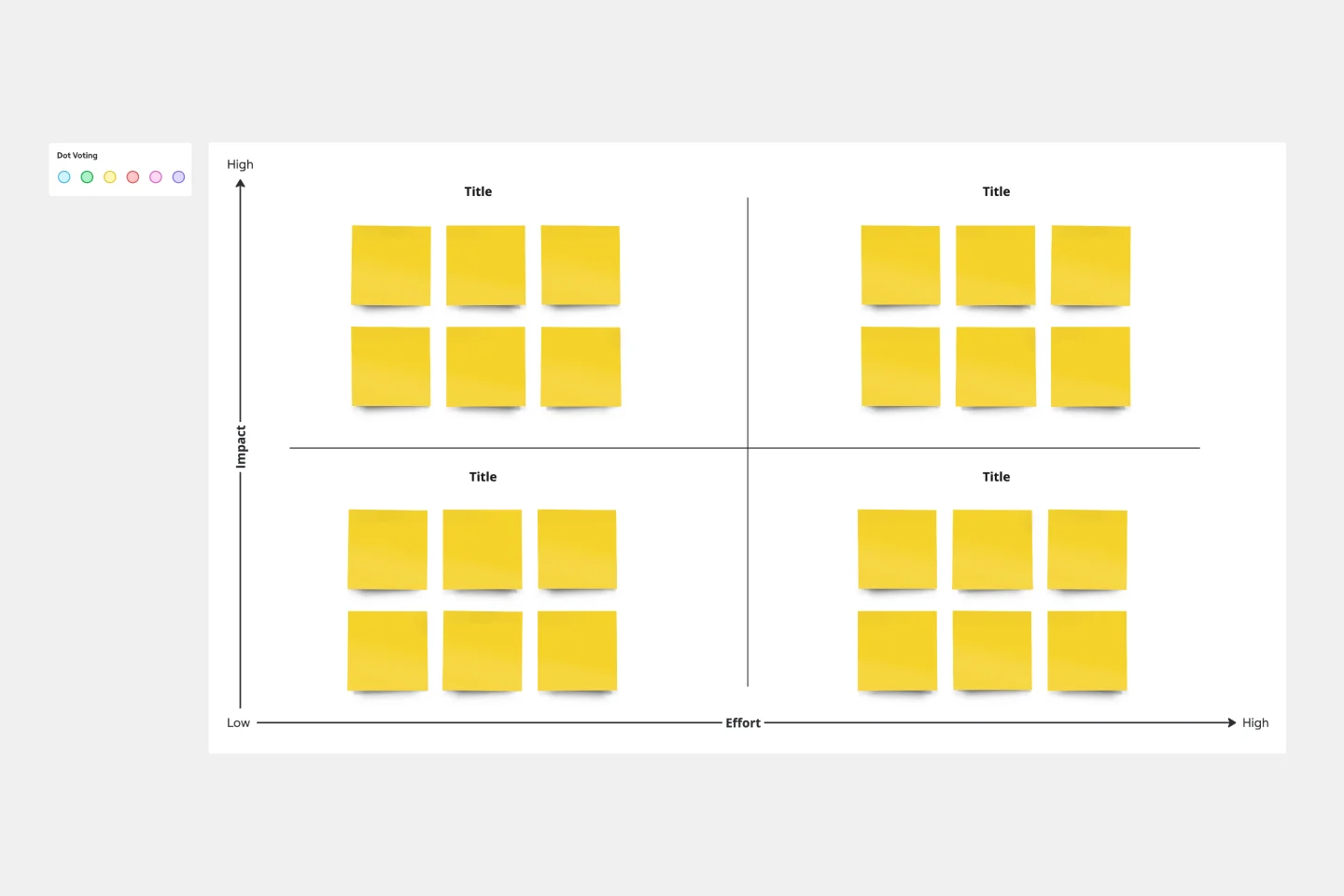

Why use a Lightning Decision Jam (LDJ)?
Creative problem solving and clear decision-making is what separates good designers and managers from the best. The problem with anything that requires creative & critical thinking, however, is that it’s easy, lose focus and fall into the trap of having, open-ended, unstructured discussions (ugh!). Projects stall, teams lose momentum, and everything goes over-budget.
But don’t despair! There’s a solution to the plague of unstructured discussions – the Lightning Decision Jam (or LDJ as we like to call it). It’s a super-powerful exercise to solve any problem by replacing open discussion with a clear process.
We’ve created this board to guide you through all the steps of the LDJ process (it’s fast and efficient). Give it a try, and we guarantee your meeting will never be the same!
What to use this exercise for:
It’s always good to frame an LDJ session with a broad topic, here are some examples:
The conversion flow of our checkout
Our internal design process
How we organise events
Keeping up with our competition
Improving sales flow
Watch the video
AJ&Smart
Product Design Sprint Agency
AJ&Smart is an award-winning product design sprint agency that uses Design Sprints to compress work that would usually take months into days.
Categories
Similar templates
Official Remote 5-day Design Sprint

Official Remote 5-day Design Sprint
The goal of a Design Sprint is to build and test a prototype in just five days. You'll take a small team, clear the schedule for a week, and rapidly progress from problem to tested solution using a proven step-by-step checklist. Steph Cruchon of Design Sprint created this template for Miro in collaboration with design sprint gurus at Google. This Design Sprint template is designed specifically for remote sprints so you can run productive and efficient sprints with colleagues around the world.
Remote Design Sprint

Remote Design Sprint
A design sprint is an intensive process of designing, iterating, and testing a prototype over a 4 or 5 day period. Design sprints are conducted to break out of stal, work processes, find a fresh perspective, identify problems in a unique way, and rapidly develop solutions. Developed by Google, design sprints were created to enable teams to align on a specific problem, generate multiple solutions, create and test prototypes, and get feedback from users in a short period of time. This template was originally created by JustMad, a business-driven design consultancy, and has been leveraged by distributed teams worldwide.
Action Priority Matrix Template

Action Priority Matrix Template
You and your teammates probably have more ideas than resources, which can make it difficult to prioritize tasks. Use an Action Priority Matrix to help choose the order in which you will work on your tasks, allowing you to save time and money and avoid getting bogged down in unnecessary work. An Action Priority Matrix is a simple diagram that allows you to score tasks based on their impact and the effort needed to complete them. You use your scores to plot each task in one of four quadrants: quick wins, major projects, fill-ins, and thankless tasks.
Official Remote 5-day Design Sprint

Official Remote 5-day Design Sprint
The goal of a Design Sprint is to build and test a prototype in just five days. You'll take a small team, clear the schedule for a week, and rapidly progress from problem to tested solution using a proven step-by-step checklist. Steph Cruchon of Design Sprint created this template for Miro in collaboration with design sprint gurus at Google. This Design Sprint template is designed specifically for remote sprints so you can run productive and efficient sprints with colleagues around the world.
Remote Design Sprint

Remote Design Sprint
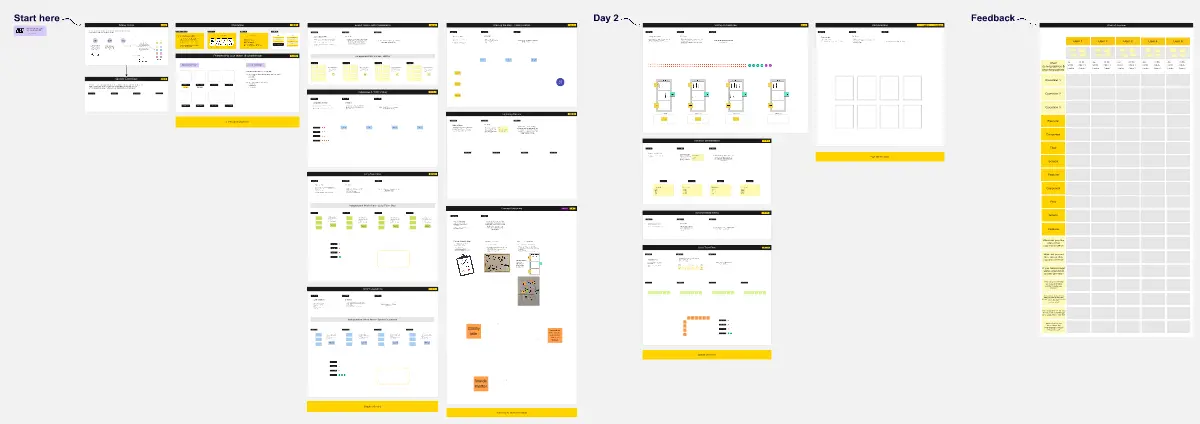
A design sprint is an intensive process of designing, iterating, and testing a prototype over a 4 or 5 day period. Design sprints are conducted to break out of stal, work processes, find a fresh perspective, identify problems in a unique way, and rapidly develop solutions. Developed by Google, design sprints were created to enable teams to align on a specific problem, generate multiple solutions, create and test prototypes, and get feedback from users in a short period of time. This template was originally created by JustMad, a business-driven design consultancy, and has been leveraged by distributed teams worldwide.
Action Priority Matrix Template

Action Priority Matrix Template
You and your teammates probably have more ideas than resources, which can make it difficult to prioritize tasks. Use an Action Priority Matrix to help choose the order in which you will work on your tasks, allowing you to save time and money and avoid getting bogged down in unnecessary work. An Action Priority Matrix is a simple diagram that allows you to score tasks based on their impact and the effort needed to complete them. You use your scores to plot each task in one of four quadrants: quick wins, major projects, fill-ins, and thankless tasks.