Table of contents
Table of contents
By signing up, you agree to Miro's Terms of Service and Privacy Policy.
The 70/30 rule behind every stalled AI ROI story
I sit between product and go-to-market on Miro's customer AI transformation team, working with our biggest enterprise accounts on their AI transformation efforts. So I get asked the same question, in a dozen different phrasings, almost every week: how do we actually measure the ROI of AI?
Most enterprises haven't solved this yet, and it's not because they lack the tools. It's because a small slice of their organization is already fluent in AI while the rest of the company can't get in the door. Fix that gap and the ROI conversation gets a lot easier.
Collaborative AI Workflows
Join thousands of teams using Miro to build the right thing, faster.
Nobody I talk to has actually solved this
When I joined this team, I assumed our largest customers had this figured out. They have wall-to-wall enterprise contracts with Anthropic, Microsoft, and OpenAI, and company-wide model access, so surely somewhere in there was a working AI transformation roadmap.
I can't point to a single partner that has it solved. Not one.
What I see instead is millions of dollars in token spend that hasn't turned into anything you can point to on a P&L. Everyone's seen AI make individual work faster. But the organization as a whole is spending more on tokens than ever, drowning in more context than ever, and still can't say what any of it bought them.
That gap between visible individual wins and invisible enterprise returns is the problem I keep running into.
Your org already has a working example of AI ROI. It's just 30% of the building
The pattern behind that gap is what I've been calling the 70/30 rule. The numbers are anecdotal, based on what I see across my accounts.
Roughly 30% of a typical enterprise, usually engineers, is already about 95% of the way toward getting real value from AI. They've built their own skill files, their own workflows in tools like Cursor or Claude Code, their own habits. The other 70%, the business side, is stuck. Not because they lack ambition, but because getting into a markdown file to edit a skill, or reading a Python script to understand what a workflow actually does, is a real barrier for someone who's never had to do it.
That fluent 30% can't move enterprise economics on their own. You can have the best AI engineers in the company running circles around their old workflows, and the company's overall numbers barely move, because 70% of the people doing the work are still locked out.
The real question isn't how to get more out of AI. It's how to get the 70% to the same starting line as the 30%, without asking a marketer or a supply chain manager to learn to read code.
What a visual skill file actually does
The workflows your best AI users already built usually live inside a terminal only they can read, and that's the actual barrier: not skill, access.
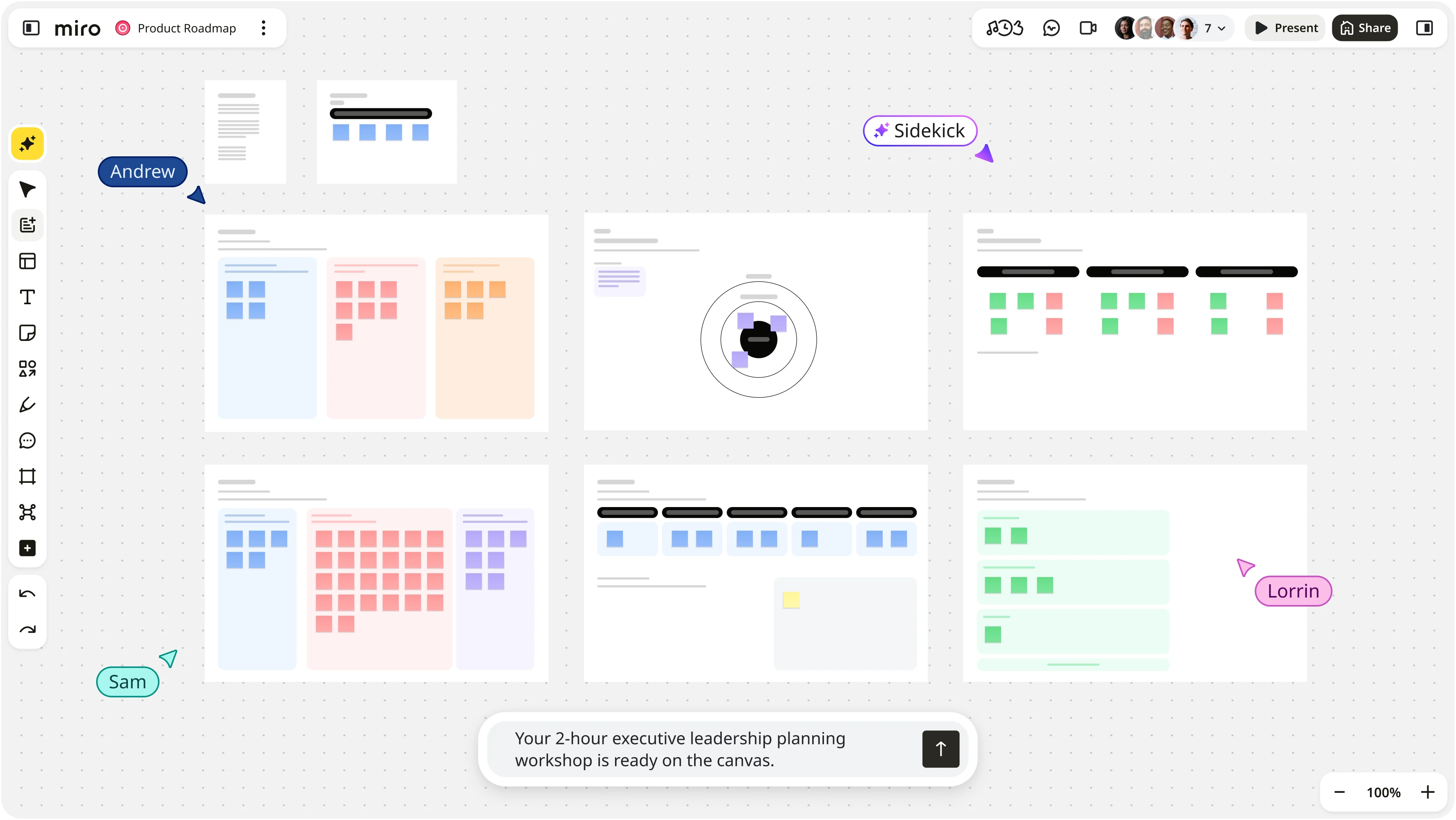
Getting the rest of the team to that same starting line means taking what's already happening in code and rebuilding it as something a whole team can look at, question, and improve together, not just the people who wrote it.
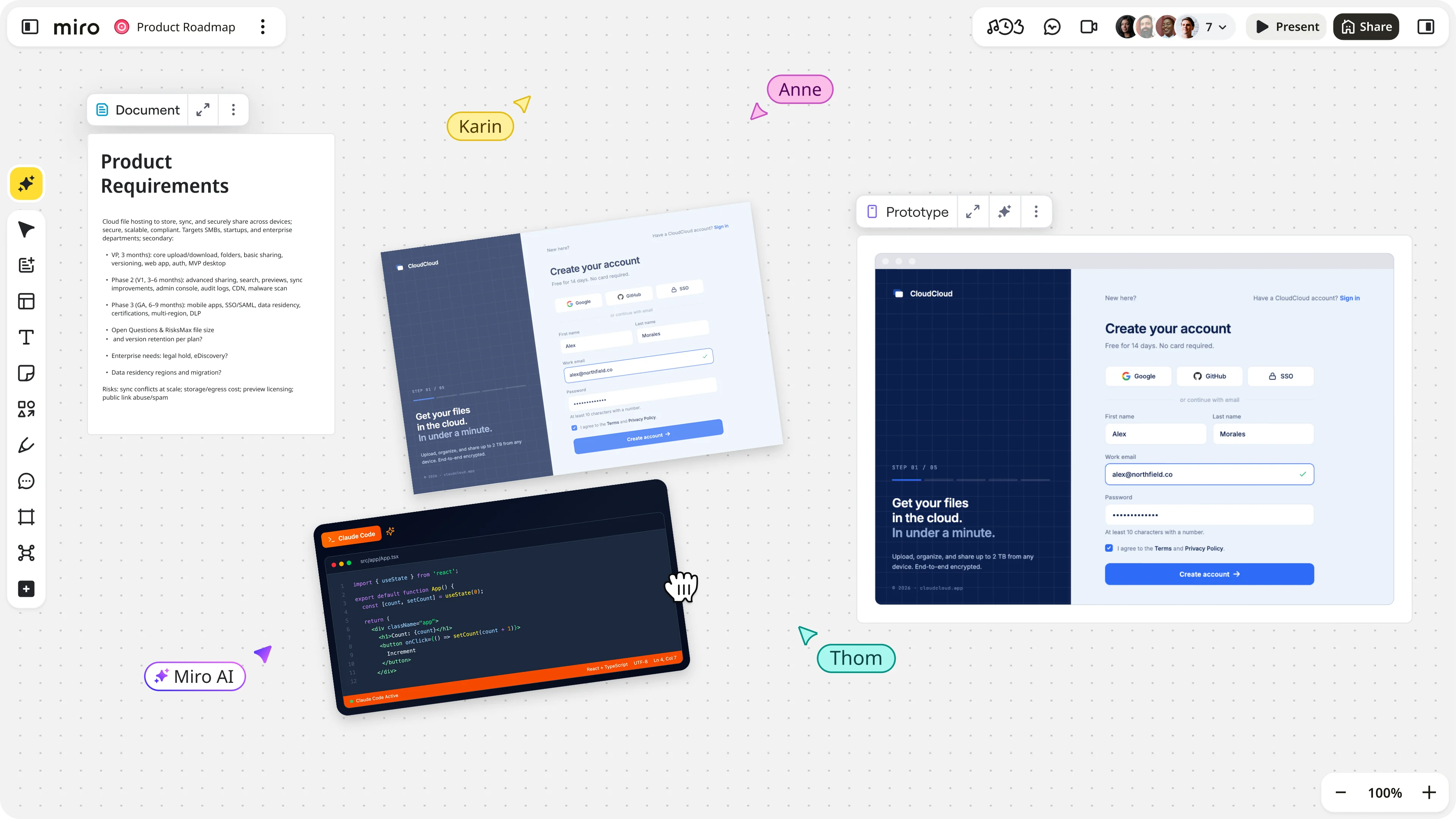
This is where Miro's connected canvas earns its keep. I've started describing it to teams as a visual skill file, and when I suggest the metaphor, it's almost like flipping a light switch. People get it right away.
A team has usually already built some AI-assisted steps into their product development process, often as skills in Cursor or Claude Code. We bring that work onto the canvas through MCP or Miro flows tied into our AI engine.
Every stage of the process becomes visible: what decision is being made, what the prompt is doing, how information moves from one step to the next.
Nobody needs an AI engineering background to follow it. They can see the logic, question a step, suggest a change, and eventually turn the whole thing into a template that scales across the organization. A shared, visible workspace does what a training program can't: it lets the 70% act on what the 30% already knows, instead of just hearing about it.
A six-month decision in an afternoon, and the part nobody plans for
I want to give you a concrete example, though I'll keep the details anonymized since this pattern shows up across several of my accounts, not just one.
Picture a business decision process that used to take months: heavy manual research, a lot of people, a lot of meetings, a lot of hours before anyone signs off. In several cases, these are decisions worth up to a billion dollars.
With a few of these teams, we built what I've started calling decision engines directly on the Miro canvas: a flow connected to MCP that handles research, vetting, and analysis, sometimes drafts product requirements, and produces an executive-ready deck at the end. A process that took six months can now run in an afternoon. Theoretically, you can run that six-month process in an afternoon now. But do you?
That's the question that comes up when we sit down with a team to figure out how to present it to their C-suite. Just because you can turn a six-month process into four hours doesn't mean your organization is ready to run at that speed. More of our work now goes into the people side: how a team adjusts its rhythm, checkpoints, and trust in the output when the timeline changes that dramatically.
So when I talk to teams about measuring ROI here, I push them to separate two things: whether AI has enabled the path to a goal you couldn't reach before, and whether the organization has actually done the people and culture work to take advantage of that new capability. Skip that second part, and the technical win doesn't turn into a real result.
Efficiency is the wrong finish line for half of you
There's a default assumption that AI ROI means doing more, faster. In my experience, that's actually the smaller of two camps.
The other camp, and it's the bigger one, wants AI to free up room for deeper strategic thinking, not more output. If you're only measuring speed and volume, you're going to miss where a lot of your organization actually expects the value to show up.
This matters a lot for services firms specifically. There's a market assumption now that if AI exists, you should obviously be moving faster, and that's become a baseline expectation, not a differentiator. Going faster doesn't automatically mean doing more. What it should mean, if you're using that speed well, is going deeper: delivering a level of quality and distinctiveness that's actually above what speed alone gets you. The bar for speed moved. The bar for quality didn't disappear along with it.
So before you build a metric, ask which camp your team or your executive sponsor is actually in. A pilot optimized for volume will look like a failure to someone who wanted depth, and vice versa.
What I think 2027 actually looks like
I'll be honest, I think the next six to twelve months get genuinely weird.
The pace of model advancement isn't slowing down, and you can't separate that from what's happening politically among the major AI players right now. I'm already hearing 2027 mandates from executive teams, including staffing changes, without confident plans for how to get there alongside token spend that's still climbing.
I don't know if that means companies expect the fluent 30% to carry the load with fewer people, and I don't know if it means a pullback in AI spend to give the other 70% room to catch up.
It probably depends on the company. What I do think is that how we work is going to change a lot in 2027, just not as a single overnight switch. It's going to be a slow, uneven shift, and we're already in the middle of it.
Where that leaves you
If you're trying to figure out your own AI ROI story right now, start with the 70/30 question before you start with a metric. Who in your organization is already fluent, and what's actually stopping everyone else from getting there? In most cases, the tools are there. What's missing is a way for the rest of the organization to learn from that fluent 30%.
I've developed a decent tolerance for ambiguity working around startups for a while, and mine still gets tested most days. My honest advice: lean into that ambiguity instead of fighting it. Experiment where it makes sense, but don't feel like you have to be experimenting constantly just because the ground keeps shifting. Think about how your day-to-day work adapts to the broader transition, rather than waiting for someone to hand you a finished playbook. Nobody has one yet.
If you want to see what a visual skill file looks like on an actual canvas, that's exactly the kind of workflow Miro's connected canvas and AI-powered tools are built to make visible. Start with a free Miro account and bring one of your team's AI workflows onto a board where everyone can actually see it.
Read more
Join our 100M+ users today


