5 likes
8 uses
Dr Max’s One-Page Speed Strategy canvas helps from running a strategy meeting to creating a strategy process, developing a culture of strategic thinkers and everything in between, it will help you to create real-world strategies that deliver outstanding results.
It will help anyone, regardless of experience, to better develop their inner strategic potential for outstanding results in our ever-changing world.
Speed Strategy is a simple-to-use approach that develops better strategic habits for individuals and groups. You are already a strategist. Using Speed Strategy will help you to nurture your innate ability to shape events in ways that make desirable outcomes more likely.
Speed Strategy can be used on its own with no other tools, but, because it is modular (like Lego!) you can also use it with any existing tool, model or system.
It is based on real-world experience - and deep-research - to avoid the common reasons that strategy fails. It follows the principle that no strategy succeeds unless it adapts to the real world.
It encourages big-picture thinking by asking the basic (and critical) questions in a way that makes it easier to see and articulate links between the answers (page 214). Using it will prevent tunnel vision and will help you become a better strategist.
■ It allows groups to understand, discuss, synthesise, and test the perspectives of other people. This means people in your group, but it also means people in other groups including colleagues, collaborators, customers and competitors.
■ You can benefit from the perspectives of others and develop shared strategic models of the world. Getting people on the same strategic page and developing a culture of strategists will allow you to achieve more than you could ever do alone (page 174).
■ The modular approach does not force you to spend lots of time learning how to use it before getting down to work, and makes it easy to use alongside other models, frameworks, methodologies, tools and information in any form (page 213).
■ It has been designed with reference to research findings and deep underpinnings of psychology, sociology, philosophy and soft systems methodologies, all of which enrich the ways in which it can be useful for real-world impact.
■ By seeing more clearly and more deeply, whether you spend 15 minutes or days or weeks, you are in a better position to figure out what needs to be done to get where you want to go, how it needs to be done, and the strategic engine powering your journey. How Speed Strategy Works
Speed Strategy helps you figure out ways to get from where you are to where you want to be. You will succeed more often when your actions are connected together in a way that is mutually reinforcing – where every action helps you to shape a better future.
15 Minute Speed Strategy
Just go with your gut. Trust yourself and just start by starting. Write down one word – or a couple of words – in any box you want. Some people start with where they want to go – the desirable destination. Some people start with where they are right now – the situation. Others fill in what is pushing them to want to go somewhere better – or what’s stopping them. Or a sense of what needs to be done and how it needs to be done – that can hint at where you need to go.
Question By Question
Dr Max's Speed Strategy answers seven significant strategic questions, and it does so in a way that encourages and develops strategic action, results, and thinking - and gets people on the same strategic page.
Where are you right now? This is about the current position and performance. It’s also about facts and feelings. Describe your current position in 3–7 words or numbers. Use those words and numbers to clarify where your strategy will start.
What's pushing you?
If you don’t want change, explain why. If you want things to change, then there will be reasons. And this is where you need to describe, discuss and dive deeper to understand. What are the top 3 to 5 things that are driving you towards your strategic goals?
Where do we want to go?
The reason you’re doing strategy is to get somewhere better than chance. You can describe this as purpose, mission, vision or objective, but the important thing is to clearly describe a desirable destination. This isn’t fixed, but it allows you to judge your actions and results. Again 3-5 words, numbers or phrases only.
What do you need to do?
First, consider the actions that are necessary. Second, look at how those actions need to be sequenced. Third, think about how those key activities reinforce each other. This is your strategic engine. It powers your strategy. As your understanding deepens, and circumstances change so will your engine (see page 198). How do you need to do it?
Actions are not all equal. You can do the same thing but in a thousand different ways with quite di erent results, so it’s important to look at the ways you are going to do what needs to be done. This can include the manner, criteria and flavour of the action. It also crucially includes culture – including all the ways that actions and decisions are made over time (see page 174).
What’s stopping you?
No effort to shape the future is completely certain to succeed. There are always things that could stop you or will stop you unless you do something to unblock the blockers. (See page 196.)
How will you measure progress?
You’ll need to measure two main things. First, you’ll want to have some idea of how to measure your desirable end in the classic ‘what will success look like?’ way. Second, you’ll want to measure the intermediate actions and results that will get you the success you want. Warning: It’s easy to only manage what is easily measured, so force yourself to think about what really matters.
www.thespeedstrategy.com
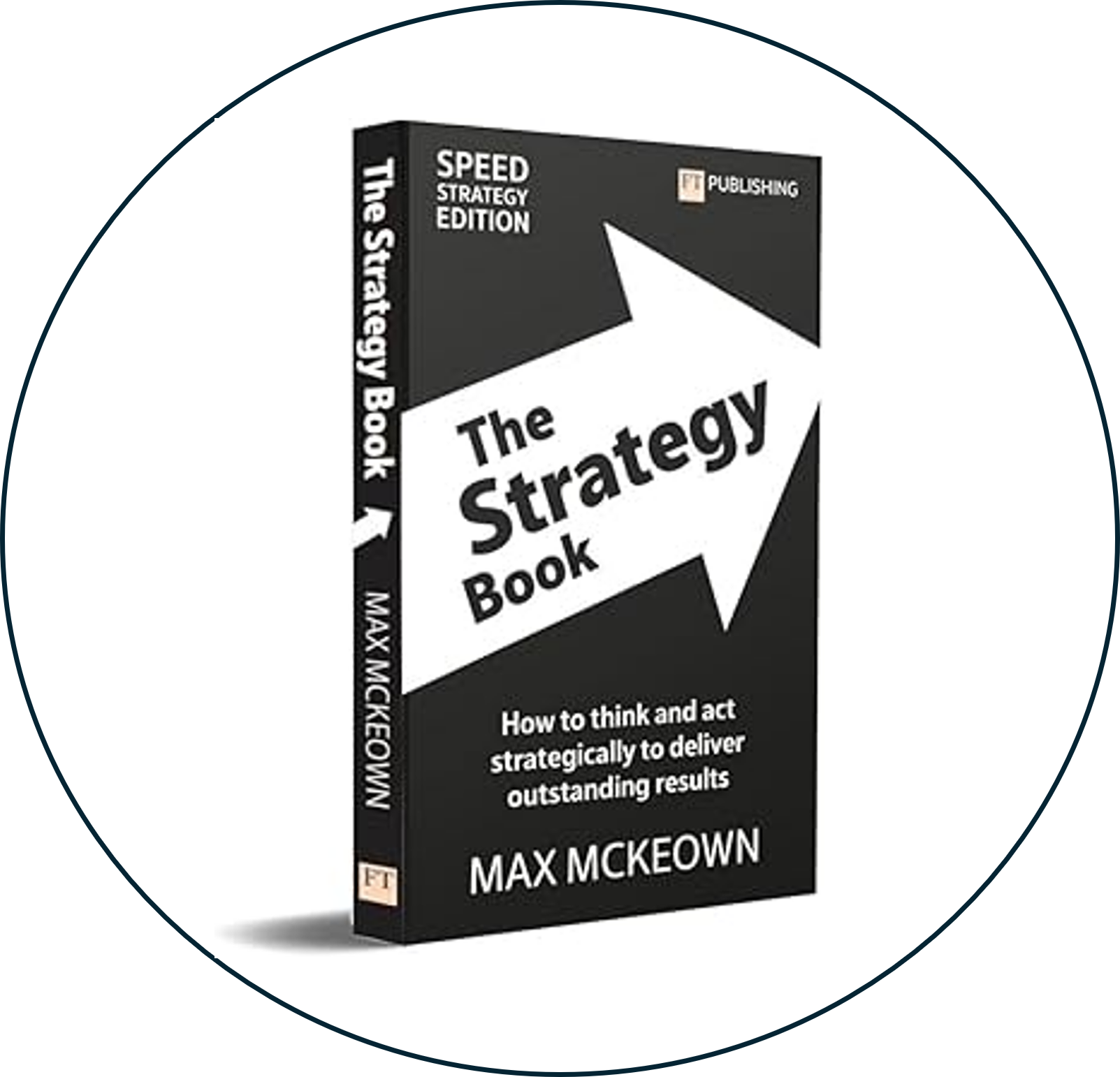
Dr Max
Author of The Strategy Book
Mckeown’s One-Page Speed Strategy. From running a strategy meeting to creating a strategy process, developing a culture of strategic thinkers and everything in between, will help you to create real-world strategies that deliver outstanding results.