Table of contents
Table of contents
By signing up, you agree to Miro's Terms of Service and Privacy Policy.
AI for product design: How we iterate faster without shipping AI slop
Akshan Ish is a senior staff product designer at Miro and a broad generalist who thrives in messy, ambiguous, fast-paced environments. He was previously Head of Design at PowerUs and led the team behind the evolution of Spotify’s Now Playing View. Outside of work, he can be found spending time with his kids by the lake or playing basketball.
Last published
I'm Akshan, a senior staff product designer at Miro. I'm an individual contributor who works across multiple teams. My projects include zero-to-one work with a lot of ambiguity, exploring how AI agents should behave on Miro’s infinitely spatial canvas along with other designers, and addressing long-standing requests from our community.
Our team keeps a prototype of Miro that we build on, and at any given time, it holds hundreds of pull requests. People ship code left, right, and center, and it gets quite crazy. Designers can ship code now, which changes what the job asks of us. When everyone builds prototypes and ships code at the same time, the hard part moves. You have to decide which idea deserves to ship, and you have to keep your work from looking like everything else AI produces.
In this article, I'll walk through the solutions that work for me: design reviews, judgment built from experience, and a setup that teaches Claude Code my taste so the first draft already carries some opinion. I'll also cover the mistakes I watch for, including how AI slop keeps shifting and why I still start from scratch on every new project. And I'll finish with my take on where this goes next. I think 2027 brings a counterculture that puts understanding the problem ahead of shipping fast, and a push toward simplification.
Collaborative AI Workflows
Join thousands of teams using Miro to build the right thing, faster.
What decides which of the hundred pull requests deserves to ship
When everybody builds at once, you need a way to separate the good ideas from the merely finished ones. Four things help us.
We run formal design reviews, like any traditional environment. You get feedback from other people, take it into account, and iterate. We use Talktracks to share our work for review async, and then gather on a call if deeper discussion or alignment is needed.
Judgment matters too, and most of mine comes from having been in similar situations before. I've seen which mental models work for people, and I know which industry patterns I can reuse when they make sense.
Then there's the user. Miro is a product that people open many times a day, so we want to minimize what they have to learn from scratch. We build on top of their existing knowledge, habits, and patterns, which means a deep understanding of who the user is still sits at the center of the job.
The last one is teaching your AI tools to produce work the way you would. That takes some setup, so I'll walk through mine.
Teach your AI tool once, then let it keep learning
Some of my teaching is constantly, almost brute-forcing it, where I tell the tool "move the icon 2px to the left" and "no, the alignment is still off. Center align it horizontally.” The most important thing, though, is a setup of skills and documentation, so the agent refers back to what it learned next time around.
I use Claude Code, and at the end of every session I run a skill called /wrap. The routine looks like this:
- I work in Claude Code as usual and correct the output when it misses.
- When the session ends, I run /wrap.
- Claude takes the learnings from the session, including anything I told it to do differently than before, and updates its own documentation.
- Next time, it refers to that documentation, so it keeps improving.
The skill is a Markdown file, another skill for Claude. I didn't build it. Another designer at Miro, Mauricio Wolff, created it, and he's the originator. He also built Vibe Lab, our internal prototyping workspace. It's been really helpful because I keep doing it continuously.
I also keep separate Markdown files for different design styles. If I want a brutalist direction, I point Claude at that file. If I want minimalist, it picks up that one instead, and it creates visual output from that specific skill. Although the models are getting better, they rely less on these files now. It’s enough to ask Claude to give you an output in a few different styles, and it’s getting pretty good at doing so. And then you’ll need to use your judgement, intuition, and taste that you’ve built up over the years to make decisions on which directions to pull at. Together, the wrap skill and the style files get me to a first draft that isn't generic. It already carries a bit of opinion and intuition, and then I nudge it in whichever direction I want to pull.
Inspiration works the same way. When I find something interesting, I screenshot it and throw it into Claude Code with a note along the lines of "the sidebar treatment looks interesting." Some designers build mood boards or an inspiration board on Miro and point the tool at that via our MCP.
AI slop keeps moving, so keep watching it
A fair question is what to avoid, and the honest answer is that the target shifts. A while ago, AI slop meant super purple gradients, and you could tell right away that AI had made the design. Now it's Instrument Serif, a font people used nicely before. If you use it today, people look at it and think "that's what Claude did."
So I make sure I know where the baseline sits at the moment, because it keeps changing and I don't want my work to collide with it.
I haven't solved everything either. Many times I feel like I'm starting from scratch. When I begin a new project, I have to build up all this knowledge for Claude again. It can refer to my other projects, but it still needs the context, and I need to rebuild the aesthetic library. I'd love an existing repository it could go back to and reference.
Design is subjective, so don't lose sight of what makes you different from other employees: your training. You learned to judge typography styles and color styles. You learned that if you want to evoke a certain emotion, a visual representation exists that will evoke it, and there are plenty of studies and theories behind that. AI tools have scraped some of this too. Even so, you have to trust your intuition and judgment.
Silly ideas need a safe room
Ideas and explorations are super fragile, and this is where a great team becomes necessary. I have a design team around me where I feel psychologically safe. When I have a silly idea, I visualize it and share it in our Slack channel. If I get no reactions, or people say "yeah, whatever," I won't come up with my next silly idea, and that one might have been the greatest idea of all time.
With an encouraging and supportive community, it feels more like playing in a band and jamming. You have an idea, someone else builds on top of it, and it keeps going from there.
Nobody one-shots quality
You will hear that you can one-shot Claude and land on high-quality work. I don't believe it. Every designer I know who has done high-quality work, with AI tools or without them, got there through iteration.
You make something, put it out there, and get input from people you trust, then you iterate on it. Once you feel comfortable enough to put it into the world, you do, and then you get feedback from people and iterate again, which is how you get to a really good place.
What AI tools changed is the time the loop takes. Something that used to take maybe five days can now take an afternoon, and I still get the same feedback. I iterate faster, so I get to higher quality faster.
Just because you can ship doesn't mean you should
Even before AI tools, I had to put on my product hat and ask whether what we're doing is relevant and why we're doing it. My hope is that because we can execute at such a fast level, and get to good quality quickly, we'll spend more time on the why. That means more time with the customers and users we design for, so we understand their workflows.
We're also realizing that you can ship a lot of stuff very quickly, but people may not be ready to absorb all of it. If you keep shipping things and moving them every three days, people will get very annoyed and want to say, "Don't move the things that I know how to use."
That's why I have a feeling that 2027 will bring a bit of a counterculture movement. We've proven we can do fast, and we've proven we can do more. Now we can go back to the things that matter, because once we know what matters, we can execute really quickly. So I'd put more of our time and energy into understanding what we should be doing and why.
For me, that comes down to a handful of questions. What is the problem? Is it relevant? Does it matter to the business? Do we want to solve it right now?
In the meantime, my fear is that we make our products more complex simply because we can, and I think the more time we spend simplifying, the more our users will be able to learn how to use the products we’re building and come back to them. So, I think you’ll see 2027 will be about simplification and consolidation.
Try it on your next project
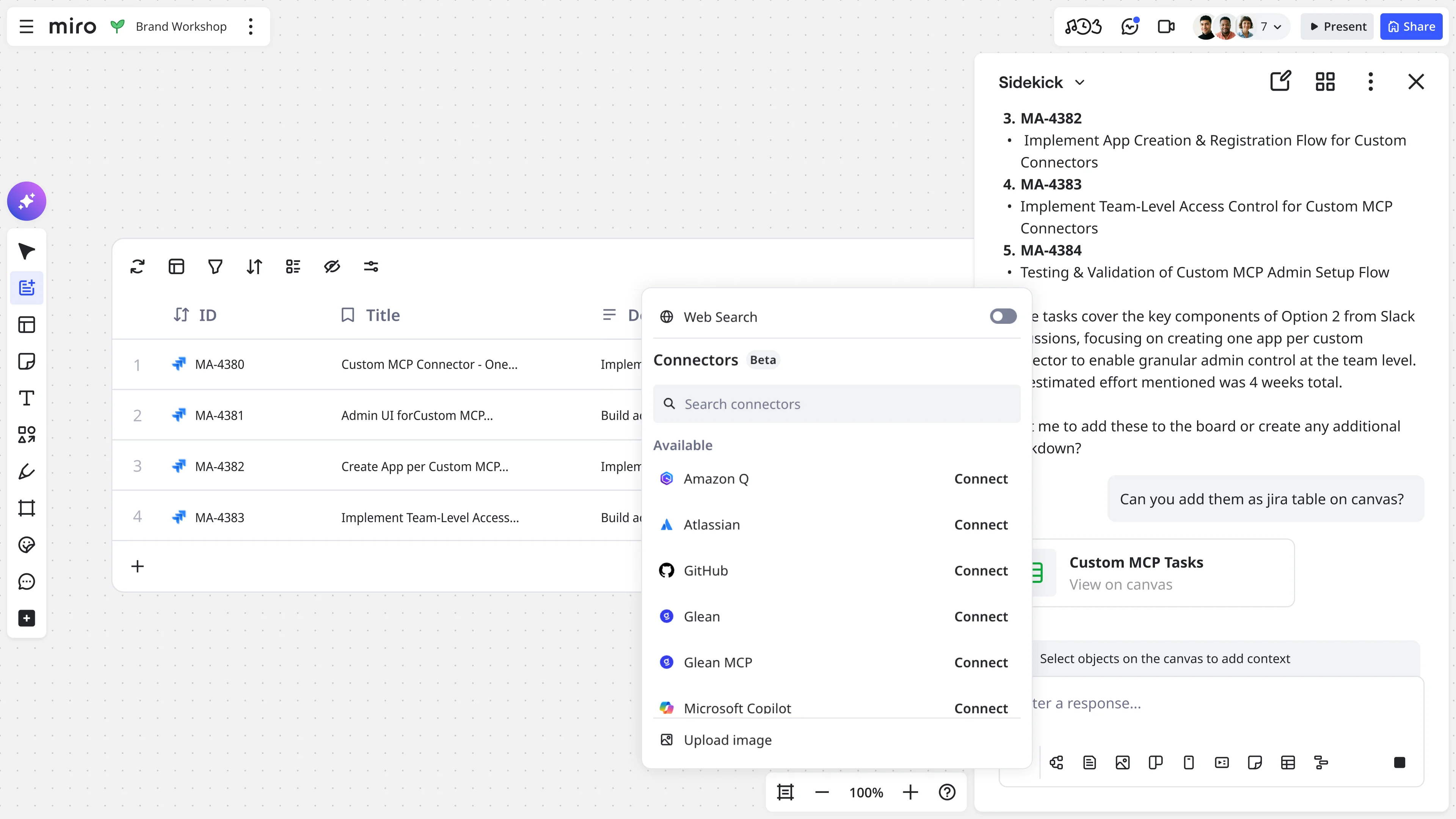
If you want to try the inspiration-board approach, set up a free Miro account, open a board, and drop in the screenshots that make you stop scrolling. Then point your AI tool at what you collected, use Miro MCP, and see how far the first draft moves away from generic.
Read more
Join our 100M+ users today


