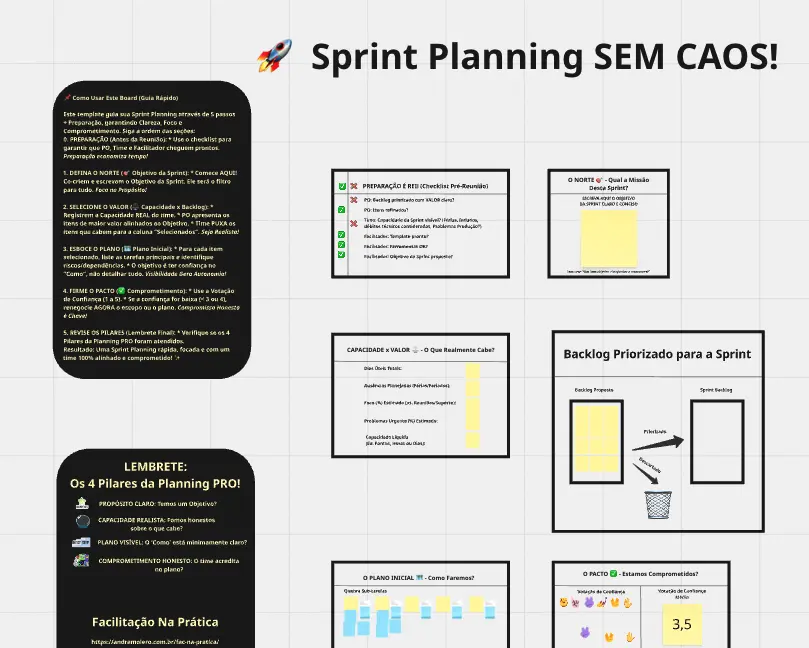
✅ Clarity Canvas -The Miro Approach for the four factor breakdown model for estimations)
This model helps us evaluate readiness and estimate more accurately by looking beyond size and understanding what could slow us down.
Write down the description and the acceptance criteria of the story. Without these in place, we are not even starting the story. You break down each story into:
🔗 1. Dependencies
Does this story rely on another team?
Or another story?
Or waiting for a design / API / environment?
Scoring example:
0 = none
1 = small dependency (internal, easy)
2 = moderate dependency
3 = external dependency (platform, vendor, another team)
🚧 2. Blockers
Is there anything stopping this story from even starting?
Something that the team cannot solve within the sprint?
Scoring:
0 = no blocker
2 = potential blocker
3 = active blocker
⚠️ 3. Risks
Is there a chance this might not work as expected?
Does it touch sensitive areas of code?
Any performance or security implications?
Scoring:
0 = no risk
1 = low impact risk
2 = medium risk
3 = high-risk item
❓ 4. Unknowns
Do we feel unsure about implementation?
Any exploration / spikes needed?
Do we lack clarity on acceptance criteria?
Scoring:
0 = nothing unknown
1 = minor unknown
2 = some investigation needed
3 = major unknown / unclear acceptance criteria
📊 Put It All Together: “Story Readiness Score”
For each story, the team fills a 4-box grid and assigns numbers.
Then total score =
Dependencies + Risks + Unknowns + Blockers
Example:
Dependencies → 3
Unknowns → 1
Risk → 0
Blocker → 3
Total = 7
🚦 The Sprint-Readiness Traffic Light
Use the total score to quickly decide the story’s readiness:
🟩 0–3 → SAFE to pull into sprint
Stories are straightforward, low-risk, low dependencies.
🟨 4–6 → REVIEW before committing
These require a conversation:
Can we reduce dependencies?
Can we split it?
Can we remove the unknowns before pulling it in?
🟥 7+ → NOT READY (needs refinement)
This story is a problem.
Typically you’ll see:
Too many dependencies
Unknowns that are actually blockers
Missing clarifications
This ensures your team stops dragging risky stories into the sprint and instead refines them properly first.
💡 For example
We have 3 dependencies but 1 unknown which is a blocker → probably the story cannot be pulled into the sprint.
Converted to the model:
Dependencies = 3
Unknown = 3 (unknown = blocker)
Risk = maybe 0
Blocker = 3
Total = 9 →
🟥 RED → not ready.
🔥 Why This Works
Makes estimation objective
Helps the team say “no” to unclear stories
Reduces mid-sprint surprises
Helps the PO know exactly what to fix
Turns refinement into a data-driven conversation,not a guessing game