November 23, 2026
Moving the heart of Miro: migrating our monolith from EC2 to Kubernetes
Author: Apoorva Kulkarni (Software Engineer)
Miro has a backend monolith, and it sits at the heart of the product. When you open a board in Miro, there's a good chance the request passes through it. At peak, in our busiest region alone, the monolith serves around 30K API requests per second and around 300K live user sessions, processing around 70K real-time commands per second. It isn't a service you simply redeploy somewhere else.
This post is about how we moved Miro's monolith from AWS EC2 instances to Kubernetes with confidence.
A note before we start: this isn't a technical deep dive. We solved plenty of hard engineering problems along the way, and they deserve posts of their own. This one is about the other half of the challenge: the organisational side of moving something so central, across many teams.
Why the move?
Like any other company, Miro went through phases of platform evolution. We started with EC2 instances for hosting our application, and with accelerated growth the platform expanded. We introduced our Kubernetes clusters, and they became our primary platform for hosting any new applications. With time, the platform grew in both directions and we ended up maintaining two parallel tech stacks. Every layer, from image building and configuration to autoscaling, CI/CD and observability, used a different set of tools.
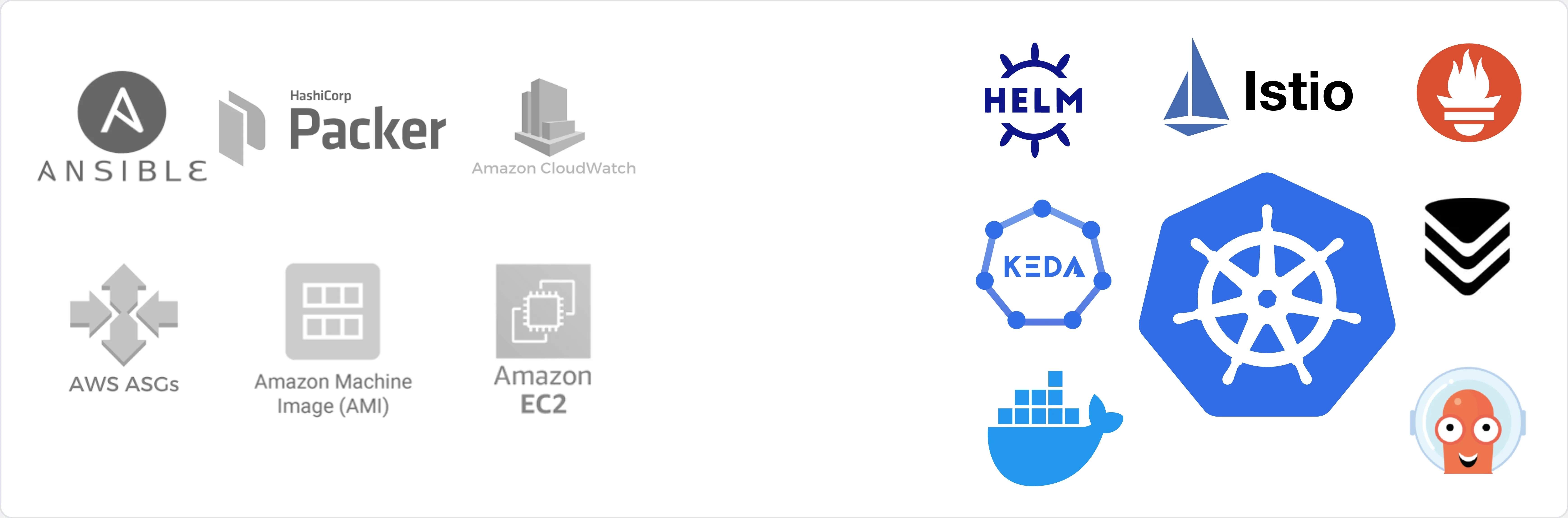
Left: the monolith's retired EC2 stack. Right: the Kubernetes platform it moved to.
This meant solving every problem twice. Some were easy to solve in a Kubernetes-native way while being more complicated for the EC2 instances. It hit our platform team in terms of cost, time and focus. At the same time, it affected developer experience: engineers struggled with constant context switching between the two for deploying, scaling and debugging.
It was clear that we had to make a change. The goal was simple, but it needed a strategic approach, clear success criteria and a clean migration plan. That's when we started the Unified Compute Platform (UCP) initiative: one platform for all our services.
We weren't starting from zero. Our teams had years of Kubernetes experience from running microservices, and we knew the monolith's lifecycle on EC2 well. UCP's first criterion for success was a zero-downtime migration. Here's how we approached it.
Our approach
Tackling the critical workloads first
From a code perspective, Miro's monolith is one codebase. At runtime, it's split into multiple deployment units that we call monolith profiles, each responsible for a different part of the product. These fall into three groups:
- WebSocket-based collaborative workloads
- API-based workloads, also known as the "API profile", which handles high traffic volume from many different sources
- Other supporting workloads
We chose to migrate the most critical and performance-sensitive workloads first: the collaborative workloads. This is where we built the foundation, solving the fundamental problems of adopting the target platform. We built the manifests, the pipelines, the operational guidelines, and new capabilities.
Once adopted, the new pods were tested against our end-to-end test suites on staging. All tests passed, and then came the question of where to start the rollout in production. We chose our busiest region first. The choice was deliberate: it had the most volume and the widest variety of traffic.
A Miro board is a creative space, used with every kind of widget in every combination imaginable, and real usage has its own daily rhythm: a morning spike, a wave after lunch, a final push in the evening. Those patterns only show up with real users. If something was going to surprise us, we wanted to find it where the signal was strongest, with safety nets in place.
Once the migration of the collaborative workloads to Kubernetes was successful, the API profile followed. It had its own characteristic problems to solve, but the bigger picture was already clear.
Validating performance
The functional test suites were green, but that only told us the monolith worked, not that it performed the same. So we built performance tests and simulated peak load against both the EC2 fleet and the new pods. For the collaborative workloads, we tested board loading and the creation, update and deletion of widgets. For the API, we covered the key user flows. The results were comparable across both platforms, and from then on we knew the platform could take the load.
Rolling out infrastructure like a feature
Gradual rollouts weren't new at Miro. Product teams do it every day, so we used the same approach and the same tools. The collaborative workloads already had their own solution for this, but the API workloads needed something new. The rollout had to be gradual whatever the traffic source, and teams shouldn't have to change their code.
The first part was choosing who to move. We used Iteration Platform, Miro's in-house feature-flagging platform, to pick an audience and a percentage of it. We started with Mironeers, Miro's own employees, then free-tier customers, businesses and organisations, and finally everyone else.
The second part was routing their requests. For selected users, Miro's web, desktop and mobile apps added a header to each request based on the selection from Iteration Platform, and our service mesh sent those requests to the new Kubernetes pods. Everything else continued to EC2. Traffic from other sources, such as integrations and internal services, was shifted by weight at the service mesh. The endpoint hosts remained the same, so no team had to change their code. Both controls worked in reverse. We could lower the percentage in Iteration Platform, or send traffic straight back to EC2 at the mesh.
Having independent ways back meant every step was reversible, and that's what made starting in production predictable. Now we just needed to observe and catch patterns that indicated a problem.
Monitoring both platforms side by side
If we had to give one piece of advice to anyone attempting something like this: build a dashboard that compares the old and new platforms before you move any traffic. Ours had side-by-side panels for the EC2 fleet and the new pods, comparing request rates, error rates, latencies and resource usage. At every step we knew which platform was serving which traffic and how much of it, and the question was simple: do both sides look the same?
In practice, answering it took judgement. Different groups of users use the same APIs very differently, and some calls are much heavier for one group than another. Early in each ramp, the new pods also served only a small share of traffic. With a smaller sample, the slow tail of requests stood out more, even though those slow requests came from application logic, not from the new platform. We had to learn how the metrics behaved, ignore the noise, and sometimes trust our instincts and keep going. As more traffic moved over, the rates, averages and percentiles settled and genuinely started to look the same.
Two moments made this concrete.
- A real problem Partway through moving one of the API profiles, requests started to queue up and even get rejected under load. We paused and moved traffic back. Then we worked through it step by step: adjust the configuration, ramp a little traffic, check the dashboard, repeat. When the performance stabilised at full volume, we continued. It didn't lead to any customer-facing incidents.
- A false alarm Every time a deployment finished, the dashboard showed a sudden drop in traffic. Our new deployments used Argo Rollouts, and metrics were collected through pod monitors. When a rollout completed, the labels on the pods changed, and the scrape targets got recalculated. For a short window, some pods weren't being counted. The traffic was actually fine; the measurement was wrong. We fixed this separately.
The two cases point to the same lesson from different directions. A good dashboard helps you find real problems while they're small, and knowing how your metrics are collected stops you chasing problems that don't exist.
People Engagement
Throughout all of this, none of it was done by one team.
Platform engineers can build the paths, the pipelines and the safety nets, but we don't know every endpoint the way its owner does. Developers are the eyes on the ground. They know what "normal" looks like for their part of the system long before an alert fires.
So we set up the collaboration deliberately:
- Clear roles Every workstream had a single point of contact, a decision-maker who could unblock things, and a clear list of who needed to be consulted and who needed to be kept informed.
- A small, honest ask We asked partner teams for focused capacity during their production ramp, plus ad-hoc help in test environments.
- Plain communication Before we started, we presented what was changing, what wasn't, and what to watch out for. Working-group meetings kept everyone aligned, and one project channel was where everything happened.
- Teams on standby for every ramp When traffic moved, the owners of those endpoints watched their own metrics alongside ours.
Where we ended up
Today, all of the monolith API server's traffic is served from Kubernetes. The old EC2 fleet was switched off in June 2026.
We gained:
- One platform, not two Problems now get solved once, not twice. As a bonus, the monolith now comes up like any other service in our disaster recovery exercises, with no extra steps. Our newest data residency region, in Japan, was built entirely on Kubernetes from day one, which made bootstrapping it far simpler.
- Containers, not AMIs The monolith is built as a container image, like every other service. That freed up a CI runner that spent an average of 19 minutes waiting for an AMI build. It also removed the periodic maintenance and cleanup of old AMIs.
- GitOps delivery Argo CD deploys the monolith, so its releases are as visible as any microservice's. Argo Rollouts gives the monolith automated canary analysis with automatic rollback.
- One service mesh The monolith is now a first-class mesh workload. Istio routes and secures its traffic the same way as our other microservices.
- One observability stack Prometheus, VictoriaMetrics and the same dashboards as our microservices.
Now on Kubernetes, the monolith can take part in wider platform initiatives. One of them is Composable Environments, a Miro initiative that lets engineers spin up an isolated sandbox containing the services they're changing. Only test traffic reaches that sandbox, and everything else uses the baseline services, so changes are tested against real dependencies without a dedicated environment.
The initiative relies on Signadot, Kubernetes and our service mesh. As a first-class mesh workload, the monolith now takes part the same way our microservices do.
Read more in Signadot's case study: How Miro builds and tests agentic features at scale.
What we learned
Start hardest, where it's busiest. Move your most critical workloads first, in your highest-traffic region, with a way back. If they hold there, everything else will.
Roll out infrastructure like a feature. Keep it gradual and use the tools your product teams already trust.
Make every step reversible. Always keep a way back, so you can undo a step the moment something looks off.
Compare old and new side by side, and read it with care. Build the dashboard before you need it, and understand how your metrics behave and how they're collected before you make a call.
Communicate early, often and plainly. Tell teams what's changing, what isn't, and what to watch for before you start, and keep them updated at every step. Their quick questions in our project channel kept us vigilant throughout.
Closing thoughts
Moving the heart of Miro was a massive undertaking. The platform teams planned it like a feature release: hardest workloads first, one audience at a time, from Mironeers to everyone, with a way back at every step. The teams who own the services tested with us, watched their own metrics at every ramp, and didn't need to change their code for the migration. When the EC2 fleet was finally switched off, it was the approach and the partnership together that had given us the confidence to get there.
Thanks to our platform engineers: Rodrigo Fior Kuntzer for paving the way and solving the most fundamental problems, Filippo Moret for migrating profiles alongside me, Fernando Torres for introducing canary analysis with Argo Rollouts for the monolith, and Aleksandr Kulikov, Rado Sohlich and Murat Özkan for supporting the migrations and key decisions. Thanks to our program managers, Chris Borg and Oleg Stepakov, for steering the program. And thanks to the Compute team, the platform engineers past and present, the product teams who ramped with us, and our leadership for backing the move.
Kubernetes, Prometheus, Helm, Istio, Argo and KEDA are trademarks or registered trademarks of The Linux Foundation. Docker is a trademark or registered trademark of Docker, Inc. VictoriaMetrics is a trademark of VictoriaMetrics, Inc. Ansible is a registered trademark of Red Hat, Inc. HashiCorp and Packer are trademarks of HashiCorp, Inc. Amazon Web Services, AWS, Amazon EC2 and Amazon CloudWatch are trademarks of Amazon.com, Inc. or its affiliates. Signadot is a trademark of Signadot, Inc. All other trademarks are the property of their respective owners. Use of these names and logos is for identification purposes only and does not imply endorsement or affiliation.