The context problem behind product managers’ prompt fatigue
Prompting matters. But it’s not the whole story — and it’s not where the real fix lives.
You know this loop:
You ask AI to help with something — synthesize a round of user interviews, draft a set of requirements, make sense of a backlog of support tickets — and the output misses.
So you refine the prompt. Still not quite right.
You try a different framing.
You look up prompting techniques.
Eventually, you’re writing prompts to help you write prompts, asking one AI conversation to coach you through a better brief for another AI conversation.
That compounding frustration of investing more and more effort into prompting and getting diminishing returns is prompt fatigue.
And it happens because AI doesn’t have the context your work already contains. Every session starts cold. You’re not collaborating with AI — you’re repeatedly onboarding it.
Better context beats better prompts
The typical prescription for prompt fatigue is more training. Learn the frameworks. Write tighter briefs. Invest in prompt engineering skills. But that advice only helps you explain your work to AI more efficiently — it doesn’t change the fact that you have to explain it all.
Every hour spent re-briefing AI is an hour your team isn’t spending on the work itself — solving problems together, making decisions, and moving forward.
Product managers carry a huge portion of this re-explanation burden: responsible for strategy, customer insight, and cross-functional execution, they’re constantly translating context that lives in their heads into prompts that AI can use. And because each conversation starts cold, that work never compounds. It just repeats. When AI tools operate outside the flow of team work, every person on the team bears the full cost of context-setting individually, every time. The briefing burden doesn’t scale. It multiplies.
And for PMs, the relevant context is scattered to begin with. Your customer feedback is in Intercom or Productboard. Your roadmap decisions are in Jira. Your team’s alignment from this morning’s planning call is in a Slack thread. You’re experimenting with a bunch of AI tools — from Claude to Lovable to GitHub Copilot — each one starting almost from scratch every time you open it. Before you can even brief AI on the task at hand, you have to synthesize all of that yourself.
Even the teams that have gone further — fine-tuning models on internal documentation, building custom knowledge bases, training AI on their product specs and past decisions — run into the same wall. Those systems know what your organization knew when the systems were trained. They don’t know about the brainstorming session you ran this morning, the direction your team landed on after two hours of debate, or the stickies your teammates left on the board while you were working through the problem together. The context that matters most is often the most recent — and it’s almost always the hardest to capture in a system that sits outside where the work is actually happening.
What would your workflow look like if AI already knew what your team knows?
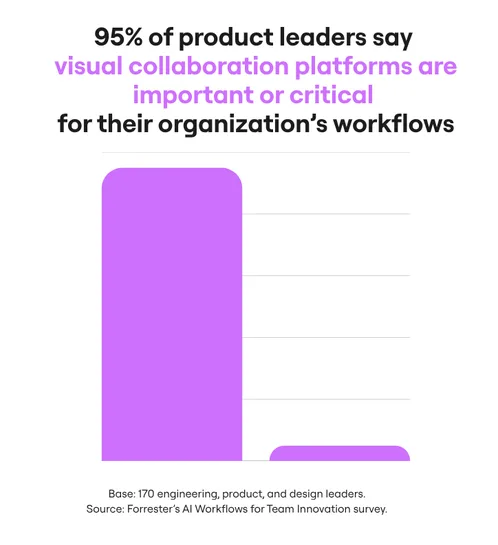
Better context in practice: two PM workflows, minimal prompting
When AI lives where your team’s work already lives (on a visual collaboration platform), it doesn’t need a detailed brief — it can read what your team has built. The canvas becomes the prompt: less setup, more signal, and work that builds on itself over time instead of evaporating every time you close a tab.
Here’s what that looks like in practice for two key PM workflows:
Synthesizing customer feedback
You have the signal: interview transcripts, NPS data, support tickets, Intercom threads. But to get useful AI output, you have to manually extract that signal from wherever it lives, paste it into a chat window, and explain what you’re trying to learn — without the product context, the user segment framing, or the roadmap priorities that make the synthesis relevant to your decisions.
You’re not only prompting for analysis, but also constructing an entire brief from scratch every time. And when the output doesn’t reflect your actual situation, you refine, re-explain, and start the loop again.

The AI playbook: Research synthesis
In contrast, when that research lives in the same workspace as your roadmap, your personas, and your team’s prior decisions, the brief is already written. AI can pull in transcripts, cluster feedback, and surface patterns without you re-explaining the product to it. The result: 70% less time on manual analysis, and clear insights in an afternoon instead of a week. Every insight stays linked to its original source, so team decisions stay grounded in the data rather than in your best attempt to reconstruct it from a prompt.
Accelerate the path to a PRD
This workflow has the same context problem, just at a different stage. Your team does a planning session. The thinking is sharp — decisions get made, constraints get identified, the why behind the roadmap is alive in the room. Then someone has to turn that into a PRD that engineering can build against.
Every step of that process is an opportunity for context to leak. By the time a PM is prompting AI to help draft requirements, they’re working from notes that don’t capture the full discussion, briefs that have been edited by multiple people, and a mental model of decisions that they now have to reconstruct into a prompt. The output is a PRD that’s technically coherent but may be missing the reasoning behind it — and when that reasoning doesn’t make it into the brief, it doesn’t make it into the build.
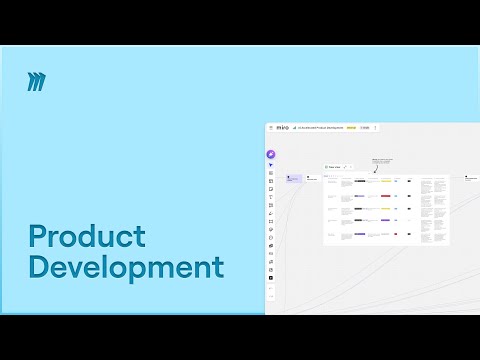
The AI playbook: Product development
When the workshop, the documentation, and the PRD-drafting all happen in the same workspace, the context carries forward without leaks. AI can generate requirements from the actual artifacts your team produced, not from your best attempt to summarize them after the fact. Teams working this way are moving 40% faster from strategy to PRD and beyond — and shipping an average of two weeks sooner — not because the AI is smarter, but because it’s working with full context rather than a reconstructed brief.
Prompt fatigue ends here
Prompt fatigue ends when AI stops starting from scratch — not because you’ve gotten better at prompting, but because the context your team has built finally lives somewhere AI can read. Miro connects to 250+ tools including Jira, Figma, Confluence, and Slack, bringing context from across your stack into the workspace where your team aligns and decides.
That decision record is what AI actually needs — not just what the data says, but what your team chose to do about it. When AI already knows what your team knows, you stop explaining and start deciding. That’s how teams solve hard problems together.


