Table of contents
Table of contents
Frameworks for healthy PM–design–engineering collaboration in startups
Summary
In this article:
- Why PM–design–engineering collaboration breaks down, and where the real cost sits
- The three places alignment most commonly fails
- How AI-assisted prototyping is compressing weeks of alignment work into a single afternoon
- A practical framework for running product discovery to dev handoff without losing context
- How Miro Prototypes supports the full loop, from first sketch to coded app
TL;DR: Most PM–design–engineering collaboration fails at the handoff, not because of attitude, but because context doesn't travel between tools. Teams that prototype early, keep requirements and designs in the same space, and validate before sharing tend to ship features that match what was actually intended. Miro Prototypes supports that entire loop on one canvas, with AI that can generate prototypes from a PRD, run usability audits on demand, and hand off directly to Figma or a coding agent. Mathias Davidsen, who leads the Miro Prototypes team, recently walked through exactly this workflow, and it's worth seeing how the pieces connect.
Collaborative AI Workflows
Join thousands of teams using Miro to build the right thing, faster.
There's a version of cross-functional collaboration that everyone agrees sounds great in theory. The product manager writes a tight PRD, the designer turns it into a polished prototype, the engineer reviews it, asks a few clarifying questions, and builds exactly what was intended. Everyone ships on time. Nobody sends a Slack message at 10 p.m. asking what a button is supposed to do.
That version mostly shows up in onboarding decks.
The reality in most startups is messier. Requirements shift mid-sprint, prototypes get made in isolation and shared too late, and engineers start building from a spec that the designer already revised three times. Somewhere between discovery and delivery, the original user context gets lost entirely. The feature ships, technically correct, but not quite what anyone imagined, and nobody can fully explain why.
The problem isn't usually attitude or effort. People want to collaborate well. The problem is structural: most teams use separate tools for separate phases of the work, which means handoffs are where decisions go to die.
Why startup teams struggle with PM–design–engineering alignment
PM–design–engineering collaboration tends to fail in predictable places, not random ones.
Discovery happens in one tool, design lives in another, and engineering specs go into a third. AI tools, increasingly, have been added on top as individual productivity boosters, one for the PM, one for the designer, one for the engineer. According to a Forrester Consulting study commissioned by Miro, 75% of leaders agree that most AI tools focus on individual rather than team productivity. The problem that creates isn't that people are less productive on their own. It's that they're more productive in different directions, which makes alignment harder, not easier.
The same study found that 71% of leaders say switching between tools causes friction and interrupts workflows, with 69% saying the same specifically about switching between their core work tools and AI tools. For startup teams already moving fast, that friction compounds into the kind of misalignment that surfaces in sprint reviews and stakeholder presentations, usually in the form of a feature that was built correctly but landed wrong.
There's also a deeper issue: early-stage collaboration in product development is structurally undervalued. Most teams spend the least time validating ideas at the exact point where those decisions are hardest to reverse, before requirements are locked and engineering is scoped. The PM writes a PRD, the designer makes a prototype, the engineer scopes it, and everyone assumes they're aligned until they aren't.
Three places where alignment most commonly fails
Most startup teams run into some combination of these three problems, and they tend to compound each other.
Context gets stripped at handoff
By the time a design reaches engineering, the reasoning behind key decisions has often evaporated. The designer knows why a particular interaction was chosen. The PM remembers the user research that motivated the feature. But none of that made it into the handoff artifact, which means the engineer is interpreting a prototype without the story behind it. The result is a build that's technically accurate to the mockup but misses the intent, and a design to dev handoff evaluation that surfaces problems after the work is already done.
Prototypes arrive too late to be useful
Prototypes often get made too far into the process, after requirements are locked and stakeholder expectations are set. A prototype shown at that point doesn't validate an idea; it defends one. The feedback you get is constrained by sunk cost, and any significant change feels like a setback rather than an insight.
Designs go unvalidated before stakeholders see them
Before a prototype gets in front of real users or stakeholders, it usually gets in front of nobody. It goes from the designer's screen to the engineering backlog, sometimes with a brief review in a design critique. The opportunity to pressure-test the design against usability principles or basic logic gets skipped in the interest of speed, and the first real stress test happens in production.
What healthy PM–design–engineering collaboration actually looks like
Good cross-functional teams tend to share a few practices, regardless of how formally they've defined them.
Prototyping happens early and intentionally rough. The goal of an early prototype isn't to show a finished design; it's to make an idea concrete enough to critique. When the PM, designer, and engineer are all looking at the same rough version of something, the conversation changes from abstract to specific. "I think users will be confused by this" becomes "I can see right here where they'd drop off."
Context stays attached to the work. Good collaboration doesn't separate the decision from the reasoning. A design should carry forward the PRD that motivated it, and a prototype should reference the user research it was based on. Handoff artifacts should include the questions that were still open when the design was finalized. When context travels with the work, engineers can make better judgment calls on the implementation details that inevitably come up mid-build.
Designs get stress-tested before they're locked. Whether that means a round of stakeholder review or a structured heuristic evaluation, teams that ship well find ways to pressure-test designs before committing to a sprint. The cost of a usability problem found in a prototype is roughly zero compared to the cost of finding it in a shipped feature.
And increasingly, these teams use AI to reduce the time between each of those steps, cutting the mechanical friction rather than replacing the judgment calls that matter. Whether you're a product manager, designer, or engineer, AI is starting to replace weeks of prototyping work in a single afternoon, without breaking your design system or losing user context. The question is whether your team is set up to use it as a shared resource or as another set of siloed individual tools.
How Miro Prototypes supports the full collaboration loop
Miro Prototypes is built around the idea that the best place for teams and AI to work together is on a shared canvas, where context is visible to everyone and the work doesn't need to be re-explained every time it changes hands.
Mathias Davidsen, who leads the Miro Prototypes team, recently walked through a workflow that shows what this looks like in practice, using a scenario that maps directly onto the three failure points above.
From Confluence to canvas, with context intact.
The scenario starts with an existing fintech product screen, a loan application summary view, and a PRD sitting in Confluence that specifies how a loan calculator should be added to it. In most teams, the PM would write the PRD, the designer would eventually find it, and the connection between the two would rely on someone remembering to check the doc before designing.
In this workflow, Miro Sidekick connects directly to Confluence via MCP (Model Context Protocol), pulls the PRD, and adds it to the Miro board alongside the existing screen. Both artifacts are now in the same visual space, fully readable, and ready to be used as context for generation. The designer doesn't have to go hunting, the engineer can see both the original screen and the spec, and the PM's requirements are right there, attached to the work they're meant to inform.
Generating a prototype that reflects the spec
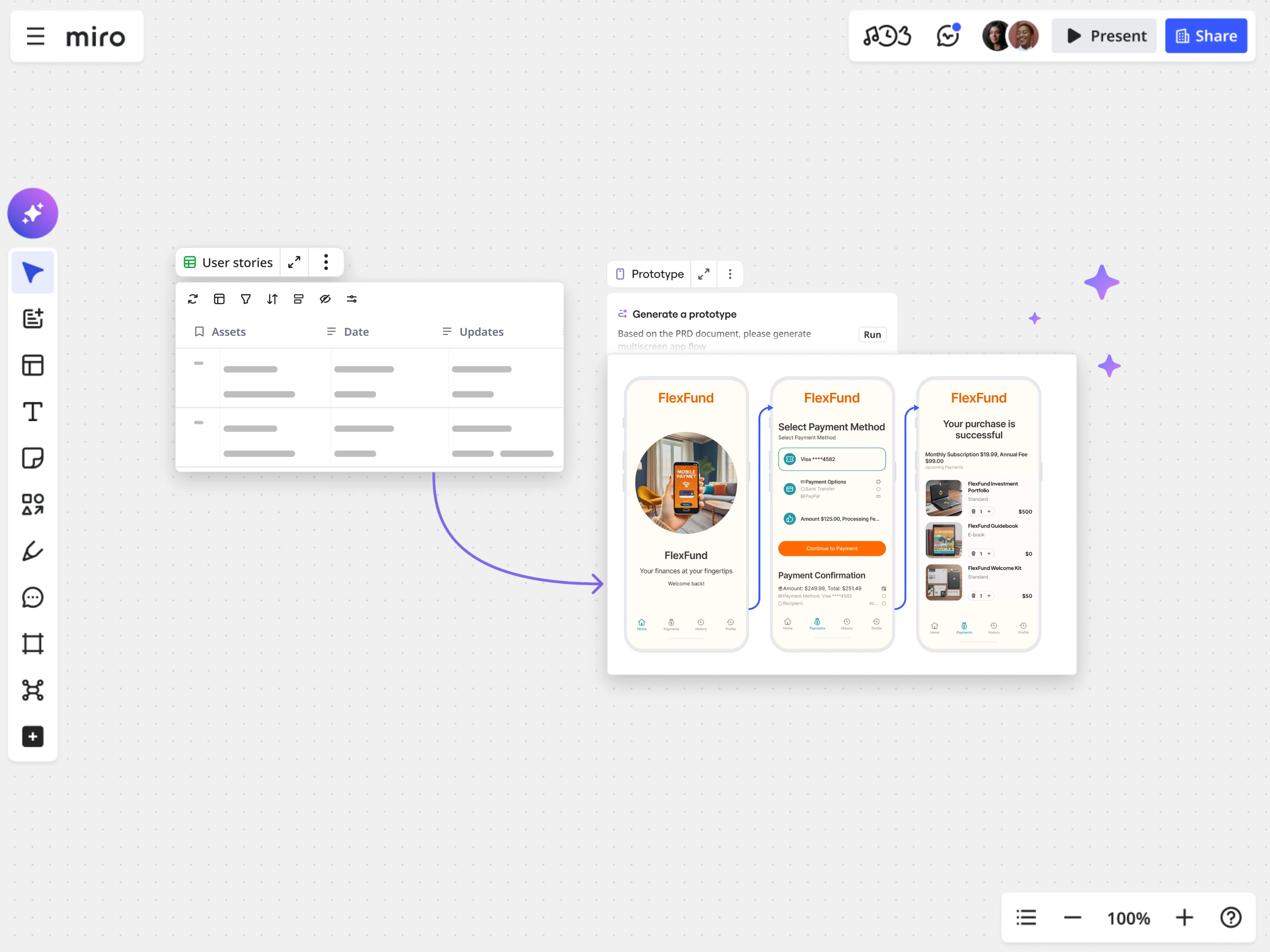
With both the existing screen and the PRD selected on the canvas, Mathias prompts Sidekick to implement the loan calculator feature as specified. Sidekick dynamically adjusts the existing input fields and adds a loan calculator as a collapsible sidebar. Everything generated is fully editable, which matters, because an AI-generated prototype is most useful as a credible starting point the team can react to and refine, not a finished artifact.
When the sidebar layout feels cramped, a follow-up prompt asks Sidekick to place the calculator as a horizontal section instead. The new version appears on the canvas alongside the original, so the team can compare, discuss, and decide without losing either option or having to rebuild from scratch. The iteration happens in a shared space where all three roles can see what changed and why, rather than in separate tools that each person checks at different moments.
Synthetic validation before it reaches stakeholders
Before sharing the prototype with anyone outside the team, Mathias switches to a custom Sidekick configured as a usability research expert, then prompts it to evaluate the prototype against Nielsen's ten UX heuristics. The output is a structured list of issues and recommendations, categorized by severity.
Instead of sending an untested prototype to stakeholders and discovering problems in the review, the team gets a structured usability audit on demand. The more severe issues get addressed immediately, using another prompt to generate a revised prototype that incorporates the recommended fixes. The stakeholder review can then focus on strategic questions rather than catching basic usability problems.
For startups, especially, this changes the economics of feedback. Getting high-quality design critique used to require either a dedicated UX researcher or a senior designer with enough bandwidth to run a structured heuristic evaluation. Neither is readily available in most early-stage teams. A configurable Sidekick that can be prompted to think like a usability expert or represent a specific user persona closes a lot of that gap.
The product design to dev handoff
Once the prototype is validated and the team is aligned, the handoff to engineering is where context most often disappears. In traditional workflows, the designer exports screens, the engineer interprets them, and the gap between intent and implementation gets filled by whoever is fastest in the sprint meeting.
Miro Prototypes offers two paths that preserve more context than a static export. The first is a direct copy-to-Figma workflow: the prototype elements copy cleanly into Figma, fully editable, ready to be refined further before engineering picks them up. The second is an MCP handoff directly to a coding agent. In the demo, Mathias opens Claude Code in the terminal, references the Miro prototype via MCP, and prompts it to generate a pixel-perfect React app based on the prototype. Claude takes the prototype and begins generating a working application.
The speed here is real, but it's not the main point. The context assembled on the canvas, including the PRD from Confluence, the design decisions made through prompting, and the usability improvements from the synthetic audit, all informed the prototype that the coding agent is working from. The product design to dev handoff evaluation becomes much simpler when the artifact being handed off already reflects the requirements, the design intent, and the validated interactions.
A practical starting point for teams adopting this workflow
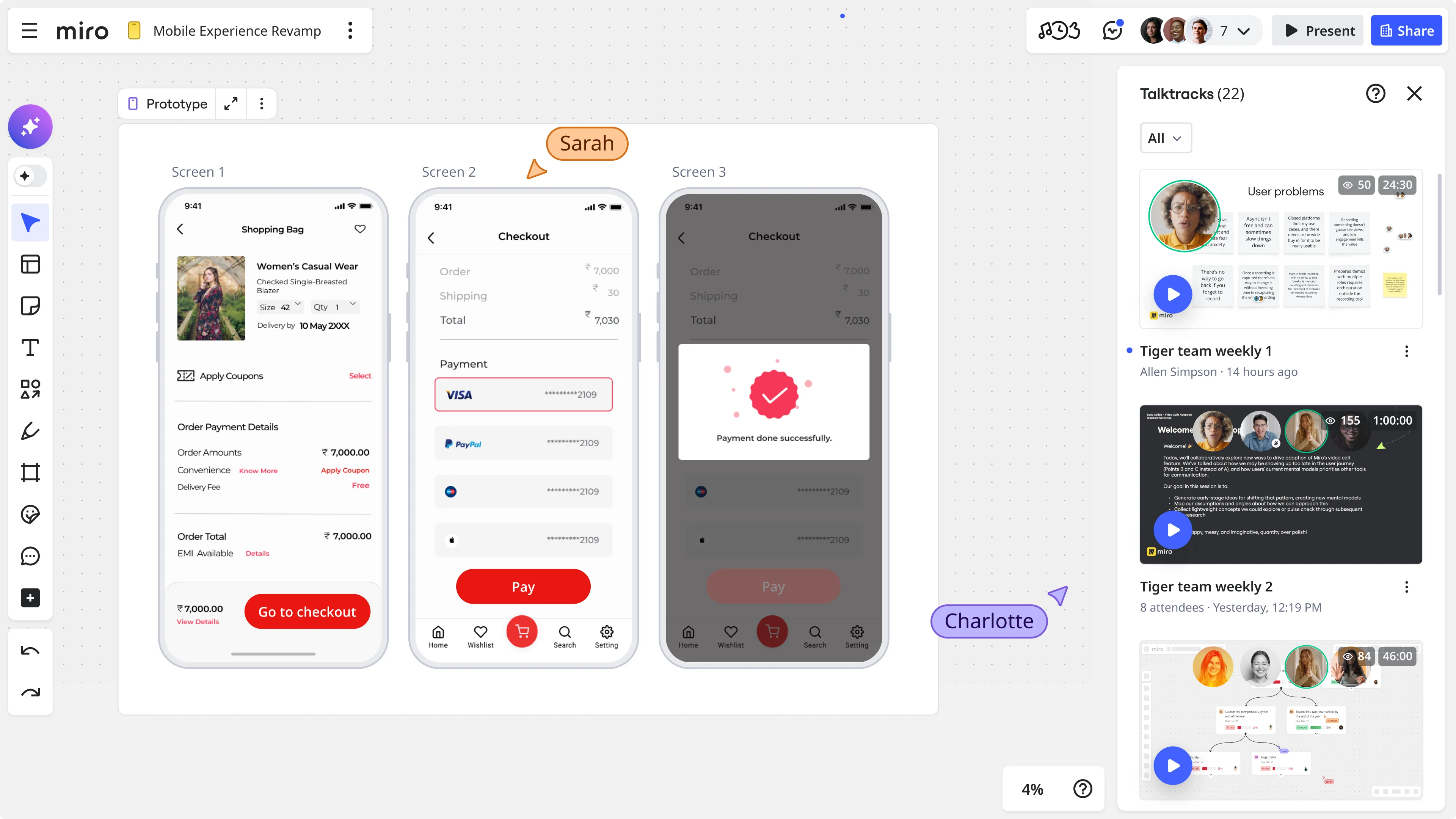
For teams that want to try this approach, the practical starting point is simpler than it might look.
Prototype before you lock. Before any feature goes into a sprint, generate a rough prototype in Miro. It doesn't need to be polished; it needs to be concrete enough for the PM, designer, and engineer to look at together and identify the questions that still need answers. The goal is to surface disagreement early, when a change costs an afternoon, rather than mid-sprint, when it costs a week.
Keep context attached to the work. Use Miro's canvas as the single space where the PRD, the design explorations, and the final prototype all live together. When the engineer starts building, they should be able to see not just what the final design looks like, but the reasoning behind it. The MCP integration with tools like Confluence and Jira makes this easier; documentation doesn't have to be manually copied over.
Validate before you share. Before a prototype goes to stakeholders or into the sprint, run a structured evaluation. A Sidekick-powered heuristic audit takes minutes and surfaces the problems that are easiest to fix now and most expensive to fix later.
The broader point about AI and team collaboration
The individual productivity gains from AI tools are real, and they're not going away. PMs are drafting better PRDs faster, designers are generating prototypes in minutes, and engineers are shipping more code per sprint. The risk, though, is that each person gets more productive in their own lane while the lanes become harder to cross.
The teams that get the most out of AI-assisted workflows are the ones that use AI as a shared resource, embedded in the space where the team actually works together, rather than as a collection of personal tools that each person runs in isolation. A canvas-based workspace like Miro, where the PM's requirements, the designer's prototype, and the engineer's handoff artifact all live in the same place, is what makes AI-assisted collaboration actually work.
The goal is a prototype that everyone understands, that carries the context of how it was made, and that hands off to engineering without losing the reasoning behind it. Getting there doesn't require a new process from scratch; it mostly requires a shared space to put the work in.
Ready to bring your PM, design, and engineering team into the same workflow? Start building with Miro Prototypes for free.
Frequently asked questions
What is the PM–design–engineering collaboration framework?
A PM–design–engineering collaboration framework is a set of shared practices that help product managers, designers, and engineers work together across the full product development cycle. Effective frameworks typically include shared artifact spaces, clear handoff protocols, and structured validation steps before features move to build.
How does AI change product design to dev handoff?
AI-assisted tools can compress the time between design and development by generating prototypes from specs, running synthetic usability evaluations, and producing structured handoff artifacts that carry context from the original requirements. In Miro Prototypes, this includes pulling a PRD from Confluence, generating a prototype that reflects it, validating the design against heuristics, and handing off to a coding agent, all within a single session on a shared canvas.
What is a Miro design to dev handoff evaluation?
A Miro design to dev handoff evaluation is the process of reviewing a prototype in Miro before it moves to engineering, using Miro's AI-powered tools to assess usability, completeness, and alignment with the original requirements. This can include a Sidekick-driven heuristic audit using Nielsen's ten UX heuristics, a comparison against the source PRD, or a persona-based review using a custom Sidekick configured to represent your target user.
When should startups prototype in the product development process?
As early as possible, before requirements are locked and engineering scoping begins. Early prototyping surfaces disagreement and clarifies intent when changes are cheap. Prototyping too late results in artifacts that defend decisions rather than validate them.
How does Miro Prototypes support cross-functional teams?
Miro Prototypes brings the PRD, the design explorations, and the validated prototype into a shared canvas where product managers, designers, and engineers can all work from the same context. Through MCP integrations with tools like Confluence, Jira, and coding agents like Claude Code, teams can move from requirements to working application without the context loss that typically happens at each handoff point.
Can AI replace the need for a dedicated UX researcher in a startup?
Not fully, but Miro's custom Sidekicks can substantially reduce the gap. A Sidekick configured as a usability research expert can run structured heuristic evaluations, identify usability issues by severity, and generate revised prototypes that address the findings, without the overhead of scheduling a formal research session. For early-stage teams that can't yet justify a full-time researcher, this provides a practical baseline for validating designs before they reach stakeholders.
Last updated: May 20, 2026
Read more
Join our 100M+ users today


