TRANSLATE is a five-stage framework for turning a defined business question and the evidence you actually have into an analysis-ready evidence set, without inventing information the source material does not contain.
Use it to identify the available evidence, define what the investigation needs that evidence to represent, sort each evidence item by the role it may play, translate Business Concepts into evidence that can be used directly, derived or flagged as missing, and check whether the finished evidence set is ready for analysis.
That evidence may be quantitative, qualitative or mixed. TRANSLATE can work with structured business data, transcripts, interviews, customer feedback, observations, process records, documents and other material that can legitimately represent what the investigation needs to know.
The framework is designed for commercial, growth, product, customer, operating and broader business questions where the available evidence rarely arrives in exactly the form the question requires.
How to use it
Identify the raw evidence you actually have access to.
Define the Business Concepts the evidence must represent.
Sort each evidence item by the analytical role it may play.
Translate each Business Concept into evidence you can use directly, derive into a usable representation or flag as missing.
Check whether the finished evidence set can evaluate the question honestly.
TRANSLATE uses three classifications:
Direct: The available evidence already represents the Business Concept clearly enough to use as-is.
Derived: The information exists, but it must be coded, classified, combined, calculated or otherwise transformed before analysis.
Missing: The investigation requires something the available evidence cannot represent.
Missing evidence does not automatically stop the investigation. A gap may be acceptable if the remaining evidence can still answer the question within a clear boundary. Likewise, derived evidence may still carry limitations that must remain visible in the analysis.
Move forward when the evidence set is Ready for Analysis or Ready with Known Limitations. If a critical part of the question cannot be represented, return to the source of the gap. That may mean clarifying the Business Concept, finding additional evidence or, if the evidence cannot reasonably be obtained, narrowing or reframing the investigation question.
A worked example is included to show the method in use across mixed evidence. It combines structured outbound call records with qualitative call-transcript evidence, including both a genuine missing-evidence case and evidence that can be carried forward only with a stated limitation.
This board can be used on its own, or as part of Signal Foundry’s Commercial Investigation System:
TRACE: Frame the business question worth investigating.
TRANSLATE: Prepare the available evidence so it can represent what the question requires.
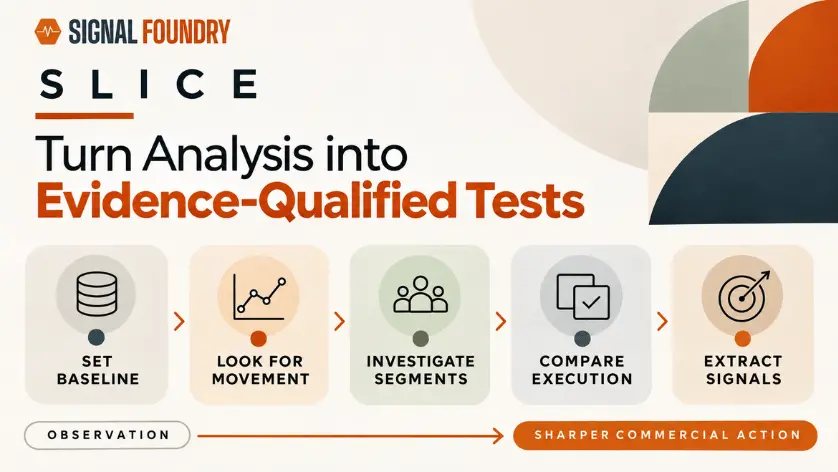
SLICE: Analyze the evidence and qualify what the findings support.
The goal is not to make imperfect evidence look complete. It is to make clear what the evidence can represent, what must be derived, what remains missing and what limits must travel with the analysis.