SLICE is a five-stage investigation framework for turning analysis-ready business data into evidence-qualified signals and tests worth running.
Use it when you have a defined business question and usable data, but need a disciplined way to determine what is actually changing, where the pattern concentrates, what may help explain it and which findings are strong enough to carry forward.
SLICE is designed for commercial, growth, revenue and operating questions where the data contains many possible patterns but not every visible difference deserves interpretation or action.
How to use it
Set Baseline — Establish the overall measure, population, period and reference point before cutting the data.
Look for Movement — Find meaningful changes, breaks or divergences without explaining them prematurely.
Investigate Segments — Use relevant cuts to locate where the pattern becomes stronger, weaker or disappears.
Compare Execution — Compare observable behaviour, activity, process or operating conditions where outcomes differ.
Extract Signals — Qualify the strongest findings, decide what should be promoted, tabled or abandoned, and turn promoted signals into Test Briefs.
The method is intentionally progressive. Start with the broad pattern, then narrow only where the evidence earns another cut. SLICE helps prevent common analytical mistakes such as jumping from one observation to a conclusion, exploring every available segment simply because the data allows it, or treating correlation as proof of cause.
The final stage uses SIGNAL to separate fact from hypothesis, identify the decision affected, gauge the strength of the evidence, name the business implication, articulate the next test and record the limits that constrain what can honestly be concluded.
Promoted signals become portable Test Briefs containing the test, supporting signal, business need, protocol, limits, accountable owner, support and measure. Tabled signals remain available for a future cycle. Findings that do not support a worthwhile next test can be abandoned without losing the analytical record.
A worked example is included to show the complete method in use without changing the structure of the working frames.
SLICE can be used on its own when you already have a clear investigation question and prepared data, or as the final phase of Signal Foundry’s Commercial Investigation System:
TRACE — Frame the business question worth investigating.
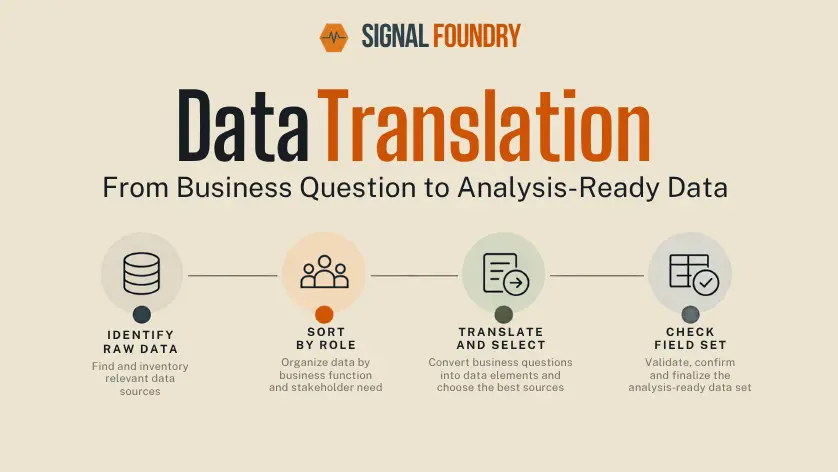
TRANSLATE — Turn the question into analysis-ready data.
SLICE — Analyze the evidence and determine which tests are worth running.
The goal is not to manufacture certainty from imperfect data. It is to narrow the evidence far enough that the next commercial test is deliberate, defensible and capable of producing useful learning.