What is the Software Release PERT Template?
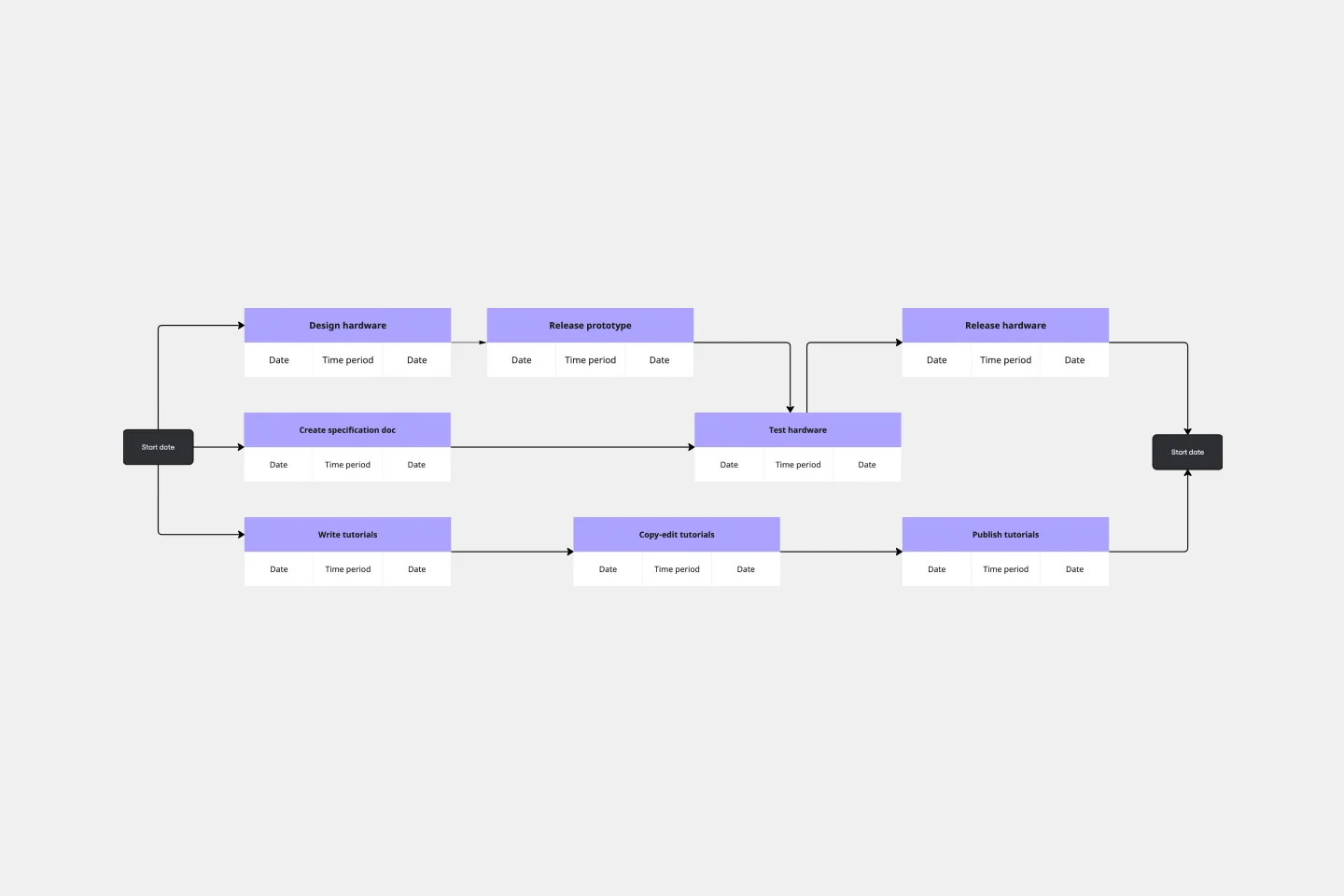
A software project planning template that helps product and engineering teams map release activities, dependencies, estimated durations, and the critical path. Teams can see how design, development, testing, deployment, and launch activities connect.
What problem does the Software Release PERT Template solve?
Unclear release dependencies
Engineering and marketing plans that are disconnected
Hidden schedule risks
Testing scheduled too late
Poor visibility into parallel work
Unclear critical-path activities
Release dates without supporting logic
How to use the Software Release PERT Template
Define the release milestone.
List the major release activities.
Connect dependent tasks.
Identify work that can run in parallel.
Add optimistic, most likely, and pessimistic estimates.
Calculate expected durations.
Identify the critical path.
Add owners, dates, risks, and response actions.
Common pitfalls
Turning every engineering ticket into a PERT activity
Missing cross-functional dependencies
Scheduling QA only after development ends
Treating every activity as critical
Ignoring release approvals
Using estimates without revisiting them
Ways to avoid mistakes
Keep the chart at milestone level.
Include product, engineering, QA, and launch teams.
Start QA planning early.
Highlight only the true critical path.
Review dependencies at each major release checkpoint.
Update estimates when scope changes.
Miro Features You Can Use
Shapes for release activities
Connectors for dependencies
Color coding for critical-path tasks
Tags for engineering, QA, design, and marketing
Comments for risks and handoffs
Tables for PERT estimates
Milestones for beta, release candidate, and launch
FAQs
Q: Who can benefit from this template?
A: Product managers, engineering teams, QA teams, DevOps, designers, product marketers, and technical program managers.
Q: What types of software projects work well?
A: Feature releases, platform upgrades, integrations, migrations, mobile releases, and major product updates.
Q: Should every release task be included?
A: No. Focus on the activities that affect sequencing, dependencies, or release timing.
Q: What is the critical path?
A: The longest dependent sequence of work that determines the earliest possible launch date.
Q: What will participants leave with?
A: A visual release schedule with dependencies, expected durations, critical-path activities, owners, and timing risks.