Understand what is standing between today’s performance and the desired result
A bold, colourful, presentation-ready template for exploring the factors behind a defined performance gap, problem, or undesired outcome. It uses a familiar fishbone-style structure to help teams move beyond symptoms and identify the people, process, systems, and external conditions contributing to the gap.
What’s included
Start by defining the problem or performance gap:
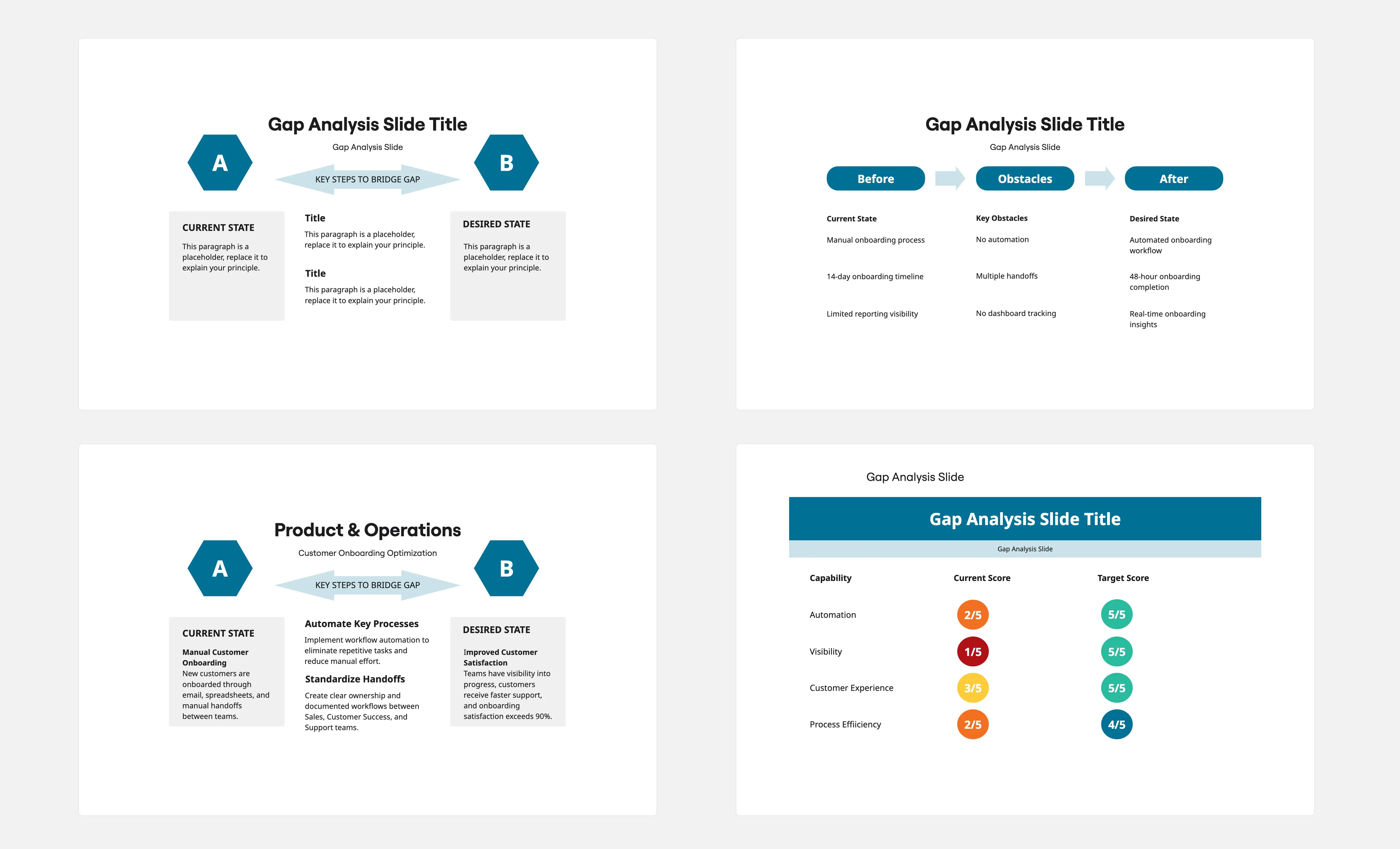
What is happening now?
What should be happening instead?
What is the impact on cost, delivery, risk, customers, or outcomes?
Then investigate possible contributing factors across six areas:
People — skills, capacity, communication, leadership, and workload.
Process — steps, handovers, decisions, and controls.
Technology and equipment — tools, systems, machinery, data, and maintenance.
Materials and suppliers — quality, availability, sourcing, packaging, and suppliers.
Measurement and information — data, metrics, reporting, feedback, and visibility.
Environment and external factors — market, regulation, customer, economic, and other external conditions.
Each branch includes space to capture what might be contributing, what evidence supports it, and what still needs checking.
How to use it
Define the current state, target state, and impact of the gap.
Invite participants to add possible contributing factors to the relevant branches.
Capture evidence beside each idea, and clearly mark assumptions or unanswered questions.
Cluster related notes and identify the factors most likely to explain the gap.
Choose the priority causes to validate, address, or escalate.
Use the completed board as a clear, slide-ready summary of the analysis and next steps.
Suggested 45-minute workshop
5 min — Define the gap: Agree the problem, target state, and impact.
10 min — Generate factors: Participants add possible contributors across all six branches.
10 min — Add evidence: Distinguish known facts from assumptions and open questions.
10 min — Prioritise: Identify the contributing factors with the strongest evidence and greatest impact.
10 min — Agree next steps: Assign owners to validate key causes or develop improvement actions.
Who it’s for
Ideal for project, operations, product, service, quality, and leadership teams investigating underperformance, delays, defects, customer issues, missed targets, or delivery risks. It is especially useful when you need to turn a complex discussion into a concise presentation or decision-making slide.