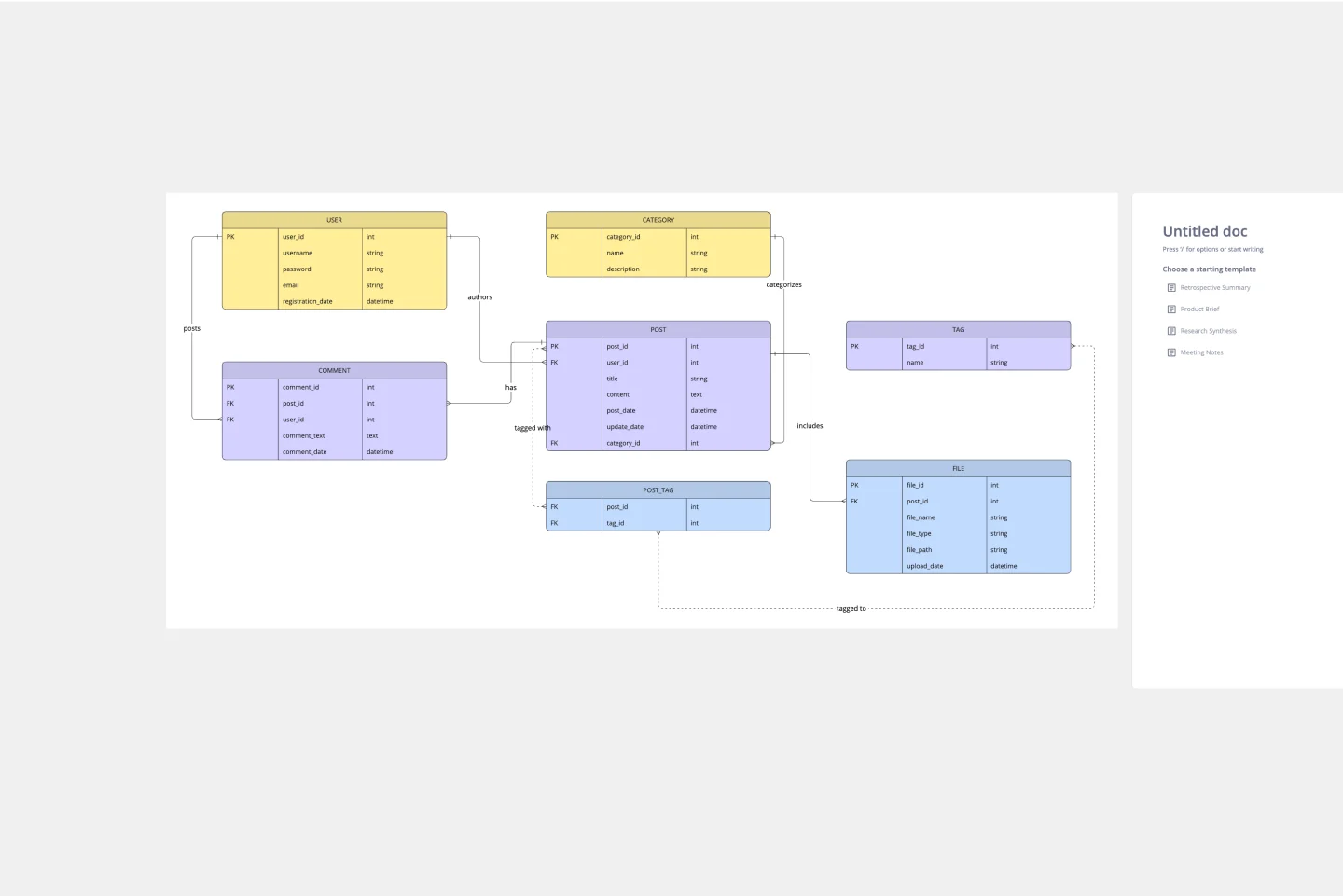
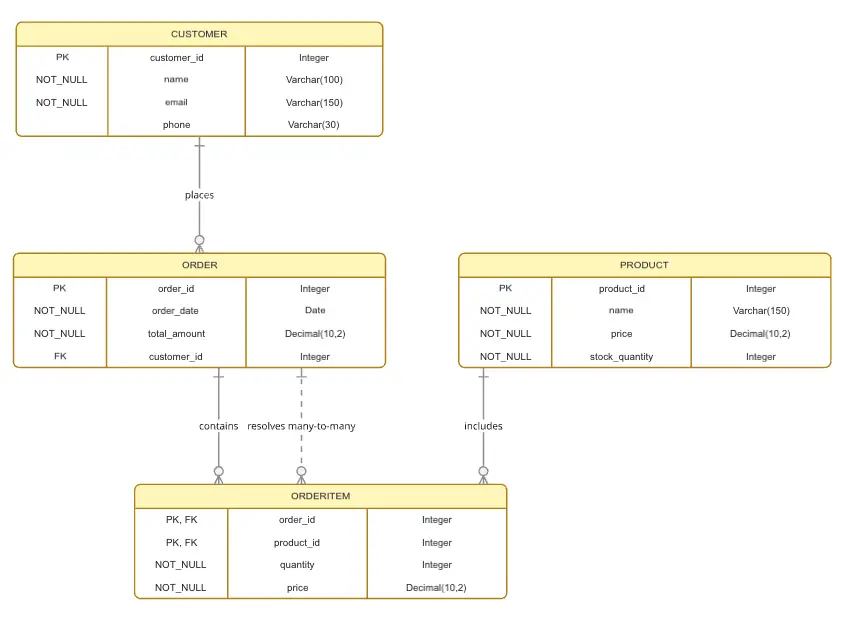
What is the Simple ERD Template?
A visual database planning template that helps teams map entities, attributes, keys, and relationships. Teams can document how core data objects connect before creating or changing a database.
What problem does the Simple ERD Template solve?
Unclear data structure
Missing entities
Confusing relationships
Duplicate data
Weak product and engineering alignment
Database changes without shared documentation
How to use the Simple ERD Template
Define the system or workflow being mapped.
List the main entities.
Add key attributes to each entity.
Mark primary and foreign keys.
Connect related entities.
Label each relationship.
Set one-to-one, one-to-many, or many-to-many cardinality.
Review the completed diagram with the technical team.
Common Pitfalls
Mapping too much of the system at once
Using actions as entity names
Leaving entities without primary keys
Missing foreign keys
Using many-to-many relationships without linking entities
Adding fields unrelated to the selected workflow
Ways to Avoid Mistakes
Start with one product flow.
Use singular nouns for entities.
Keep attributes focused on the workflow.
Review every relationship with an engineer.
Use linking entities for many-to-many relationships.
Record assumptions and open questions.
Miro Features You Can Use
ERD shapes for entities
Text fields for attributes
Connectors for relationships
Crow’s-foot notation for cardinality
Color coding for primary and foreign keys
Comments for technical questions
Frames for separate workflows
FAQs
Q: Who can benefit from this template?
A: Product managers, software engineers, data engineers, technical leads, designers, analysts, and startup teams.
Q: What should an entity contain?
A: An entity should contain a clear name, a primary key, and the main attributes needed for the selected workflow.
Q: What is a primary key?
A: A primary key uniquely identifies each record in an entity.
Q: What is a foreign key?
A: A foreign key links one entity to another.
Q: How many entities should a simple ERD include?
A: Four to eight entities usually keeps the diagram focused.
Q: What will participants leave with?
A: A simple ERD containing core entities, attributes, keys, relationships, cardinality, and open technical questions.