Build an evidence-based case for your market opportunity
A two-part template for assessing the size, reachability, and commercial potential of a market before committing to an expansion, product launch, or new business idea. It combines market sizing with the key questions needed to make a practical market-entry recommendation.
What’s included
The first board provides a visual market-sizing view using four layers:
Total Addressable Market (TAM) — the full demand if every relevant customer could buy.
Serviceable Available Market (SAM) — the part of the market you can serve with your current product, geography, and channels.
Serviceable Obtainable Market (SOM) — the realistic share you can win over the next 12–24 months.
Revenue opportunity — what that share could mean in customers, annual revenue, and growth.
Use the accompanying metric cards to capture market value, customer numbers, growth rate, and timeframe.
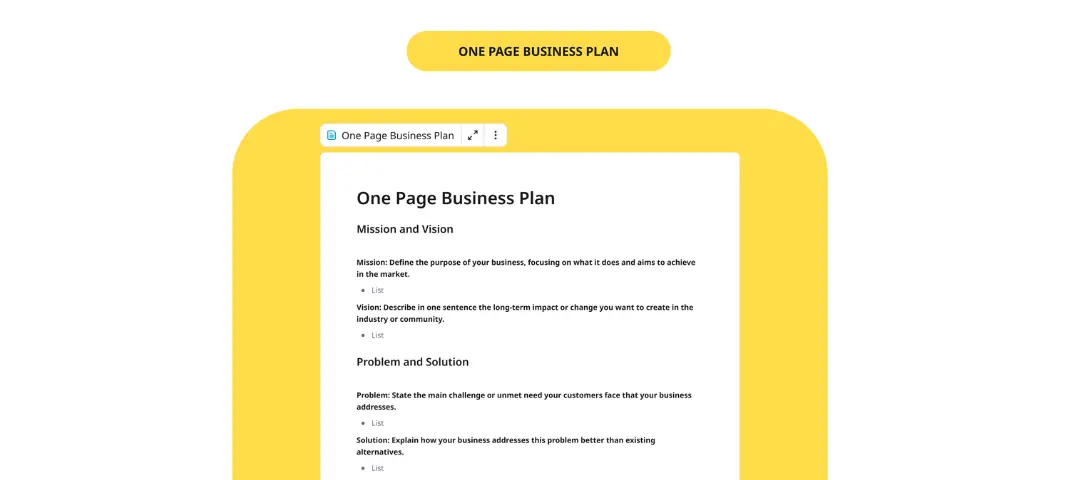
The second board turns sizing into a stronger business case by exploring:
Customer and need — who you are targeting, what problem they face, and why the opportunity matters now.
Competition and differentiation — current alternatives, competitors, and your advantage.
Route to market — acquisition channels, pricing, business model, and key partners.
Assumptions and evidence — what must be true, what supports the estimates, and the biggest risks.
Market-entry recommendation — a clear decision, rationale, validation step, owner, and date.
How to use it
Start with the market-sizing board and define your TAM, SAM, SOM, and revenue opportunity.
Add a timeframe and data source for each estimate; avoid relying on percentages without a clear base.
Move to the business-plan board and define your primary customer and the urgent problem you are solving.
Assess competitors, alternatives, your differentiator, and how you will reach and serve customers.
Record the assumptions behind your estimates and identify the evidence you still need.
End with a decision: Proceed, Test first, Refine, or Do not pursue.
Assign one validation step—such as interviews, desk research, a pilot, or an experiment—and set an owner and date.
Suggested 75-minute workshop
10 min — Define the opportunity: Agree the product, market, customer segment, and decision to be made.
20 min — Estimate the market: Work through TAM, SAM, SOM, and revenue opportunity using available data.
15 min — Test the market case: Discuss customer need, alternatives, competition, and differentiation.
15 min — Plan entry: Identify acquisition channels, business model, partners, assumptions, and risks.
10 min — Decide and validate: Agree the market-entry recommendation and next validation step.
5 min — Close: Confirm the owner, evidence still needed, and review date.
Who it’s for
Ideal for founders, product teams, strategy teams, innovation leads, consultants, investors, and business-development professionals. Use it when evaluating a new product, target segment, geographic expansion, or market-entry opportunity.