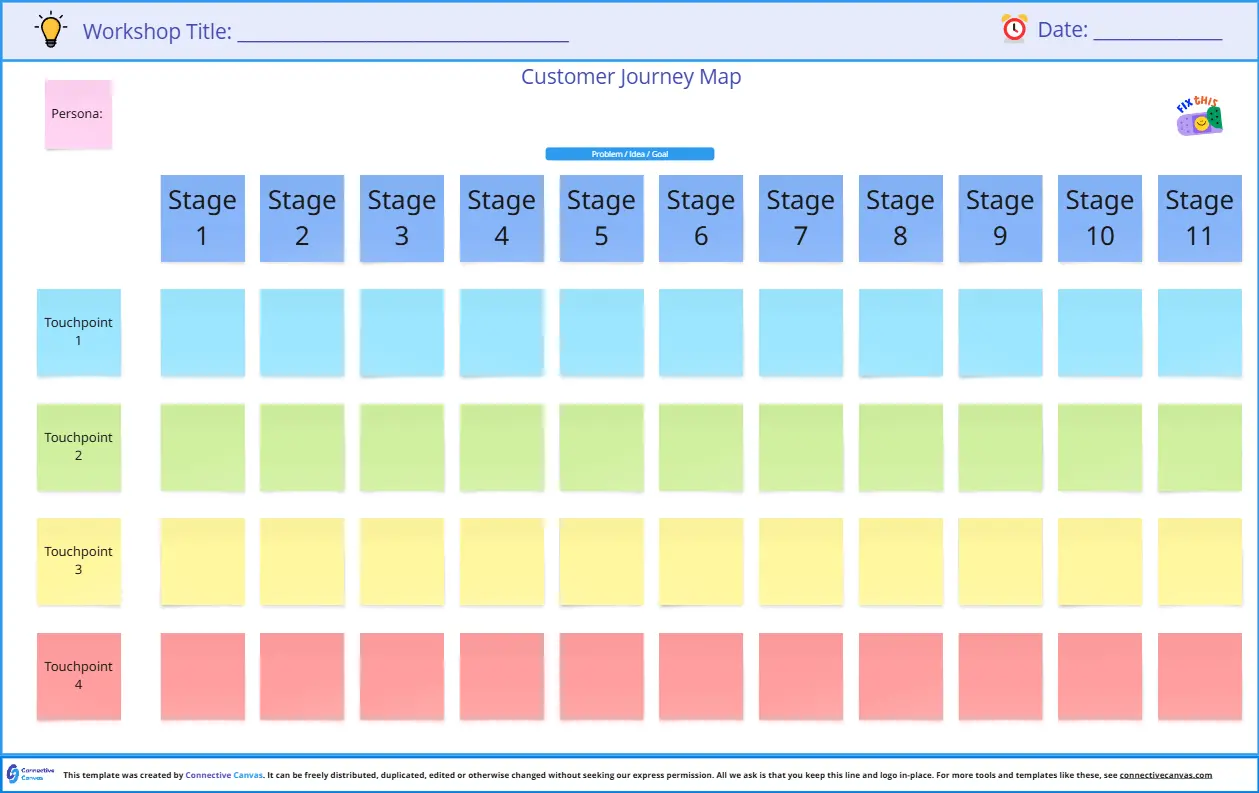
Design a better customer experience before building it. This collaborative workshop helps startup founders and product teams imagine an ideal future customer journey, visualize key interactions, challenge assumptions, and turn promising ideas into testable product improvements.
About This Template
What would your customer experience look like if you started with your customer's ideal outcome instead of your product's existing features?
The Customer Journey Future-State template helps startup founders and product software teams design customer experiences that are intuitive, valuable, and aligned with real customer needs.
Rather than mapping the experience customers have today, this workshop challenges your team to imagine what the experience could become.
Through individual ideation, collaborative storyboarding, and scenario-based evaluation, participants build a shared vision of the future customer journey and identify the ideas worth testing.
This template is designed for small teams and works for both virtual and in-person workshops.
Who Is This Template For?
Startup founders defining or refining their product experience
Product managers exploring new customer journeys
UX/UI designers developing future-state experiences
Software development teams aligning on customer needs
Customer success teams identifying opportunities to improve customer outcomes
Workshop duration: 90 minutes
Recommended participants: 3–8
Facilitator: Product manager, UX designer, product strategist, or workshop facilitator
How to Use This Template
Step 1: Define the Ideal Customer Outcome (10 minutes)
Start with one customer persona and a specific goal.
Ask participants to complete:
"Our customer should be able to ______ without ______."
Discuss the responses and agree on one customer outcome that will guide the workshop.
Output: A shared future-state customer goal.
Step 2: Imagine Better Experiences (15 minutes)
Ask each participant to independently generate three ways the customer could achieve the desired outcome.
Encourage participants to challenge existing product workflows, remove unnecessary interactions, and explore entirely new approaches.
Share ideas and organize similar concepts on the board.
Output: A collection of potential future customer experiences.
Step 3: Build the Future-State Storyboard (25 minutes)
Select a promising concept and collaboratively create a six-frame customer journey:
Customer need or motivation
First interaction
Early progress
Critical moment of value
Successful outcome
Continued engagement
For each frame, document the customer's actions, expected emotions, product interactions, and assumptions.
Output: A visual storyboard representing the ideal customer experience.
Step 4: Challenge the Future Journey (20 minutes)
Stress-test the proposed experience through realistic scenarios.
Consider a first-time customer, someone with limited time, or someone who makes an unexpected mistake.
Identify confusing interactions, missing information, potential failure points, and assumptions that require validation.
Revise the storyboard to address the most significant gaps.
Output: A refined future-state customer journey and a list of risks and unknowns.
Step 5: Turn Ideas Into Experiments (20 minutes)
Identify the riskiest assumption or most promising opportunity within the proposed journey.
Define a lightweight experiment to validate it with customers.
Document the hypothesis, prototype or testing approach, success measures, owner, and next action.
Output: A customer validation experiment ready for the team to pursue.
What You'll Achieve
By completing this template, your team will have:
A clearly defined future-state customer outcome
A shared vision of the ideal customer experience
A six-frame customer journey storyboard
A list of customer needs, assumptions, and potential risks
A prioritized experiment to validate a product improvement
Clear next steps and team ownership
Tips for Facilitators
Give participants time to develop ideas independently before discussing them as a group. This helps surface different perspectives and reduces the influence of the most vocal participant.
Keep the conversation focused on what the customer wants to accomplish rather than which features the team wants to build.
Treat the final storyboard as a hypothesis. Use customer research, usability testing, and prototype feedback to determine whether the proposed experience creates meaningful improvements.
The goal isn't to design more features. It's to design a better path to customer value.