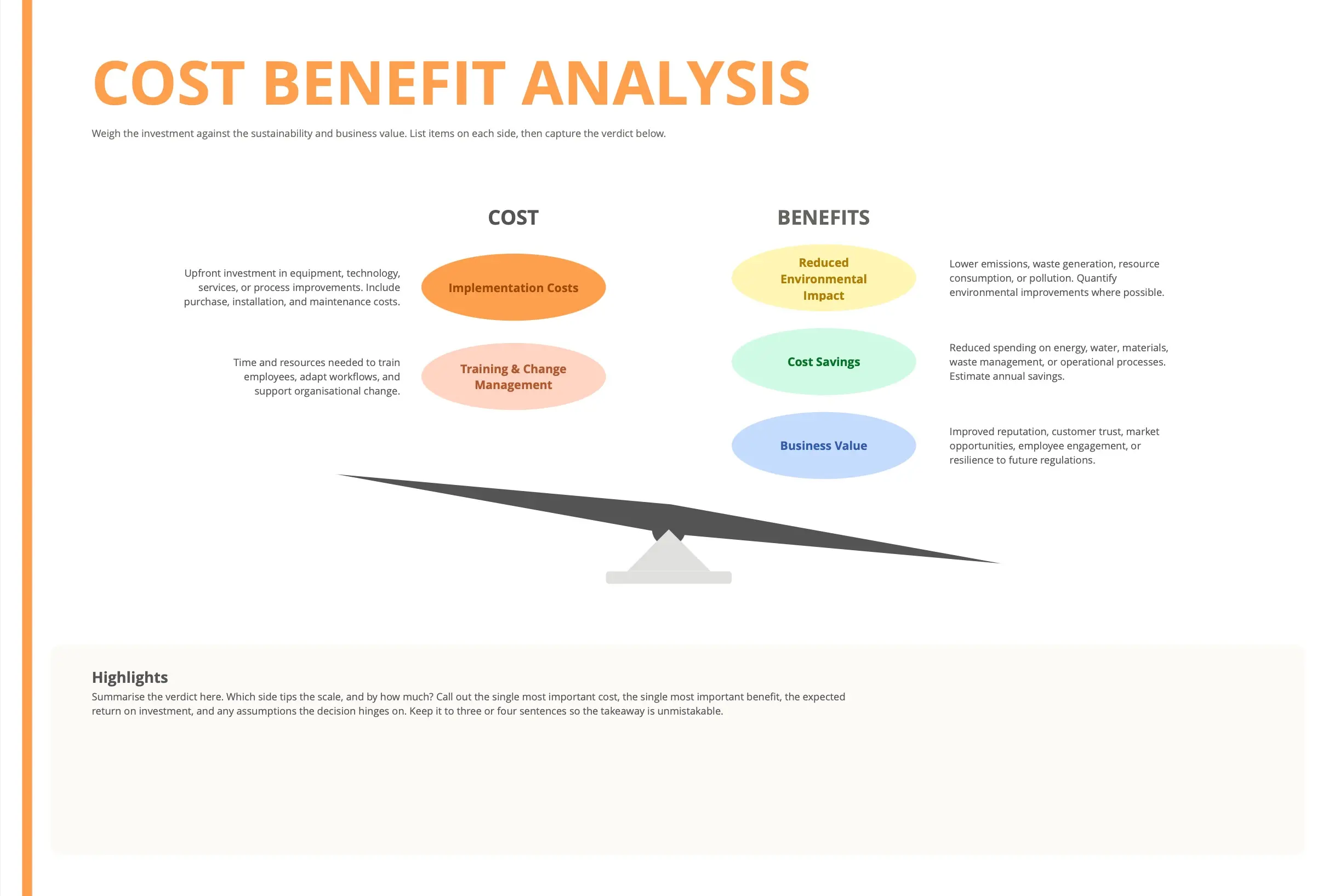
The Cost Benefit Analysis: Investment Decision Lab template helps product managers, business leaders, and project teams evaluate competing investments, compare financial returns, and make informed funding decisions. Use this collaborative Miro workshop to calculate costs, estimate benefits, challenge assumptions, and prioritize investments based on financial and strategic value.
How to Use Cost Benefit Analysis: Investment Decision Lab
Identify investments: List competing opportunities, initial costs, expected outcomes, and available budgets.
Evaluate costs and benefits: Capture implementation expenses, ongoing costs, potential savings, revenue, and nonfinancial benefits.
Compare financial returns: Calculate net benefits, ROI, and estimated payback periods using a consistent timeframe.
Challenge assumptions: Identify validated estimates, uncertain projections, and evidence gaps that could affect the investment decision.
Allocate funding: Use the Investment Auction to compare proposals, prioritize opportunities, and document funding recommendations.
Why Use Cost Benefit Analysis: Investment Decision Lab?
Investment decisions require more than comparing upfront costs. This template helps teams:
Compare financial and nonfinancial benefits across investments.
Identify hidden expenses and unrealistic return assumptions.
Evaluate investment opportunities using consistent financial measures.
Make strategic trade-offs within limited budgets.
Build agreement around funding priorities and business value.
Miro Features: Editable tables organize financial comparisons, sticky notes capture costs and assumptions, shapes represent investment options, and frames guide each workshop stage.
FAQs
Who benefits from this template? Product managers, startup founders, finance teams, project leaders, and business executives evaluating investment opportunities.
Can I compare more than three investments? Yes. Duplicate investment cards and extend the comparison table to evaluate additional projects or business opportunities.
How do I account for benefits that are difficult to measure financially? Record qualitative benefits separately, such as customer satisfaction, reduced risk, or improved employee productivity. Evaluate their strategic value without assigning unsupported financial estimates.