Build buyer personas backed by real customer research. This collaborative workshop helps startup founders and product teams analyze customer insights, challenge assumptions, uncover buying motivations, and create evidence-based buyer personas that guide product, marketing, and sales decisions.
About This Template
How much of what your team believes about your ideal buyer is supported by actual customer research?
The Buyer Persona Evidence Lab template helps startup founders and product software teams move beyond assumptions to develop a deeper understanding of the people making purchasing decisions.
Traditional buyer personas can become collections of assumed characteristics, job titles, and motivations. This workshop takes a research-first approach, using customer interviews, sales conversations, support feedback, and behavioral insights to uncover what actually influences buyers.
Through collaborative evidence mapping, research synthesis, and assumption testing, participants identify patterns in customer behavior, evaluate the strength of their findings, and transform those insights into an actionable buyer persona.
Designed for small teams, this template works for both virtual and in-person workshops.
Who Is This Template For?
Startup founders defining their target buyers
Product managers aligning product decisions with customer needs
UX researchers synthesizing customer research
Marketing teams developing more relevant messaging
Sales teams identifying purchase motivations and objections
Customer success teams sharing recurring customer challenges
Workshop duration: 60 minutes
Recommended participants: 3–8
Facilitator: UX researcher, product strategist, product manager, or workshop facilitator
How to Use This Template
Step 1: Define the Buyer You're Investigating (10 minutes)
Start by identifying one buyer segment and the purchasing decision you want to understand.
Ask participants to independently document two assumptions about this buyer's goals, challenges, or purchasing behavior.
Share the assumptions and agree on the buyer role, purchasing context, and primary research question.
Example: "What motivates operations managers at growing SaaS startups to purchase project management software?"
Output: A defined buyer segment, research question, and initial assumptions.
Step 2: Build the Evidence Wall (15 minutes)
Review existing customer interviews, sales discovery notes, support conversations, and relevant behavioral data.
Ask participants to capture one research insight per sticky note and include a reference to its source.
Organize the findings into five categories:
Group related observations and look for recurring patterns across independent customer sources.
Output: An organized evidence wall highlighting buyer needs, motivations, and purchasing behaviors.
Step 3: Separate Evidence From Assumptions (10 minutes)
Review the findings and evaluate how strongly each one is supported by research.
Classify the findings into three categories:
Multiple Sources: Supported by several independent customer sources.
Single Source: Supported by one relevant source and requiring further investigation.
Unsupported: Based on team assumptions or lacking direct customer evidence.
Challenge findings that contradict the team's original expectations. Document unanswered questions and areas requiring further research.
Output: An evidence confidence assessment and a list of assumptions to validate.
Step 4: Build the Evidence-Based Buyer Persona (15 minutes)
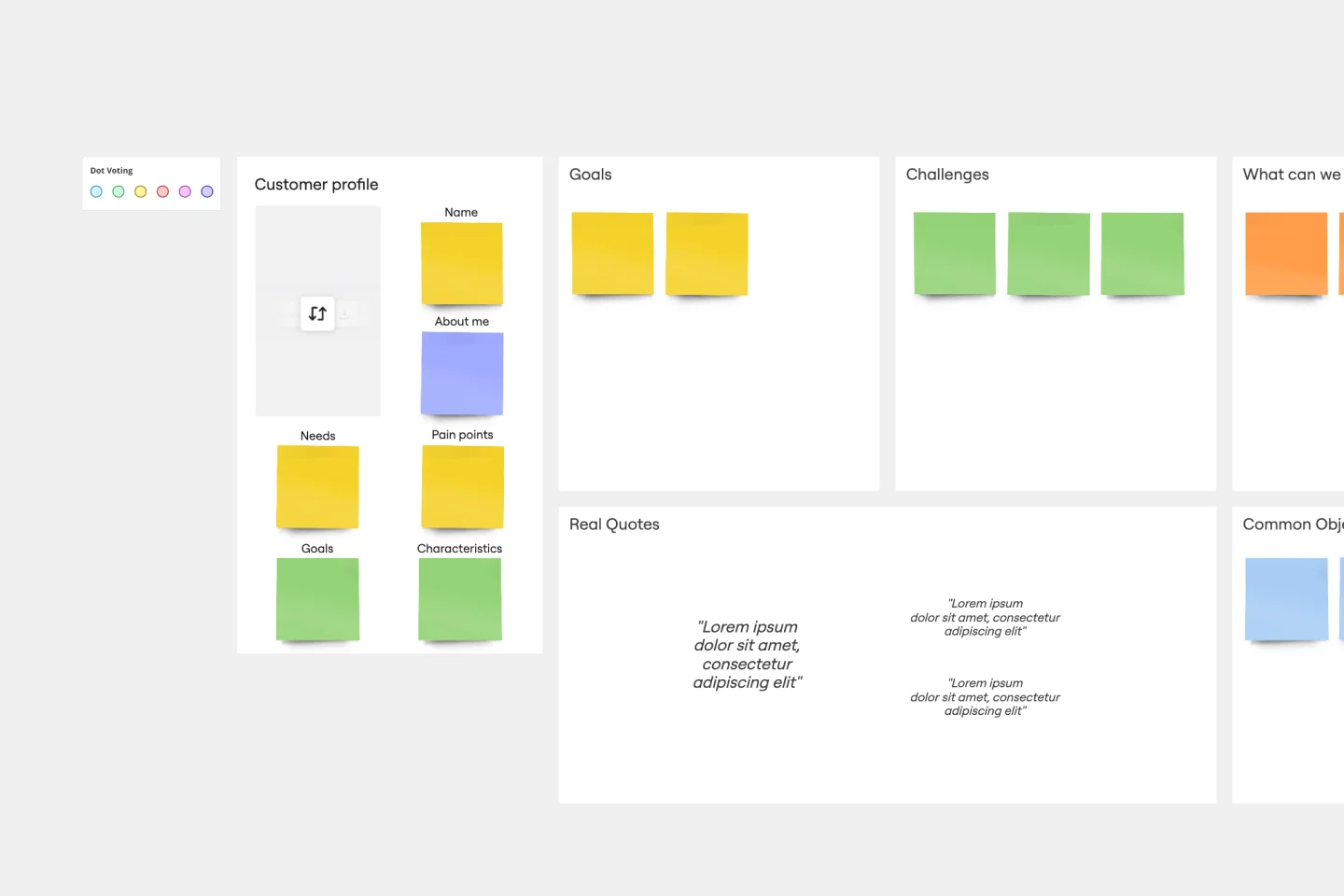
Use the strongest research findings to complete the buyer persona canvas.
Document the buyer's:
Role and purchasing responsibilities
Primary goals and desired outcomes
Challenges and frustrations
Purchase triggers
Evaluation criteria
Buying objections
Preferred information sources, when supported by research
Link important persona characteristics to their supporting evidence.
Mark unknown or weakly supported characteristics as areas requiring further research rather than filling the gaps with assumptions.
Output: A research-backed buyer persona with clearly identified knowledge gaps.
Step 5: Turn Buyer Insights Into Action (10 minutes)
Review the completed persona and discuss how the findings should influence product development, marketing, or sales.
Ask participants to independently propose one action connected to a research insight.
Discuss the suggestions and select two actions the team can pursue.
Identify one unanswered research question that deserves immediate attention.
Assign an owner, target date, and measurable outcome to each action.
Example: "Test onboarding messages focused on faster implementation against feature-focused messaging to evaluate which resonates more strongly with operations managers."
Output: Two actionable product or go-to-market initiatives and one prioritized research question.
What You'll Achieve
By completing this template, your team will have:
A clearly defined buyer segment and research focus
An organized evidence wall containing customer research insights
A shared understanding of buyer goals, challenges, and purchase motivations
An assessment distinguishing supported findings from assumptions
A research-backed buyer persona with traceable sources
A list of unanswered buyer research questions
Two actionable product or go-to-market priorities with assigned owners
Tips for Facilitators
Start with research, not assumptions. Ask participants to bring relevant customer interviews, sales notes, support feedback, or behavioral insights before the session.
Keep insights connected to their sources. Every meaningful persona characteristic should be traceable to the research that supports it. Repeated observations from one interview should not be counted as independent evidence.
Encourage individual contributions. Give participants time to review and capture research findings independently before organizing them as a team. This helps reveal different interpretations and overlooked insights.
Challenge unsupported conclusions. When participants make claims about buyer preferences or motivations, ask what evidence supports those statements.
Focus on purchasing behavior. Prioritize characteristics that explain why someone searches for, evaluates, approves, or rejects a solution. Avoid adding personal details that have little relevance to buying decisions.
Treat the persona as a working research artifact. Revisit and update it as new customer evidence becomes available. If research is limited, clearly label the persona as provisional.
The goal isn't to create a convincing fictional buyer. It's to build a reliable understanding of the real people making purchasing decisions.