Table of contents
Table of contents
Product positioning: The complete guide for product managers
Summary
- Product positioning defines how your product occupies a distinct place in customers' minds relative to alternatives
- Strong positioning drives measurable results: up to 29% increase in sales, shorter sales cycles, and lower acquisition costs
- This guide covers proven frameworks (April Dunford's five-component model, Geoffrey Moore's positioning statement, Jobs-to-be-Done)
- Includes a practical 7-week step-by-step process for crafting positioning across any industry
- Learn how visual collaboration tools like Miro help teams synthesize research, map competitors, and build positioning strategies
- Discover best practices, common mistakes to avoid, and metrics to measure positioning effectiveness
Product positioning might be one of the most misunderstood concepts in product management. Teams often confuse it with messaging, branding, or even feature lists. But here's the truth: product positioning is the strategic foundation determining whether your product succeeds or gets lost in a crowded market.
If you've ever wondered why some products with fewer features win while feature-rich alternatives struggle, the answer often lies in positioning. Let's break down what product positioning really means, why it matters more than you think, and how you, as a product manager, can master this critical skill.
What is product positioning?
Product positioning is the strategic process of defining how your product occupies a distinct place in your target customer's mind relative to alternatives. It's not what you say about your product—it's how customers perceive and categorize it when they have a problem to solve.
Think of positioning as answering these fundamental questions:
- What is this product?
- Who is it for?
- What problem does it solve?
- Why should customers choose it over alternatives?
- What makes it different or better?
The challenge? You're not positioning against a blank slate. Your customers already have mental categories for products, existing solutions they're using, and preconceived notions about what works and what doesn't. Your positioning must fit into—or create new—mental real estate in their minds.
Here's what product positioning actually includes:
Target market definition: Who are you building for? Not "everyone" but specific customer segments with shared problems, contexts, and buying behaviors.
Category assignment: What existing product category does your solution belong to, or are you creating a new one? This shapes expectations about features, pricing, and use cases.
Competitive alternatives: What do customers use today to solve this problem? This includes direct competitors, indirect solutions, and even "doing nothing."
Unique value proposition: What measurable outcomes or specific benefits does your product deliver that alternatives don't?
Proof points: What evidence supports your positioning claims? Customer results, data, testimonials, and demonstrations that validate your differentiation.
Why product positioning matters more than you think
Product positioning isn't just marketing fluff—it's a strategic decision that cascades through every aspect of your product and go-to-market strategy. Here's why it deserves your attention:
Positioning drives product decisions
Your positioning determines what features you build and which you don't. Without clear positioning, product teams waste time building features that don't reinforce their strategic differentiation. Research shows that many teams lose momentum during the Discovery and Definition phases—often because they lack clarity on who they're building for and what problem they're truly solving.
Positioning impacts buying decisions
Your target customers evaluate dozens of solutions. They're asking "What exactly will this do?" before committing their time. Technical audiences, especially senior leaders, evaluate software by measurable outcomes. They are results-oriented people who focus on impact in their work.
When you anchor positioning in specific, tangible benefits rather than grandiose promises, you speak their language. Instead of claiming to "revolutionize workflows," show how teams achieve concrete results like reducing planning time by 50% or completing projects in a third of the expected time.
Positioning creates market clarity
Strong positioning helps customers quickly understand whether your product is right for them. This saves everyone time—yours and theirs. It attracts the right customers while repelling poor fits, leading to higher satisfaction, better retention, and more powerful word-of-mouth.
Companies that position clearly see their ideal customers self-select.
How product positioning influences your product strategy
Product positioning isn't a static document you create once and file away. It's a strategic lens that should inform decisions across your organization.
Roadmap prioritization
Your positioning acts as a filter for feature requests and opportunities. Does this capability reinforce your differentiation? Will it help you better serve your target market? If not, it's probably a distraction.
When teams lack positioning clarity, roadmaps become a collection of everyone's pet features rather than a coherent strategy. You end up building for "everyone" and delighting no one.
Go-to-market alignment
Sales, marketing, customer success—every customer-facing team needs to tell a consistent story about what your product is and who it's for. Positioning provides that shared narrative.
Without it, your sales team might sell to the wrong customers, setting unrealistic expectations. Marketing might attract the wrong audience. Customer success struggles to define what "success" even looks like.
Competitive strategy
Your positioning determines which competitors matter. If you position in a crowded category, you're fighting established players with deeper pockets. Position in an adjacent or new category, and you might avoid direct competition entirely.
Clear positioning cuts through noise by being specific about what you do and don't solve. In a market saturated with tools promising everything, specificity becomes your competitive advantage.
Product positioning frameworks: Your strategic toolkit
Let's explore proven frameworks that product managers use to develop strong positioning. These aren't theoretical exercises—they're practical tools for gaining clarity.
Geoffrey Moore's positioning statement
This classic framework forces you to articulate positioning in a single, disciplined statement:
Format: "For [target customer] who [statement of need or opportunity], [product name] is a [product category] that [statement of key benefit]. Unlike [primary competitive alternative], [product name] [statement of primary differentiation]."
Example: "For distributed product teams who struggle with alignment across time zones, Miro is an AI-powered innovation workspace that enables real-time and async collaboration on one visual canvas. Unlike traditional document-based tools or basic whiteboards, Miro combines visual thinking with AI capabilities that help teams move from ideas to decisions faster."
Why it works: This framework prevents vague positioning by demanding specificity about target customers, alternatives, and differentiation.
April Dunford's positioning canvas
April Dunford's approach, detailed in her book "Obviously Awesome," emphasizes understanding customer context first. Her canvas includes five components:
1. Competitive alternatives: What would customers use if your product didn't exist? This includes direct competitors, DIY solutions, spreadsheets, or even doing nothing.
2. Unique features: What capabilities do you have that alternatives don't? Be honest and specific here.
3. Value (benefit) of unique features: For each unique feature, what measurable outcome or benefit does it deliver? Don't just list features—translate them into customer value.
4. Target market characteristics: Who cares most about these specific benefits? What makes them different from other potential customers?
5. Market category: What existing category can you position in where your unique value matters most? Or do you need to create a new category?
How to use it: Start by listing competitive alternatives. This grounds your positioning in customer reality rather than your aspirations. Then work through unique features and their benefits before narrowing to your best-fit market and category.
Use Miro workspace and templates to map this out with your team. Create sticky notes for each alternative, feature, and benefit. Group related items. This makes the abstract concrete and gets everyone aligned.
April Dunford's Positioning Template by Erwan Derlyn
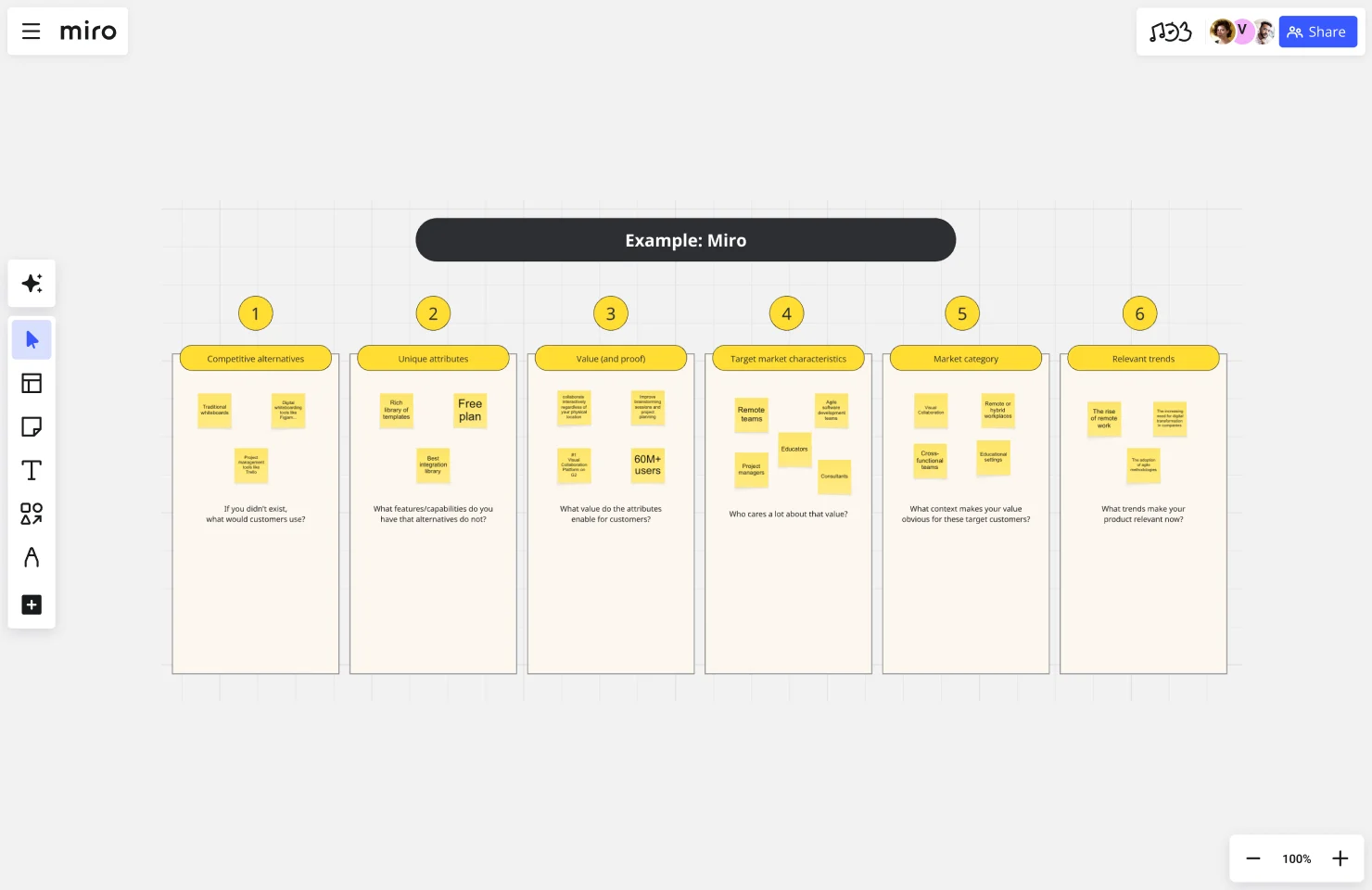
To streamline your positioning work, Miro offers a pre-built April Dunford Positioning Template that guides you through the five-component framework discussed in this article.
The template provides structured sections for mapping competitive alternatives, identifying differentiated capabilities and their value, defining best-fit customers, and selecting your market category—all on a visual canvas your team can collaborate on in real-time.
Instead of starting from scratch, product managers can use this template to immediately begin capturing customer insights, facilitating positioning workshops, and building consensus across cross-functional teams. It's designed to make the seven-week positioning process more efficient and keep your strategic work organized in one accessible place.
Jobs-to-be-Done positioning
This framework positions your product around the "job" customers are trying to accomplish rather than product features or market categories.
The core questions:
- What job is the customer hiring your product to do?
- What are the functional, emotional, and social dimensions of this job?
- What circumstances trigger the need for this job?
- What does success look like from the customer's perspective?
Example: Instead of positioning as "a project management platform," you might position around the job: "Help construction managers coordinate complex multi-trade projects by centralizing schedules, material deliveries, and subcontractor communication in one accessible system."
This grounds positioning in tangible moments from their daily work: tracking which trades can start work based on completed inspections, coordinating material deliveries to avoid site congestion, and ensuring subcontractors have current blueprints before starting each phase.
Why it matters: Jobs-to-be-Done positioning resonates because it describes the customer's world, not yours. It focuses on outcomes, not outputs.
Step-by-step: Crafting your product positioning
Ready to develop or refine your positioning? Here's a practical process you can follow, whether you're launching something new or repositioning an existing product.
Step 1: Gather customer insights (Week 1)
Start with understanding, not assumptions. Talk to at least 10-15 customers who love your product.
Key questions to ask:
- What were you using before our product?
- What problem were you trying to solve?
- Why did you choose us over alternatives?
- What specific results have you achieved?
- How would you describe our product to a colleague?
Document these conversations. Pay attention to the language customers use—they'll often articulate your positioning better than you can.
Create a shared visual workspace where your team can synthesize insights. Use one section for competitive alternatives mentioned, another for problems customers describe, and a third for benefits they've experienced. Visual collaboration helps teams process and synthesize research findings more effectively than endless document threads.
Step 2: Analyze the competitive landscape (Week 2)
Map out alternatives customers mentioned. Don't just focus on direct competitors—include adjacent solutions, DIY approaches, and the status quo.
For each alternative, document:
- What customer segments use it?
- What jobs does it help them do?
- What are its strengths and weaknesses?
- How much does it cost?
- What's required to adopt it (technical, organizational, behavioral)?
This isn't about finding what competitors do badly so you can attack them. It's about understanding the full landscape customers navigate when solving their problems.
Step 3: Identify your unique value (Week 2-3)
Based on customer insights and competitive analysis, what can you do that alternatives can't or don't?
Be brutally honest. "We're more user-friendly" isn't differentiation unless you can quantify it. "We're AI-powered" isn't unique when everyone claims the same.
Strong differentiation is:
- Specific: "Process visual content from whiteboards and diagrams, not just text" beats "better AI"
- Measurable: "26% less time in meetings" beats "more efficient"
- Provable: Customer results, data, demonstrations
- Relevant: Solves a problem your target market actually has
Use your visual workspace to map features to customer benefits. Generate initial value propositions, then refine them based on real customer language and proof points.
Step 4: Define your best-fit market (Week 3)
Who cares most about your unique value? Not everyone—specific customer segments with particular characteristics.
Define your target market by:
- Demographics: Company size, industry, geography, budget
- Firmographics: Organizational structure, decision-making process, technical maturity
- Behavioral characteristics: How they currently solve the problem, their willingness to change, their evaluation criteria
- Contextual factors: Distributed vs co-located, fast-growth vs stable, technical vs non-technical
The narrower you can define this initially, the stronger your positioning becomes. You can always expand later once you dominate a niche.
Step 5: Choose your category (Week 3-4)
Should you position in an existing category or create a new one? This is one of the most strategic decisions you'll make.
Position in an existing category when:
- Customers already understand and budget for solutions in this category
- You have clear differentiation within the category
- The category is growing or underserved
- You can win without being the market leader
Create a new category when:
- Existing categories don't capture what you uniquely do
- You combine capabilities from multiple categories in a novel way
- The new category solves a meaningful customer problem
- You're willing to invest in educating the market
Consider how successful products have evolved from narrow categories to broader ones—expanding the category to capture broader value while maintaining clear differentiation.
Creating new categories is expensive and risky. Most products are better served by positioning within or adjacent to existing categories where customer understanding and budgets already exist.
Step 6: Craft your positioning narrative (Week 4)
Now synthesize everything into a clear, compelling positioning statement and narrative.
Use the Geoffrey Moore template as a starting point:
- Target customer: Be specific
- Statement of need: Ground it in real problems
- Product category: Choose strategically
- Key benefit: Make it measurable
- Competitive alternative: Name what customers actually use
- Primary differentiation: Be honest and provable
Then expand this into a positioning narrative that includes:
- The problem context customers face
- Why existing alternatives fall short
- How your product uniquely solves this
- Proof points that validate your claims
- What success looks like for customers
Remember: technical audiences need measurable details, not sweeping statements, to evaluate if a tool is worth their attention.
Step 7: Validate and refine (Week 5-6)
Test your positioning with customers, prospects, and internal teams.
With customers: Does this resonate? Does it match their experience? Would they describe you this way to colleagues?
With prospects: Does this clearly differentiate you? Does it make them want to learn more? Can they quickly understand if you're right for them?
With internal teams: Can sales explain it? Does marketing know who to target? Does customer success know what "success" means? Does product understand what to build?
Create a visual positioning canvas that your team can reference and refine over time. Make it visible, not buried in a document. Use your innovation workspace to keep positioning front and center as you make product decisions.
Using Miro to craft your product positioning strategy
Creating effective product positioning requires collaboration, visual thinking, and the ability to synthesize complex information from multiple sources. Here's how to use Miro's innovation workspace and AI-powered capabilities to develop positioning that actually works.
Set up your positioning workspace
Start by creating a dedicated Miro board for your positioning work. This becomes your single source of truth throughout the positioning process.
Create zones for:
- Customer insights and interview notes
- Competitive analysis and alternatives mapping
- Feature-to-benefit translations
- Target market definitions
- Positioning framework canvases
- Positioning statements and narratives
Use Miro's intelligent formats to organize information visually. Tables work well for competitive analysis. Mind maps help you explore customer segments and their characteristics. Sticky notes let you capture and cluster insights from customer interviews.
Synthesize customer research with AI
After conducting customer interviews, you'll have hours of notes, transcripts, and observations. Making sense of this qualitative data traditionally takes days of manual analysis.
Use Miro's AI capabilities to accelerate this process:
Upload interview transcripts or notes to your board. Use Create with AI to analyze patterns across multiple customer conversations. Ask AI to identify common themes in customer problems, frequently mentioned alternatives, or recurring benefits customers describe.
Generate initial insight clusters by selecting your research notes and using AI to group similar themes. This gives you a starting point for understanding patterns, which you can then refine based on your product expertise.
Extract key quotes that represent customer language around their problems and your value. AI can help identify the most representative quotes from lengthy transcripts, which you can then use in your positioning narrative.
The key is using AI to accelerate synthesis, not replace your judgment. Review AI-generated insights critically, add context, and refine based on your deeper understanding of customer needs.
Map the competitive landscape visually
Understanding competitive alternatives is foundational to positioning. Create a visual competitive map that your team can reference and update.
Build a comparison matrix using Miro's table format. List alternatives down the left side and key dimensions across the top (features, pricing, target market, key benefits, adoption requirements).
Use Create with AI to populate initial competitor research. Provide AI with competitor names and ask it to generate a starting point for their positioning, key features, and target markets. Then validate and refine this information through your own research.
Create a positioning map with two axes representing key dimensions that matter to your target customers (e.g., "technical complexity" vs. "visual collaboration capability"). Place competitors and your product on this map to visualize white space and differentiation opportunities.
This visual representation helps stakeholders immediately see where you fit in the competitive landscape and where differentiation opportunities exist.
Develop feature-to-benefit translations
One of the hardest parts of positioning is translating features into customer benefits. Technical teams naturally think in features. Customers think in outcomes.
Create a three-column layout:
- Column 1: Product features or capabilities
- Column 2: Functional benefits (what the feature enables)
- Column 3: Business outcomes (measurable results customers achieve)
Use AI to generate benefit hypotheses for each feature. Select a feature and ask Create with AI to suggest potential benefits and outcomes. This gives you starting points that you can validate against actual customer results.
Connect features to customer quotes by drawing connections between your feature-benefit mappings and specific customer testimonials or results. This validates that your benefit claims are grounded in reality, not aspirations.
Build positioning frameworks collaboratively
The positioning frameworks we discussed earlier—Geoffrey Moore's positioning statement, April Dunford's canvas, Jobs-to-be-Done—all work better as visual, collaborative exercises.
Create templates for each framework on your board. For the Dunford canvas, create sections for competitive alternatives, unique features, value of features, target market characteristics, and market category.
Use AI to generate first drafts of positioning statements. Provide context about your product, target customers, and key differentiation, then ask AI to generate positioning statements using the Geoffrey Moore format. Generate multiple variations to explore different angles.
Facilitate virtual workshops where cross-functional stakeholders contribute to positioning development. Use Miro's real-time collaboration to let team members add sticky notes, vote on alternatives, and build consensus on positioning direction.
Iterate asynchronously by leaving comments and questions on specific positioning elements. This lets global teams contribute across time zones, ensuring diverse perspectives shape your final positioning.
Test positioning variations with AI
Before committing to final positioning, explore multiple approaches to find what resonates best.
Generate positioning alternatives by having AI create variations that emphasize different benefits, target different segments, or position in different categories. This helps you see options you might not have considered.
Refine messaging and language by asking AI to make positioning statements more specific, benefit-focused, or accessible to different audiences. Compare variations side by side on your board.
Create messaging frameworks that translate positioning into specific messages for different channels and audiences. Use AI to adapt core positioning for sales conversations, marketing content, and customer success materials.
Document and share your positioning strategy
Once you've developed positioning, make it accessible and actionable for your entire organization.
Create a visual one-pager that captures your complete positioning: target customer, problem statement, positioning statement, key benefits, differentiation, and proof points. Use Miro's design capabilities to make this visually compelling and easy to digest.
Build a positioning narrative doc using Miro's Create with AI Docs feature. Generate a comprehensive positioning document that marketing, sales, and product teams can reference. Include customer insights, competitive analysis, strategic rationale, and implementation guidelines.
Export artifacts for different teams: Convert your positioning board into PDFs for sales decks, extract key messages for marketing briefs, or share specific sections with engineering teams to inform roadmap decisions.
Keep positioning living and updated by making your Miro board the definitive source. As you learn from market feedback, update insights directly on the board. Schedule quarterly positioning reviews where teams revisit and refine positioning based on new information.
Connect positioning to product strategy
Positioning shouldn't live in isolation. Use Miro to connect positioning directly to roadmap planning and product decisions.
Create a roadmap view that links planned features back to your positioning. Draw connections between initiatives and the positioning elements they reinforce. This makes it immediately visible whether your roadmap strengthens or dilutes positioning.
Use AI to evaluate alignment by asking it to assess whether proposed features support your stated positioning and differentiation. This provides an objective check on whether product decisions align with strategy.
Run positioning-focused prioritization workshops where teams evaluate feature requests against positioning criteria. Features that strengthen differentiation and serve your target market score higher than features that blur focus.
By making positioning visual, collaborative, and connected to execution, you transform it from a static document into a living strategy that guides daily decisions. Miro's AI-powered capabilities accelerate the positioning development process while keeping your team aligned around a customer-grounded strategy.
Best practices: What great product positioning looks like
After studying successful product positioning across hundreds of companies, certain patterns emerge. Here's what separates strong positioning from weak attempts.
Lead with customer problems, not your solution
Customers celebrate solving problems, not using software. They measure success by what they create, not which platform they chose.
Weak positioning starts with "We are..." or "Our product has..."
Strong positioning starts with the customer's world: "Financial advisors spend hours each week manually pulling client data from multiple systems to prepare for quarterly reviews, leaving less time for strategic conversations that grow accounts..."
Ground abstractions in tangible moments
Marketing jargon and buzzwords lose technical audiences. They believe what they can see and experience, not what marketing language tells them they should believe.
Instead of "Streamline operations," describe specific workflows: "Schedule maintenance based on actual machine performance data, not fixed calendars"; "Technicians receive repair instructions on their mobile device while standing at the equipment."
Replace "Maximize efficiency" with measurable outcomes: "Reduce unplanned downtime by 35% in the first quarter"; "Cut emergency repair costs by $240K annually through predictive maintenance."
Show, don't just tell
Your audience is hands-on. The main reason to believe in a new product for them is real product experience. Seeing is believing.
Support your positioning with:
- Customer success stories with specific results
- Product demonstrations focused on key workflows
- Free trials or freemium access to core capabilities
- Templates and frameworks they can use immediately
Create interactive demonstrations rather than static presentations. Let prospects experience your differentiation rather than just hear about it.
Be specific about who you're for (and who you're not)
Trying to appeal to everyone dilutes positioning. Strong positioning attracts the right customers while repelling poor fits, leading to higher satisfaction, better retention, and more powerful word-of-mouth.
Instead of "Teams of all sizes," specify "Distributed product teams of 10-100 people who need to align stakeholders across multiple time zones."
This specificity doesn't limit your market—it focuses your strategy and makes positioning credible.
Anchor in language relevant to their jobs
Anchor value in language and situations that are part of their daily work. Use job-specific terminology: "full set of integrations"; "API and SDK for custom solutions"; "Drive operational efficiency across multiple workflows."
For sales teams: "Track pipeline health and forecast accuracy without chasing reps for weekly updates"
For HR professionals: "Manage the complete employee lifecycle from offer letter to offboarding in one system"
For finance teams: "Close monthly books in 5 days instead of 15 with automated reconciliation"
Don't make them translate generic benefits into their specific context—do that work for them.
Emphasize enablement, not hero products
Effective positioning shows your product as the enabler, not the hero. Center people's and teams' achievements, not your features.
Instead of "Our platform revolutionizes customer service," position how teams use your tool to achieve their goals: "Support teams resolve 40% more customer issues in first contact by having complete conversation history and product context at their fingertips."
The customer's success is the story. Your product is how they achieved it.
Keep it simple and direct
Technical audiences value efficiency in their tools and their communication. The best advice for any positioning is to remove anything that doesn't directly serve your point.
Resist the temptation to describe everything your product can do. Focus positioning on your core differentiation and most important use cases.
Strong positioning can be explained in 2-3 sentences. If your positioning takes a full page to communicate, it's too complex.
How product managers drive positioning success
As a product manager, you're uniquely positioned to shape and champion product positioning. You sit at the intersection of customer insights, product capabilities, and market dynamics.
Own the positioning strategy
Someone needs to own positioning, and that someone should be product management. Not marketing alone (they lack deep product and customer context), not executives (they're too removed from daily customer interactions), but you.
That doesn't mean you dictate positioning unilaterally. It means you facilitate the process, gather the insights, synthesize the options, and drive alignment across teams.
Ground positioning in customer evidence
Your customer research, win/loss interviews, and product analytics give you privileged insights into why customers choose you (or don't), what alternatives they considered, and what value they actually realize.
According to Forrester research "Eighty-seven percent of engineering, product, and design leaders say applying relevant customer insights to the product development lifecycle is important or critical to achieving business goals." This data reinforces why positioning must be grounded in customer evidence, not internal assumptions or executive opinions.
Use these insights to pressure-test positioning assumptions. When stakeholders suggest positioning that doesn't match customer reality, you have the data to redirect the conversation.
Maintain a living repository of customer insights. Visual collaboration workspaces help teams synthesize customer research, map journey flows, and identify patterns across dozens of customer conversations. Keep these insights accessible and updated so positioning stays grounded in reality, not aspirations.
Use AI to accelerate insight synthesis
Modern AI-powered tools can help you process customer feedback, identify common themes, and generate initial positioning hypotheses faster than manual analysis alone.
Use AI to:
- Analyze customer interview transcripts for recurring phrases and themes
- Generate initial value propositions based on feature capabilities
- Create positioning draft variations for testing
- Synthesize competitive intelligence from multiple sources
But always validate AI outputs against real customer language and evidence. AI accelerates the process; it doesn't replace customer understanding.
Align product roadmap to positioning
Your roadmap should reinforce your positioning, not contradict it. Every significant feature decision is an opportunity to strengthen your differentiation or dilute it.
Ask of each feature: "Does this make our positioning more credible and defensible, or does it blur our focus?"
Sometimes the right answer is saying no to features that don't reinforce positioning, even if customers request them. That's the discipline that creates strong market positions.
Champion positioning across the organization
Create positioning artifacts that teams can actually use:
- One-page positioning brief for sales and customer success
- Visual positioning canvas for product and engineering
- Messaging framework for marketing
- Competitive battle cards showing alternatives and differentiation
Make positioning visible. Literally. Put it on walls, in shared workspaces, in presentation templates. When positioning stays buried in documents, it gets ignored.
Evolve positioning as markets change
Positioning isn't permanent. Markets shift. Competitors evolve. Customer needs change. Your product capabilities expand.
Revisit positioning at least annually, or whenever:
- You've learned something significant about customers
- Competitive dynamics have shifted meaningfully
- You're expanding to new markets or segments
- Product capabilities have fundamentally evolved
- Win/loss data suggests positioning isn't resonating
Treat positioning as a living strategy, not a fixed document.
Common positioning mistakes to avoid
Even experienced product managers make these positioning errors. Awareness helps you sidestep them.
Mistake #1: Positioning by feature list
Features are not positioning. Customers don't evaluate products by counting features—they evaluate based on which product best solves their specific problem in their specific context.
Your positioning should emphasize outcomes and use cases, with features as supporting evidence, not the main story.
Mistake #2: Copying competitor positioning
If your positioning sounds like everyone else in your category, it's not actually positioning. You're just describing the category, not your unique place in it.
Study competitors to understand the landscape, not to mimic their messaging. Real differentiation comes from understanding what you uniquely do well that matters to specific customers.
Mistake #3: Positioning for everyone
"We're for any team, in any size" isn't positioning—it's the absence of strategy. Successful products start with narrow positioning that dominates a specific niche before expanding.
Consider how category leaders started with specific markets before expanding their positioning to adjacent segments.
Mistake #4: Ignoring what customers actually use today
Your real competition isn't just similar products—it's whatever customers use now to solve the problem. This might be spreadsheets, email, whiteboards, or cobbled-together workflows.
If your positioning doesn't acknowledge and differentiate from these alternatives, it misses what customers actually evaluate against.
Mistake #5: Separating positioning from product decisions
Positioning isn't just marketing's problem. If product builds features that contradict positioning, or if roadmap decisions ignore strategic differentiation, you're undermining your market position with every release.
Product and positioning must align.
Your positioning action plan
Ready to develop or refine your product positioning? Here's what to do next:
This week:
- Schedule 5 customer interviews focused on understanding alternatives, problems, and benefits
- Document your current positioning (even if informal)
- Identify which positioning framework fits your situation best
This month:
- Complete the full positioning process outlined above
- Create visual artifacts that make positioning tangible and shareable
- Present positioning to cross-functional stakeholders for feedback
- Align roadmap priorities to positioning strategy
This quarter:
- Test positioning with prospects and measure response
- Train sales and customer success teams on positioning
- Audit product messaging and content for positioning alignment
- Track metrics that indicate positioning resonance (win rates, sales cycle length, customer acquisition costs)
Ongoing:
- Maintain a repository of customer insights that inform positioning
- Monitor competitive landscape changes
- Measure actual customer outcomes that validate positioning claims
- Refine positioning based on market feedback and product evolution
The bottom line
Product positioning is one of the highest-leverage activities in product management. Get it right, and every other decision becomes clearer—what to build, who to sell to, how to message, where to invest. Get it wrong, and you'll struggle to differentiate, attract the wrong customers, and waste resources on features that don't matter.
Strong positioning isn't about clever wordsmithing or marketing magic. It's about strategic clarity: understanding your customers deeply, knowing your competitive landscape honestly, and making deliberate choices about where you can win.
As a product manager, you have the customer insights, product knowledge, and strategic position to drive this process. Use proven frameworks, involve your team, stay grounded in evidence, and be willing to make the hard choices that create real differentiation.
Your positioning shapes your product's future more than any single feature decision. Give it the strategic attention it deserves.
Ready to develop your product positioning strategy? Start with customer conversations, use visual collaboration tools to synthesize insights with your team, and use AI-powered capabilities to accelerate your analysis. The market is waiting for clarity about what you uniquely solve and who you solve it for. What will your positioning be?
Author: Miro Team Last update: November 12, 2025
Read more
Join our 100M+ users today


