Table of contents
Table of contents
What is a vision board?
Summary
In this guide, you’ll learn:
- A clear vision board definition and meaning
- What a vision board is for (and what it cannot do)
- How a vision board works in practice
- The key elements/components of a vision board
- Vision board categories and topics (goal ideas)
- Tips for creating a vision board that stays realistic and useful
- The best way to make a vision board in Miro with a ready-to-use template
Collaborative AI Workflows
Join thousands of teams using Miro to build the right thing, faster.
What is a vision board?
In professional settings, vision boards evolve from personal motivation tools into strategic alignment tools. In product development, they help teams make the abstract concrete. Roadmaps, OKRs, and strategy decks often live in separate tools, but a shared visual layer brings them together. A product vision board creates a single reference point for what the team is building, why it matters, and what success looks like.
This is especially important in today’s work environment. According to Miro’s Momentum at Work research, knowledge workers spend three times more time on maintenance tasks than on creative and strategic work. Whether you’re a product manager building a roadmap, a designer planning your next career move, or a team aligning on what success looks like, a vision board makes goals harder to ignore and easier to act on.
Instead of relying on long documents or fragmented updates, teams can use a vision board to anchor conversations. It helps product managers communicate intent, designers ground their work in outcomes, and stakeholders stay connected to the bigger picture. When priorities shift, the board evolves with them, keeping the narrative visible even as the details change.
This becomes especially valuable during moments of early discovery, new product launches, or strategic pivots. A visual representation of the future state helps teams align faster, make decisions with more confidence, and avoid losing sight of the long-term direction while navigating short-term trade-offs.
Ultimately, a vision board in a product workflow is about clarity. It turns strategy into something visible, shared, and actionable, helping teams stay connected to the “why” behind the work as they move from idea to execution.
What does a vision board do?
Consider where most of your goals live. They’re scattered across notes, buried in conversations you barely remember, or sitting in promises you made to yourself months ago. You know what you want, but you don’t always have a clear line of sight to what you’re working toward. A vision board changes that.
Instead of holding everything in your head, it creates a visible layer of priorities. When goals are externalized, they’re easier to revisit, reflect on, and act against. You’re not just thinking about what matters, you’re seeing it regularly, which makes it easier to focus and make intentional choices.
Vision boards also help filter noise. New opportunities, projects, and distractions are constant in modern work. A clear visual anchor helps you stay oriented. Rather than reacting to everything, you can evaluate decisions against a shared direction.
In product development and professional workflows, this clarity becomes even more valuable. Product teams are constantly balancing features, timelines, and stakeholder expectations. A vision board gives them a way to zoom out. Product managers can step back from delivery and reconnect with the product vision. Designers can align creative intent with user impact. Engineers gain a clearer sense of the larger “why” behind what they’re building.
This kind of visual alignment also scales across teams. For example, architecture firm Lake Flato uses shared visual workspaces in its design process to bring clients and communities into the same conversation. Inspiration, references, and feedback live in one evolving space, helping the team spot patterns, surface priorities, and refine direction together, whether collaboration happens in real time or asynchronously.
At their best, vision boards go beyond inspiration. They act as decision filters. By keeping the future state visible, they help individuals and teams choose more intentionally, align more quickly, and stay grounded in what actually matters as work evolves.
What a vision board won't do
A vision board isn’t magic. It’s not a shortcut. It won’t make your goals happen by itself. And it won’t replace planning, work, or hard decisions without action behind them.
It becomes useful when used as a thinking tool, providing you with a place where you can think, prioritize, and reconnect with what’s important. It may help you with focus, keep you connected to your strategy, and provide a reference point when things seem unclear.
A vision board doesn’t control the outcome. But, it may help you control your direction.
How does a vision board work?
A vision board bridges the gap between abstract goals and clear action by turning ideas into something visible and tangible. In product development, this same approach helps teams move from vague ambition to shared direction: a visualized product vision makes the desired future state easier to understand, align around, and evaluate against.
When teams can clearly picture where they’re going, prioritization becomes simpler, features that support the vision rise to the top while distractions fall away, leading to tighter alignment, fewer re-prioritizations, and more efficient, intentional roadmaps.
What should I include on my vision board?
The best vision boards strike a balance between inspiration and clarity. They represent what actually matters, what’s realistic, and what you’re willing to work towards.
Goals you can articulate
You don’t need perfect wording. You just need enough clarity that the goal feels real and explainable rather than a vague desire.
“I want a better job” becomes “I want to move into a product leadership role.” “I want more freedom” becomes “I want work that gives me flexibility and autonomy.”
Visual cues
Rather than simply using images based on aesthetics, look for clues that indicate what life living that goal might be like, and how you go about it.
If you want more control over this visual direction, Miro’s AI moodboard generator allows you to create your own visuals based on your own specific intent. You can describe what you’re looking for and look at tailored visual options that fit your brief.
Words, phrases, and reminders
Use short labels or prompts, to anchor meaning. This helps with intention, guiding focus and reflection.
This is also a defining vision board element that makes them different from a moodboard. While moodboards explore visual direction and feeling, a vision board incorporates words that define purpose, priorities, and direction. It’s the words that make inspiration become intention.
Priorities and timescales
A vision board is even more effective when it has a timeframe attached to it. This will keep you from being unrealistic and from thinking that everything is of equal importance.
Action anchors
Add a few small actions or habits to link the board to behavior. Three to five should be sufficient. These could be things you want to work on, develop, or build a routine around.
Vision board categories and topics
Some of the most common topics vision boards are created around are listed below, whether you’re planning individually or with a team:
- Career growth and learning - Skills to build, roles to move into, and knowledge you want to develop.
- Project or product vision - The future of a product, service, or initiative (including outcomes, users, and impact).
- Content and creative direction - Themes, formats, audiences, and creative goals for campaigns, content vision planning, or personal projects.
- Annual planning and reflection - What you’re closing from the past year and what you want to focus on next.
- Money and financial goals - Income targets, saving habits, financial stability, or freedom.
- Health, energy, and wellbeing - How you want to feel day to day, not just what you want to achieve.
- Relationships and collaboration - The types of relationships, teamwork, and communication you want to nurture.
- Home and lifestyle - Your environment, surroundings, habits, and level of everyday living.
- Travel and experiences - Places you want to explore and experiences you want to create.
- Creativity and hobbies - Personal expression, play, and non-work goals that still matter.
- Purpose and contribution - The difference you want to make in the world that goes beyond yourself. This could be in your work, community, or your industry.
Though you can mix and match, it’s more effective to keep separate boards for different objectives or aspects of life. This way, each one remains focused and achievable.
Vision board goals ideas
Before you start thinking about what you want to accomplish, it’s helpful to consider what you want to become and what you want your life or work to feel like. Start with questions such as:
- What matters most to me right now?
- What gives my work or life meaning?
- Who do I want to be?
- What do I want to protect, not just achieve?
- Who or what do I want to positively impact?
- How do I want to spend my time?
Once you know what matters, it becomes easier to ask:
- What do I want more of, and why?
- When do I feel most engaged or proud of my work?
- Which goals excite me, and which ones feel heavy?
- What goals am I chasing for myself? Not for appearance or approval?
Vision boards can quickly become a list of everything you want one day. Real progress comes when you bring reality into the mix. Ask yourself:
- Who do I want to become?
- What would a good year look like in specific terms?
- If I could only focus on three things this year, what would they be?
- What would I regret not making progress on?
- What feels important now, not just someday?
How to make a vision board
Whether you’re making a board from scratch or using a ready-made vision board template from Miro, you don’t need to think too much about it. The steps below give you a practical guide to follow.
1 - Start with your values
What do you care about most in this stage of your life or work? What don’t you want to lose sight of? Use these answers to inform what belongs on your board. Starting this way ensures your vision board is a reflection of what you really want.
2 - Identify what motivates you
Now take each goal and ask: why this one? If the reason seems weak, contrived, or borrowed from what someone wants, that’s a sign to go back and change it. Your board should contain the goals that are still worth pursuing.
3 - Choose your priorities
Pick three to five priorities that you feel are realistic within your timeframe. Simply choose what matters most right now.
4 - Collect images and words that represent the outcome
Choose images and words that accurately represent your goals. If something doesn’t clearly connect to a goal, get rid of it.
5 - Arrange your board so priorities stand out
Put your top priority either in the middle or at the top, group goals by relaxed objectives and keep whitespace to make things easier to digest.
6 - Add a few action cues
These could be habits, next steps, or commitments that help achieve your goals. Not grand plans, just simple indicators of progress.
7 - Review and refresh regularly
Create a routine (weekly or monthly) to check it. See what still resonates. Update what doesn’t fit anymore. Change your priorities as your circumstances change.
Vision board tips
To keep your vision board functional rather than a decorative item, here are a few simple tips for creating a vision board that can make a big difference:
- Keep it specific enough to guide choices. If a goal can’t influence what you say yes or no to, refine it.
- Limit the number of priorities. Too many goals can spread the focus too thin. Three to five priorities usually work best.
- Make it visible. Place it where you’ll actually see it, not where it can be forgotten.
- Pair inspiration with action. Every great idea should relate to at least one small next step.
- Review it regularly. A quick weekly or monthly check keeps it relevant.
- Update it when your priorities change. Let the board evolve instead of locking it in time.
- Use it as a thinking tool, not a performance metric. It’s there to guide direction, not judge progress.
Potential problems with vision boards
Here are some common pitfalls to watch out for:
- Treating the board as a substitute for planning. A vision board can guide direction, but it can’t replace strategy, timelines, or decision-making.
- Overloading it with unrealistic goals. When everything goes on the board, nothing seems achievable.
- Choosing goals that don’t match your values. Goals that look impressive but don’t feel meaningful rarely stay motivating.
- Never revisiting it after creation. A board that isn’t reviewed quickly loses relevance.
- Focusing only on outcomes, not behaviours. Without action cues, the board stays inspirational but inactive.
- Copying goals from others. Vision boards work best when they are made from your own set of priorities, not someone else’s version of success.
- Expecting clarity to appear instantly. Sometimes the value is found from refining the board over time, not perfecting it on day one.
The best way to make a vision board collaboratively: Miro
Vision boards will remain useful only if people actually use them. That’s why many teams create them in Miro. Rather than jotting down ideas in random notes or slides, teams can visualize goals, organise priorities, and keep direction visible in one place.
Clients in action: Vision boards at Co-Operators
This shared, visual approach also helps to facilitate complex thinking. As Robert Johnson, Senior Solutions Analyst at Co-operators, explains:
“I use the Miro Canvas every day to visualize information, not only from the seemingly endless number of digital sources thrown at us, but to organize my own thoughts. And then I use these tangible visuals to better communicate and collaborate with other teams across several projects every day.”
That’s exactly what a vision board should be: not just a collection of ideas, but a space where thinking becomes clearer, shared, and easier to act on. In Miro, vision boards stay connected to actual work. Teams can collaborate in real time or asynchronously, add and develop ideas, and keep priorities visible as plans change.
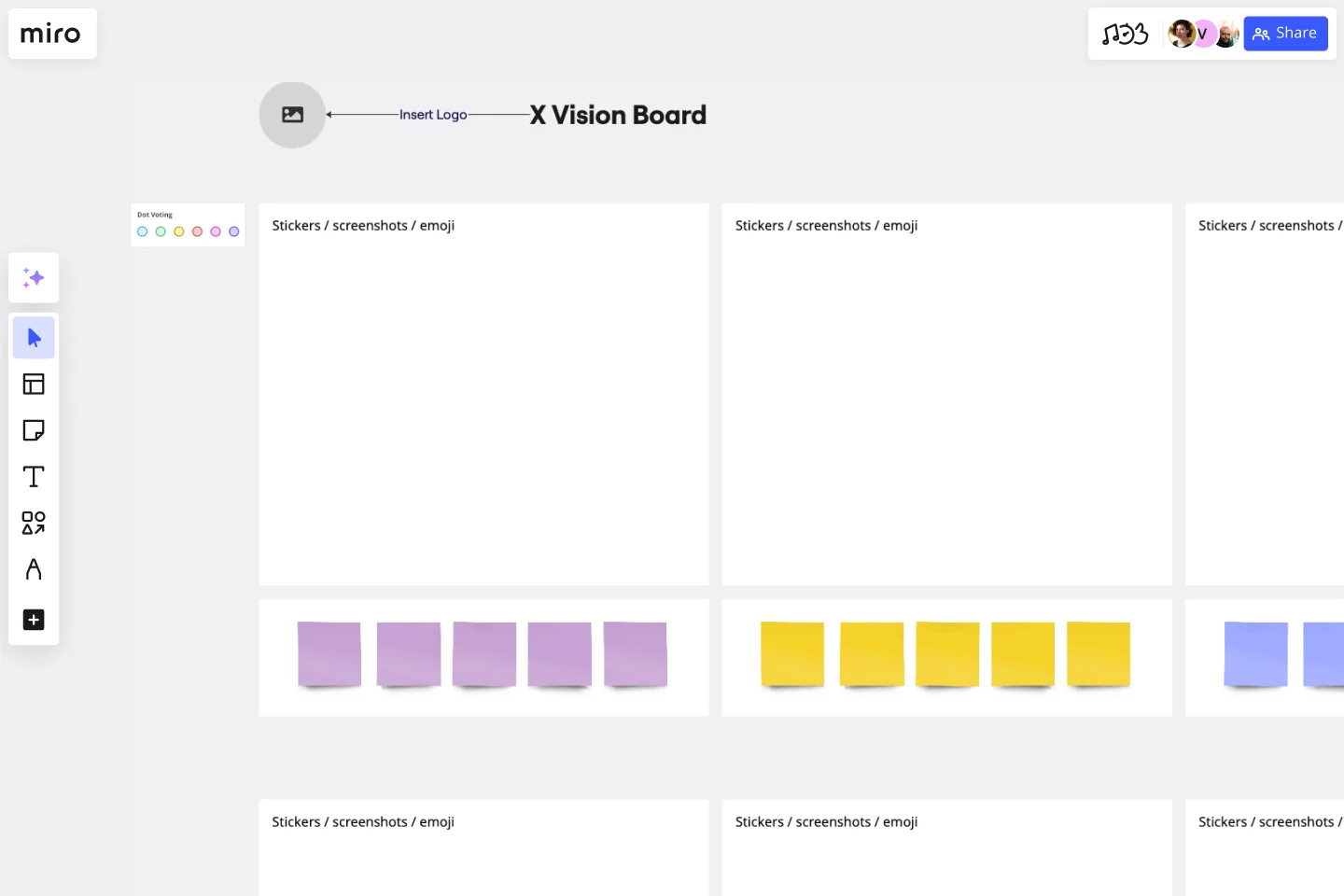
If you’re looking for a vision board that’ll help you with actual direction, actual collaboration, and actual progress, get started with Miro’s Vision Board Maker today! Build it once. Keep it alive. Let it guide what comes next.
FAQs
Can vision boards help with decision-making?
Yes. When your goals and priorities are clearly visible, it becomes easier to evaluate opportunities and distractions. A vision board can act as a reference point that helps you decide whether a new idea, project, or commitment aligns with the direction you want to move toward.
Can a vision board change over time?
Yes. A vision board should evolve as your priorities, projects, or circumstances change. Updating it ensures that it continues to reflect what matters most rather than becoming a static snapshot of past goals.
Do vision boards work for long-term goals?
Vision boards can support both short-term and long-term goals. For longer time horizons, they help maintain a sense of direction while allowing the details of how you get there to evolve over time.
Can vision boards be used in workshops or planning sessions?
Yes. Vision boards are often used in workshops, strategy sessions, or project kickoffs to help participants visualize outcomes, share perspectives, and align on priorities before detailed planning begins.
How long does it take to create a vision board?
Creating a vision board can take anywhere from 30 minutes to a few hours depending on how detailed you want it to be. The most important part is not the time spent designing it, but the clarity you gain while selecting goals, images, and priorities that truly represent what you want to achieve.
Author: Danielle Caldas, Organic Growth @Miro Last updated: April 22, 2026
Read more
Join our 100M+ users today


