Why to use?
Define and analyze the value chain and its processes, design new or improved processes, and ideate use cases of analytics & AI for improving them.
When to use?
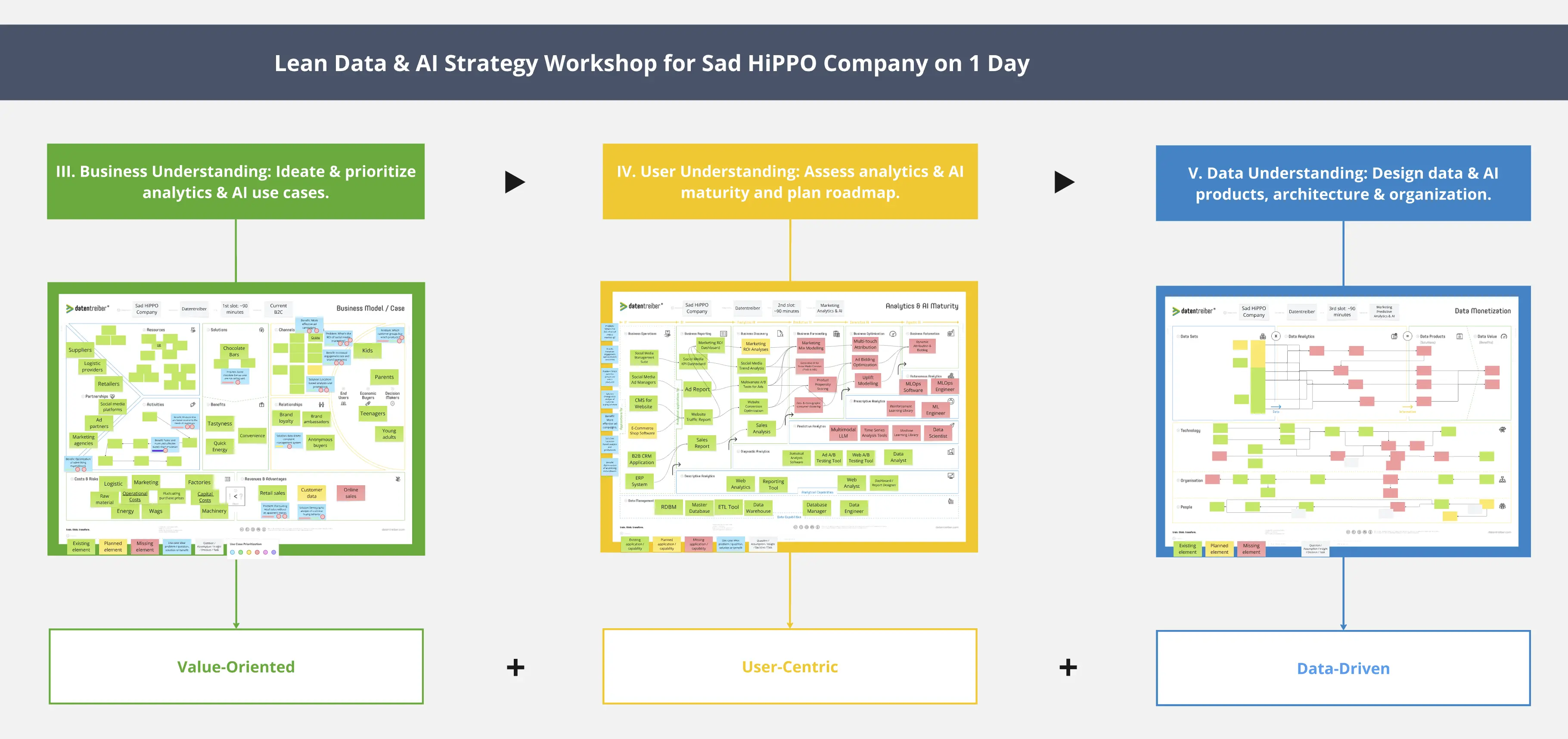
In the Business Understanding phase of a Data & AI Design Thinking workshop to define, analyze and/or design a value chain and its processes. In a further step, you can then ideate analytics & AI use cases that improve the activities, handovers and overall process outcomes.
How to use?
I. Preparation
① Fill the canvas …
a) Header: Label Focus on with a white sticky note defining the value chain or process and its start and end. Do NOT mix different process variants or current and future states but select one consistent view.
b) Footer: Add a legend with sticky notes in the corresponding color:
Green sticky notes: "Existing value chain element"
Yellow sticky notes: "Planned value chain element"
Red sticky notes: "Missing value chain element"
Blue sticky notes: "Use case idea: problem / question, solution or benefit"
White sticky notes: "Critical assumption or open question"
II. Value Chain Analysis / Design
(2-7) Fill in the boxes in the numbered order with the key elements of the value chain. Define the inputs and producers, outputs and customers, then arrange the primary activities from left to right. Add support activities, general suppliers and special suppliers. Use green sticky notes for existing, red for missing, and yellow for planned or in-progress elements. Discuss, structure and group the sticky notes so that all participants have a consistent and deep understanding of the process. Focus on the critical activities and handovers and sort out unimportant sticky notes: right canvas edge under Sorted Out.
Tip: Name activities as actions at a comparable level of detail. Connect the activity notes with arrows to show the process flow and clarify what is passed from one activity to the next.
III. Use Case Ideation
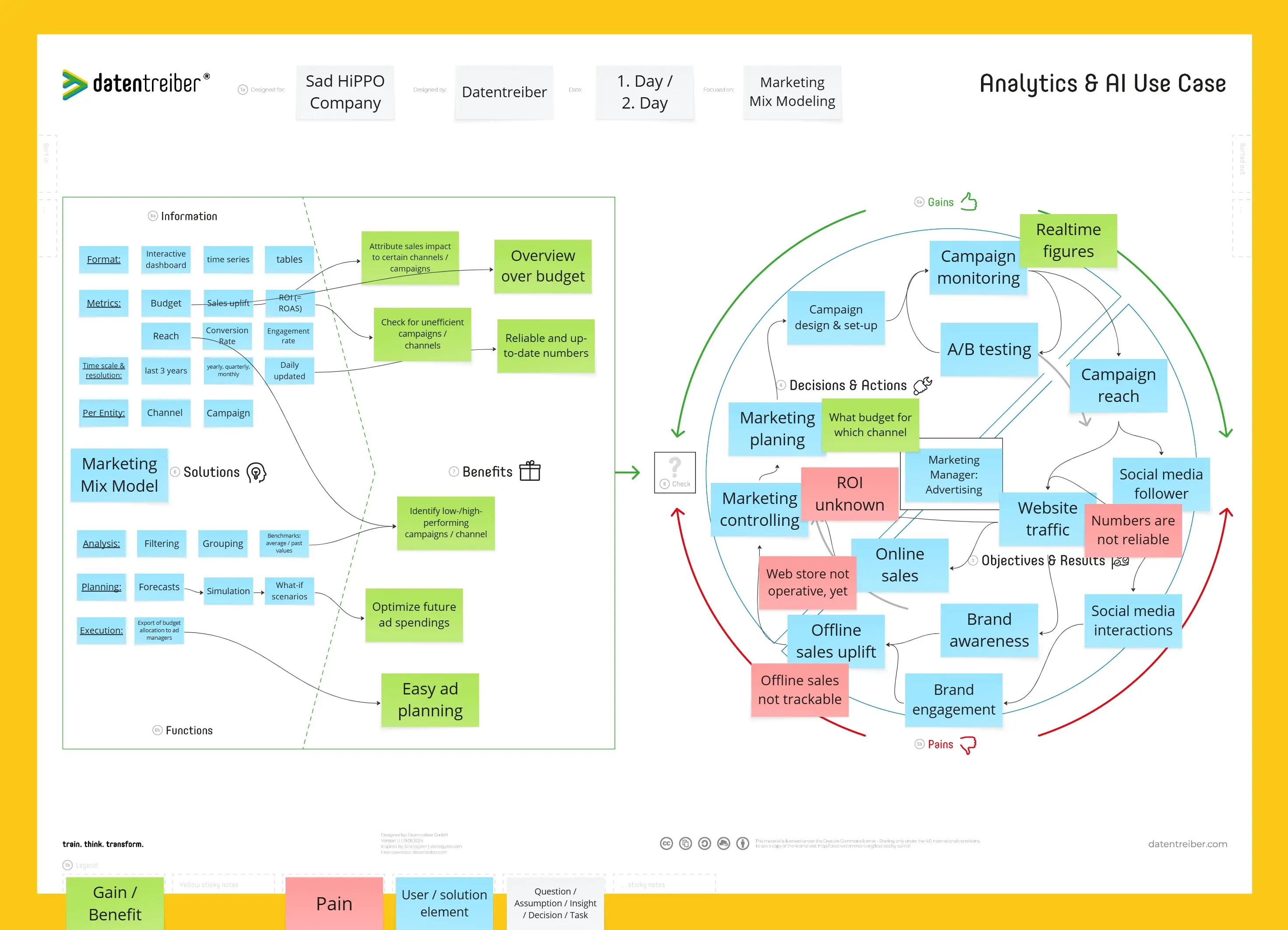
For each value chain element and relevant handover think of how analytics & AI could help to improve it. There are three ways to come up with an idea for a use case:
i. Problem-oriented: What unresolved problems or unanswered questions are there regarding the element or handover? Write the problem or question on a blue sticky note with the prefix "Problem:" next to it.
ii. Solution-oriented: What potential solutions could improve the element or handover? Add a blue sticky note with the prefix "Solution:" for the solution.
iii. Benefit-oriented: What benefits are desired for the element or handover? Attach a blue sticky note with the prefix "Benefit:" for the benefit to the relevant element or handover.
IV. Use Case Clustering
Check for and eliminate duplicates. Group similar use case ideas into application domains (e.g., process analytics, quality analytics, supply chain analytics, resource planning) and name the cluster: add a blue sticky note, write the domain name on it and underline it. Alternatively, use tags to cluster the use cases.
V. Use Case Prioritization
Have participants vote on the impact of each use case idea with regard to the workshop objective, by asking themselves:
If this problem were solved or this question answered, …
If we had this solution in use, …
If we could achieve this benefit, …
… how much would it help us to achieve the objective e.g., reduce processing times, improve quality, lower costs?
Tip: It has proved successful that the participants award 3 points, whereby they are allowed to put a maximum of 2 points on one sticky note.
VI. Next Steps
Count the votes of the use case ideas of a group (application domain) and select the domain with the most total votes. A possible next step is to determine the analytical maturity of this application domain and develop an analytics roadmap for the implementation of the use cases within this domain. Therefore copy all the relevant blue sticky notes (use case idea) to the Sort in fields on the left edge of the Analytics & AI Maturity canvas.
Tip: As office work, participants can document the use case ideas in a use case catalogue.
Where to find more?
Datentreiber offers you not only this Miroverse template, but also:
If you are interested or have any questions or feedback, please contact us at: info@datentreiber.de.
Copyright: All rights reserved by Datentreiber GmbH.