131likes
635uses
The State-Based Decision System is a visual self-reflection and decision-making template from Human Systems Design. It helps you recognize your current mental, emotional, physical, and strategic state — and then choose the best next action from that state, instead of forcing decisions from the wrong one. Use it as a 10-minute personal check-in, a daily journal alternative, or a team warm-up before planning sessions and retrospectives.
Most bad decisions aren't made by bad thinkers — they're made by good thinkers in the wrong state. A tired mind chooses differently than a rested one; an overwhelmed person prioritizes differently than a calm one.
This template makes your current state visible before you act. It maps 32 common Reality States across four lenses — Mental (how you think), Emotional (how you feel), Physical (how your body is), and Strategic (where you're heading) — and gives you a repeatable loop for moving from any state toward a better one. A Reality State is an observation, not an identity: you can't always control which state you land in, but you can always recognize it and choose the best available move.
The core principle: design decisions once, execute them many times. Instead of re-deciding how to respond to mental fatigue or overwhelm every time it hits, you design a high-quality default response once — and reuse it.
I built this system for myself as an entrepreneur making high-stakes decisions under pressure, then documented it so others can use it.
Individuals — founders, product managers, designers, consultants, students, and anyone doing demanding mental work who wants better self-awareness and prioritization
Teams — as a check-in or energizer before retrospectives, sprint planning, or workshops
Coaches and facilitators — as a structured self-inquiry exercise for clients
As a daily or weekly personal check-in (5–10 minutes)
When you feel stuck, overwhelmed, or unproductive and can't name why
Before an important decision, to check which state is making it
At the start of team sessions, to surface how the group is actually arriving
Pick your state on the State Compass. Duplicate the sticky note that matches your current state and drop it on the "You are here" center. Be honest — this is observation, not judgment.
Open a State Card. Duplicate the blank master card and fill it in: how you recognize this state, what triggered it, the common mistakes that make it worse, and the single Best Next Action. Four fully worked examples (Decision Paralysis, Overwhelm, Lost Direction, Mental Fatigue) show you what a complete card looks like.
Run the Loop. Follow the Universal State Transition: Recognize Reality → Choose the Best Next Action → Execute → Observe the New State → Reality Feed Forward.
Log what reality taught you. Add one sticky to the Feed Forward Log: date, state, action, lesson. Within a month, this row becomes your personal operating manual — the reason to come back.
One loop per check-in is enough. Consistency beats depth.
Every time you meet a new state, design a card for it. Your card library compounds into a personal decision playbook.
Teams: have everyone place their sticky on the Compass simultaneously, then discuss — a faster, deeper alternative to "how is everyone doing?"
The State-Based Decision System is part of Human Systems Design, a capability-building system developed by Mark V. Smetanin — entrepreneur and systems architect. Its stance is deliberately honest: this template cannot guarantee outcomes; it improves your capability to reach the best possible one. More at marksmetanin.com.

Mark V. Smetanin
Product Portfolio Director @ CHM inc.
E-commerce, AdTech, SalesFunnels, ShortTermRentals, Property Management, SAAS, Communication models, API, Payments, Fintech.
Product Management - Product Flow
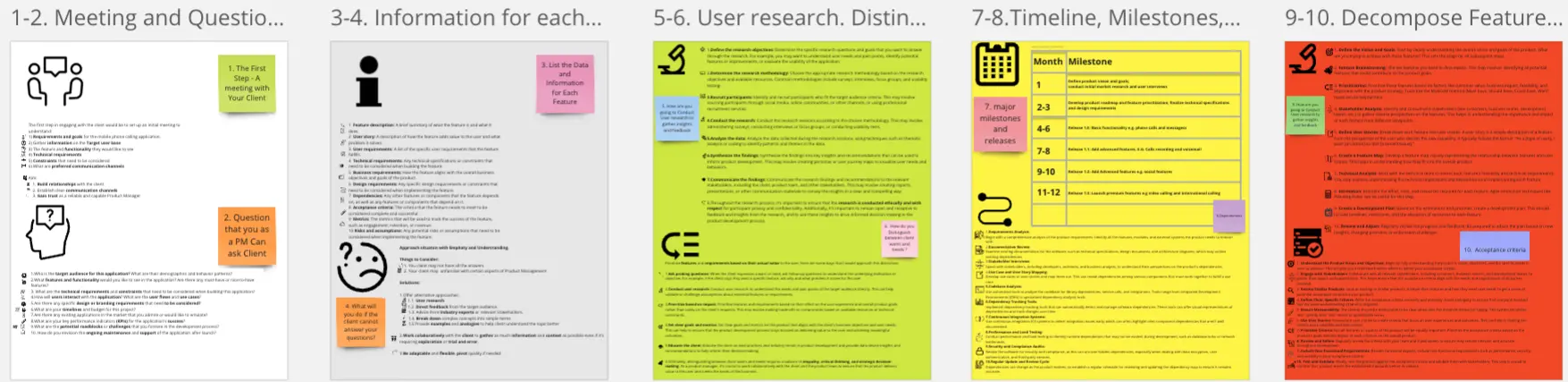
Product Management - Product Flow template enables product managers to visualize and streamline product development processes. By mapping out key stages, tasks, and dependencies, this template enhances workflow transparency and coordination. With features for identifying bottlenecks and optimizing resource allocation, it empowers teams to improve efficiency and accelerate product delivery. This template serves as a valuable tool for ensuring smooth product development and launch processes, ultimately driving better outcomes.
Product Management - Product Flow
Product Management - Product Flow template enables product managers to visualize and streamline product development processes. By mapping out key stages, tasks, and dependencies, this template enhances workflow transparency and coordination. With features for identifying bottlenecks and optimizing resource allocation, it empowers teams to improve efficiency and accelerate product delivery. This template serves as a valuable tool for ensuring smooth product development and launch processes, ultimately driving better outcomes.