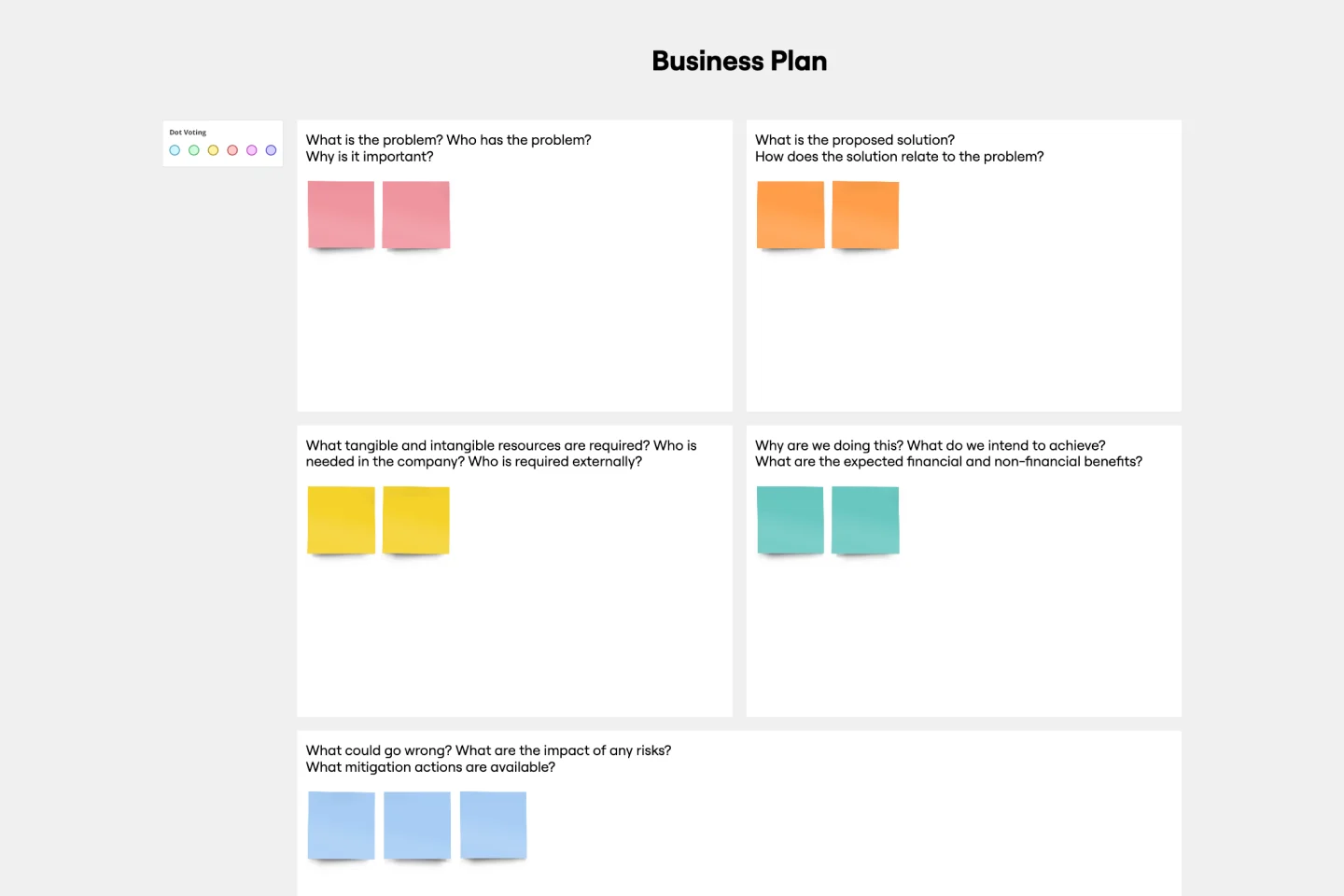
What is the Startup Business Plan Sprint Template?
A one-page startup planning template that helps founders connect the problem, customer, solution, market, business model, go-to-market approach, operations, and milestones.
What problem does the Startup Business Plan Sprint Template solve?
Unclear startup direction
Broad customer definitions
Ideas without a revenue model
Disconnected product and marketing plans
Too much early-stage documentation
Missing validation priorities
How to use the Startup Business Plan Sprint Template
Write the startup vision.
Define the problem.
Choose the first customer segment.
Describe the solution.
Document the market opportunity.
Select the business model.
Choose the first go-to-market channels.
Map the minimum operating needs.
Add financial targets and milestones.
Identify the three assumptions that need testing first.
Common Pitfalls
Trying to serve everyone
Adding too many product ideas
Building detailed forecasts too early
Choosing too many marketing channels
Ignoring operating requirements
Treating assumptions as proven facts
Ways to Avoid Mistakes
Start with one narrow customer.
Keep the solution focused.
Use evidence from customer conversations.
Choose one primary revenue model.
Start with two acquisition methods.
Test risky assumptions before investing heavily.
Miro Features You Can Use
Cards for the eight business-plan sections
Sticky notes for assumptions
Voting for validation priorities
Tags for evidence and uncertainty
Comments for founder and advisor feedback
Connectors to show how sections relate
Status labels for tested and untested assumptions
FAQs
Q: Who can use this template?
A: Startup founders, early product teams, startup advisors, accelerators, and small founding teams.
Q: When should it be used?
A: During idea validation, early company planning, accelerator sessions, founder alignment, or before creating a longer business plan.
Q: Does this replace a full investor business plan?
A: No. It creates the foundation that can later support financial models, investor materials, or detailed operating plans.
Q: How long should the workshop take?
A: About 60–75 minutes.
Q: What will participants leave with?
A: A one-page startup business plan and a short list of assumptions that need real-world validation.