2likes
26uses
Identify stakeholder alignment gaps before they slow your project. This collaborative stakeholder analysis workshop helps startup founders and product teams evaluate stakeholder support, influence, and readiness, then create a focused engagement plan with clear next steps.
Do you know which stakeholders support your initiative, who can influence its success, and who needs more information before moving forward?
The Stakeholder Analysis: Alignment Radar template helps startup founders and product software teams understand stakeholder relationships and identify potential alignment gaps.
Successful product initiatives depend on more than having the right strategy. They require people with different responsibilities, priorities, and concerns to understand the proposed change and contribute at the right time.
I've seen projects experience delays when teams assume stakeholder agreement without discussing expectations, readiness, or outstanding concerns.
This workshop introduces a simple approach to stakeholder analysis using three dimensions:
Support: How strongly does the stakeholder support the initiative?
Influence: How much can the stakeholder affect its direction or progress?
Readiness: How prepared is the stakeholder to participate in or adopt the change?
Rather than building a traditional power-interest matrix, participants use stakeholder scorecards to evaluate these dimensions, identify meaningful gaps, and agree on practical engagement actions.
The workshop concludes with a simple stakeholder engagement plan that clarifies who needs attention, what conversation should happen next, and who will take responsibility.
Designed for small teams, this template works for both virtual and in-person workshops without breakout groups.
Startup founders building alignment around strategic initiatives
Product managers coordinating cross-functional product decisions
UX/UI designers identifying stakeholders affecting product experiences
Software development teams preparing for new features or technical changes
Project leads managing stakeholder expectations
Customer success teams planning customer-facing initiatives
Teams introducing AI-powered workflows or organizational changes
Workshop duration: 50 minutes
Recommended participants: 3–8
Facilitator: Startup founder, product manager, project lead, or workshop facilitator
Choose one initiative, project, or important product decision to analyze.
Gather available information about:
The initiative's objective and expected outcome
Teams and individuals affected by the change
Stakeholders who influence decisions or approvals
Existing project communications
Known concerns, dependencies, or unresolved decisions
Stakeholder feedback or previous conversations
Prepare the five workshop sections:
Define the Initiative
Identify Stakeholders
Rate the Alignment Radar
Find Alignment Gaps
Create the Engagement Plan
For virtual workshops: Use Miro's sticky notes, stakeholder scorecards, and collaborative board.
For in-person workshops: Use printed stakeholder cards, markers, sticky notes, and a whiteboard. Record the final assessment and engagement plan in Miro after the session.
Begin by clarifying the project, decision, or change your team wants to analyze.
Use the three question cards to guide the discussion.
The Change
What are we introducing or changing?
The Outcome
What do we want to achieve?
Who's Affected?
Which people or groups may experience the change?
Ask participants to share their understanding of the initiative.
Agree on one concise initiative statement that everyone can reference throughout the workshop.
Example:
Change: Introduce AI-assisted customer support.
Outcome: Reduce customer resolution times.
Affected Groups: Customers, support teams, and relevant internal stakeholders.
Agreed Initiative: "Introduce AI-assisted customer support to reduce resolution time without compromising accuracy."
AI Alternative
Use AI to clarify the initiative.
Example prompt:
"Rewrite this product initiative as one clear statement describing the intended change, expected outcome, and affected stakeholder groups. Identify information requiring clarification: [insert initiative]."
Output: One agreed initiative statement.
Ask participants to independently identify people or groups who could influence, contribute to, approve, or be affected by the initiative.
Write one stakeholder or stakeholder group per sticky note.
Organize the notes into two categories.
Internal Stakeholders
People or groups within the organization.
Examples:
Executive sponsor
Product manager
Engineering lead
Customer support team
Security representative
External Stakeholders
People or groups outside the organization.
Examples:
Pilot customers
Customer administrators
Technology partners
External advisors
Review the collected notes and combine duplicates.
Discuss whether any important perspectives are missing.
Select approximately five to eight stakeholders for the alignment assessment.
Example: For an AI-assisted support initiative, the team selects the executive sponsor, product manager, engineering lead, customer support team, security representative, and pilot customers.
AI Alternative
Use AI to suggest potentially overlooked stakeholder groups.
Example prompt:
"For this startup product initiative, suggest relevant internal and external stakeholder groups. Explain how each group may influence or experience the change. Identify groups whose involvement should be verified: [insert initiative]."
Output: An organized stakeholder shortlist.
Create one Alignment Radar scorecard for each selected stakeholder.
Evaluate stakeholders using three dimensions.
Support
How strongly does the stakeholder support the initiative?
Influence
How much can the stakeholder affect the initiative's direction, decisions, or progress?
Readiness
How prepared is the stakeholder to participate in or adopt the change?
Use a simple rating scale from 1 to 5.
RatingSupportInfluenceReadiness1OpposedLittle influenceNot prepared2ConcernedLimited influenceSignificant preparation needed3Neutral or uncertainModerate influencePartially prepared4SupportiveStrong influenceMostly prepared5Strongly supportiveMajor influenceReady to participate
Ask participants to consider ratings independently before discussing their assessments.
Record the agreed ratings on each scorecard.
Use the evidence or concerns field to document the reasoning.
When information is unavailable, mark the rating as Unknown rather than guessing.
Example: Customer Support Team
Support: 3/5
Influence: 4/5
Readiness: 2/5
Evidence or Concern: The team recognizes the potential benefit of AI assistance but has not received training or workflow guidance.
AI Alternative
Use AI to organize stakeholder notes into preliminary assessments.
Example prompt:
"Review these stakeholder meeting notes and suggest Support, Influence, and Readiness assessments using a 1–5 scale. Explain the evidence behind each rating. Mark any dimension without sufficient evidence as Unknown rather than inventing information: [insert notes]."
Output: Completed stakeholder scorecards with ratings and supporting observations.
Review the completed scorecards and identify stakeholders who may need additional attention.
Use the three Alignment Gap zones to organize the findings.
Needs Alignment
Stakeholders with significant influence but limited support.
Example: A security representative has unresolved concerns about customer data handling.
Needs Preparation
Stakeholders who support the initiative but lack the information, resources, or preparation needed to participate.
Example: Customer support employees want to use the new feature but have not received training.
Needs a Conversation
Stakeholders whose position, needs, or expectations remain unclear.
Example: Pilot customers have not provided feedback on the proposed experience.
Move relevant stakeholder cards into the appropriate zones.
Discuss which gaps could have the greatest effect on the initiative.
Agree on up to three priority gaps to address.
Stakeholders without meaningful gaps can remain outside the three zones.
AI Alternative
Use AI to identify potential alignment gaps.
Example prompt:
"Review these stakeholder Support, Influence, and Readiness scores with their supporting notes. Identify stakeholders who may need alignment, preparation, or an exploratory conversation. Recommend up to three priority gaps and explain the reasoning: [insert assessments]."
Output: Up to three prioritized stakeholder alignment gaps.
Use the Stakeholder Engagement Plan to turn the identified gaps into practical actions.
For each priority stakeholder, complete the following fields:
Stakeholder
Who needs attention?
Alignment Gap
What concern, uncertainty, or readiness issue needs to be addressed?
Next Action
What conversation or activity should happen?
Owner
Who is accountable for completing the action?
Due Date
When should the action take place?
Discuss the proposed actions and agree on clear responsibilities.
Example 1: Security Representative
Alignment Gap: Unresolved AI data privacy concerns.
Next Action: Review proposed data handling and confirm pilot requirements.
Owner: Product Manager
Due Date: Thursday
Example 2: Customer Support Team
Alignment Gap: Limited readiness for the new workflow.
Next Action: Conduct a feature demonstration and identify training needs.
Owner: Support Lead
Due Date: Friday
Example 3: Pilot Customers
Alignment Gap: Customer expectations and concerns are unknown.
Next Action: Conduct five short feedback sessions.
Owner: UX Researcher
Due Date: Next week
Agree on when the team will review the outcomes of these conversations.
AI Alternative
Use AI to draft an engagement action plan.
Example prompt:
"Create a concise stakeholder engagement plan for these alignment gaps: [insert gaps]. For each stakeholder, suggest an appropriate next conversation or action, accountable owner role, and observable success signal. Keep the plan practical for a small startup team."
Output: A stakeholder engagement plan with actions, owners, deadlines, and a review commitment.
By completing this template, your team will have:
A clearly defined initiative
An organized list of internal and external stakeholders
Five to eight stakeholder assessments
Support, Influence, and Readiness ratings
Documented stakeholder concerns and unknowns
Three prioritized alignment gaps
A stakeholder engagement plan
Named action owners and target dates
A clear starting point for improving stakeholder collaboration
Focus on one initiative. Keep the discussion connected to a specific project or change.
Keep the stakeholder list manageable. Five to eight stakeholders provide a useful starting point for a small-team workshop.
Give everyone an opportunity to contribute. Allow independent identification and assessment before group discussion.
Use ratings as discussion tools. A score is a working assessment, not a judgment about someone's character or intentions.
Distinguish evidence from assumptions. Record Unknown when the team lacks reliable information about a stakeholder's position.
Consider influence beyond job titles. Stakeholders may affect decisions through expertise, relationships, operational responsibilities, or customer knowledge.
Treat low readiness as a support need. Missing resources or training should lead to practical preparation activities rather than negative labels.
Be careful with sensitive information. Record concerns respectfully and limit access to personal assessments when appropriate.
Prioritize meaningful gaps. Focus on the stakeholders whose concerns, influence, or readiness could affect progress.
Turn every priority gap into an action. The workshop should produce engagement commitments rather than end with a collection of ratings.
Update assessments after conversations. Stakeholder support and readiness can change as new information becomes available.
The goal isn't to label stakeholders. It's to understand what they need and build the alignment required to move forward.
It's a collaborative workshop that helps teams evaluate stakeholders using three dimensions: Support, Influence, and Readiness.
The results help identify alignment gaps and guide stakeholder engagement actions.
Traditional stakeholder matrices frequently compare power and interest.
Alignment Radar examines whether stakeholders support an initiative, how much influence they have, and whether they're prepared to participate.
The workshop focuses on turning those insights into engagement actions.
Support: The stakeholder's current position toward the initiative.
Influence: Their ability to affect decisions, direction, or progress.
Readiness: Their preparedness to contribute to or adopt the proposed change.
The scale gives teams a simple way to compare stakeholder assessments and identify potential gaps.
It supports discussion rather than providing an objective measurement of individual behavior.
Mark Support as Unknown.
Create an action to speak directly with the stakeholder or gather relevant information.
Avoid inventing a rating based on assumptions.
Yes.
A stakeholder may have significant decision-making authority and unresolved concerns about the initiative.
This combination indicates a need for engagement, not automatic opposition.
Support reflects whether someone agrees with or favors the initiative.
Readiness reflects whether they have the information, skills, resources, or capacity to participate.
A stakeholder can strongly support a change but still require preparation.
Consider decision-making authority, relevant expertise, operational responsibilities, customer relationships, and the ability to affect implementation.
Avoid relying exclusively on formal job titles.
For this workshop, five to eight is a practical starting point.
Larger initiatives may require additional stakeholder groups or separate assessments.
Ask what evidence supports each assessment.
Discuss any differences and identify information that could clarify the stakeholder's actual position.
Use Unknown when a reliable conclusion isn't possible.
Yes.
A stakeholder may have unresolved concerns and lack the preparation required to participate.
Choose the most immediate need for the workshop's action plan or record a secondary concern.
Focusing on three priority gaps keeps the engagement plan manageable and encourages the team to address the most meaningful issues first.
Remaining gaps can be revisited during later planning sessions.
Yes.
The template is useful for projects involving AI adoption, automation, new software features, and organizational changes.
Relevant stakeholders may include technical leads, customer-facing teams, security representatives, and end users.
Yes.
Participants contribute independently and then collaborate as one group to identify stakeholders, compare ratings, and create the engagement plan.
No breakout sessions are required.
Yes.
AI can help identify potentially overlooked stakeholder groups, organize existing meeting notes, summarize concerns, and draft engagement actions.
Use actual stakeholder evidence when available, and treat generated assessments as suggestions requiring human review.
Revisit the assessments after important stakeholder conversations, project decisions, or changes affecting the initiative.
Update ratings when new evidence changes your understanding of stakeholder support, influence, or readiness.
Begin the agreed stakeholder engagement actions.
Capture what you learn during those conversations and update the scorecards.
Review remaining gaps and decide whether additional engagement is needed.
Use Stakeholder Analysis: Alignment Radar when your team needs a practical way to understand stakeholder relationships and identify alignment gaps before they affect an initiative.
The completed template provides a shared picture of stakeholder support, influence, and readiness, supported by an engagement plan that turns observations into action.
Understand your stakeholders. Identify the gaps. Build alignment.

Deanne Watt
Product Strategy @ MiNDPOPGroup.com
My approach to product is to get to the heart of what drives a company. I am passionate about the entire end-to-end process and making it more efficient, collaborative as well as aligning teams and improving communication. We have built about 200 Miro boards so far that cover ideation, strategy, design, engineering, and even marketing promotion.
Stakeholder Analysis Template
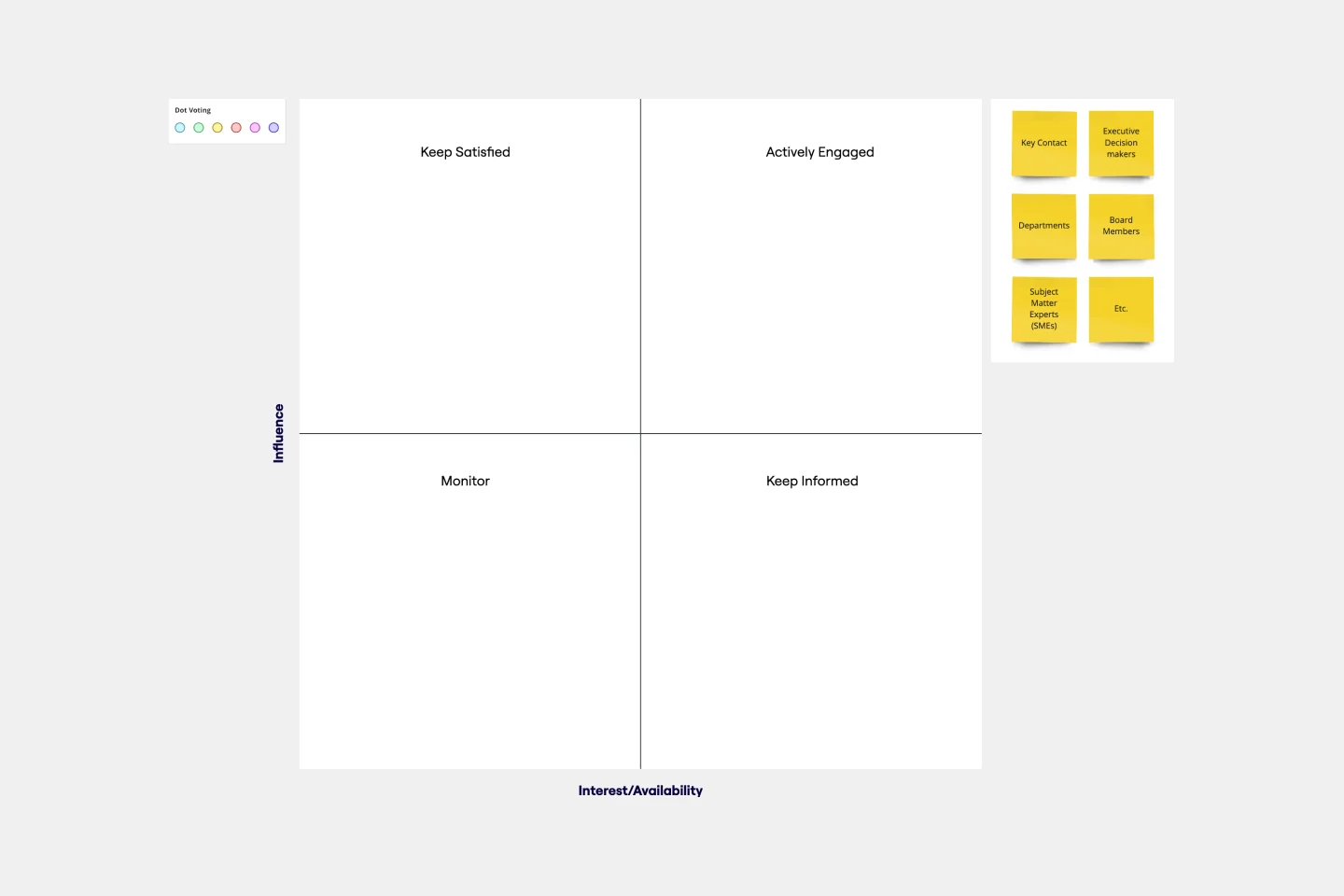
Managing stakeholders is integral to completing a project on time and meeting expectations, so here’s how to use a stakeholder analysis to help. A stakeholder analysis empowers you to meet expectations and complete projects on time by identifying individuals, groups, and organizations with a vested interest in a program or process. In a typical stakeholder analysis, you’ll prioritize stakeholders based on their influence on a project and seek to understand how best to interface with them throughout the course of the project.